THE RIDER–WAITE–SMITH DECK / 78 CARDS

Tarot card meanings

A language of images, from The Fool to the King of Pentacles. Traditional themes, upright and reversed interpretations, and the symbols within Pamela Colman Smith’s original artwork.

78 / 78 cards

Major Arcana

22

The larger patterns: turning points, inner growth and the journey of a life.

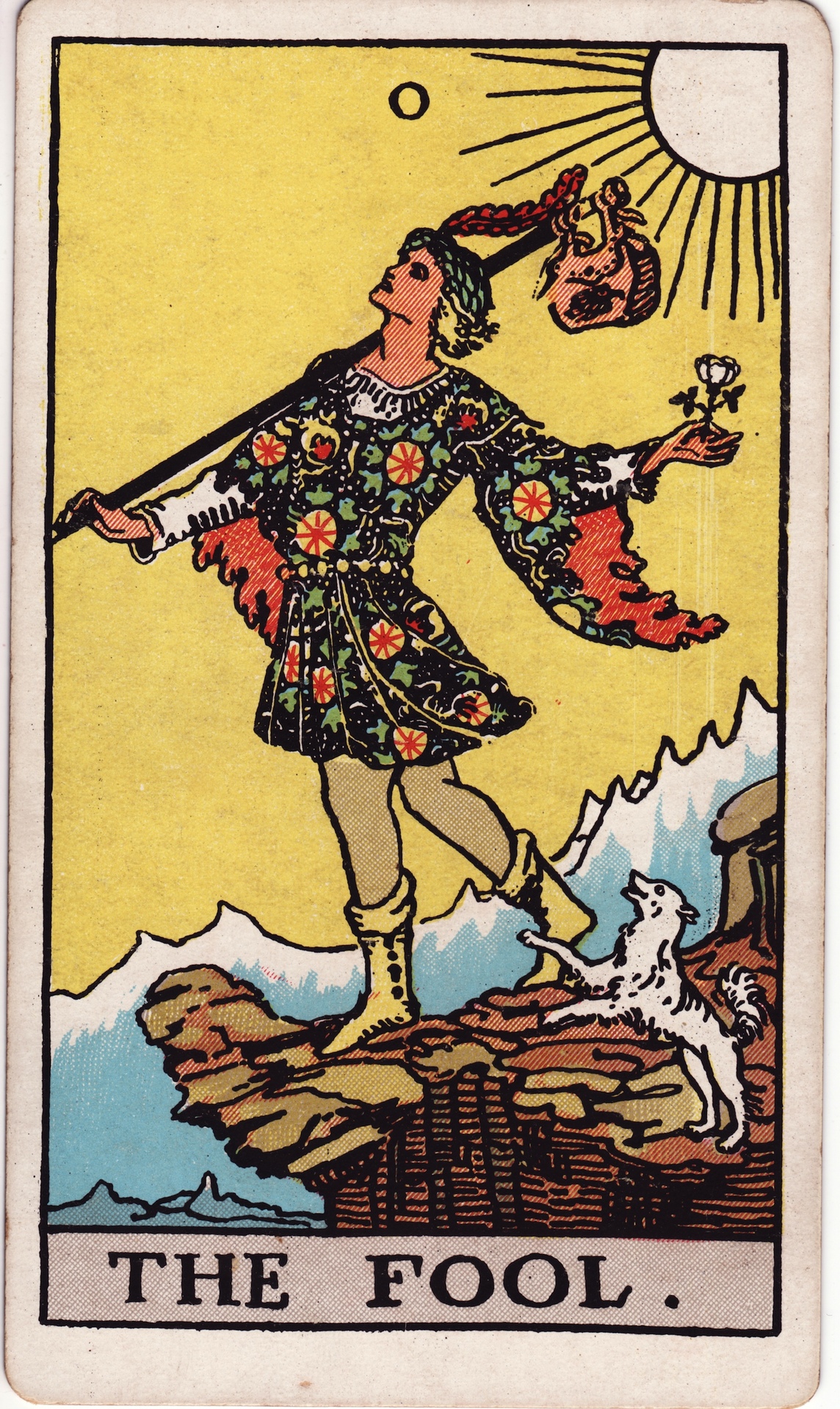
The Fool — original Rider–Waite–Smith artwork by Pamela Colman Smith

0 / Major Arcana

The Fool

Beginnings · innocence · freedom

UPRIGHT
A fresh start invites openness, spontaneity and trust. Step into unfamiliar territory, while remaining aware of practical risks.
REVERSED
Recklessness, hesitation or naïveté can interrupt a beginning. Consider whether you are ignoring a danger or letting fear prevent a useful leap.
SYMBOLISM
The cliff marks the unknown; the small bundle carries experience. The white rose suggests innocence, while the dog can be read as instinct or a warning. The sun illuminates the journey.
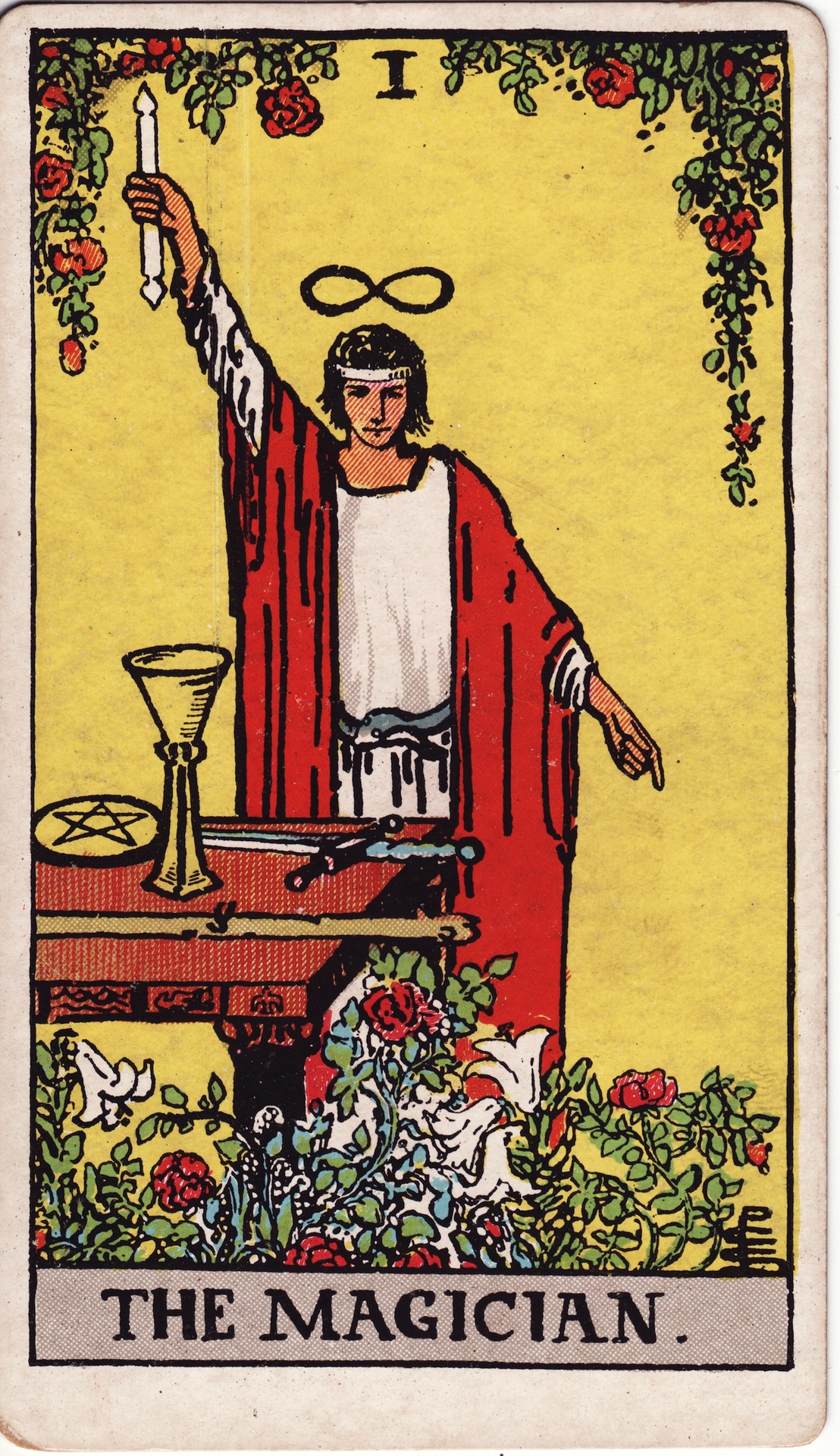
The Magician — original Rider–Waite–Smith artwork by Pamela Colman Smith

I / Major Arcana

The Magician

Will · skill · manifestation

UPRIGHT
Focused intention and practiced skill turn possibility into action. Recognize the resources already available and use them deliberately.
REVERSED
Manipulation, scattered effort or unused talents can weaken your purpose. Check whether words and actions align.
SYMBOLISM
One hand points upward and the other downward, joining spirit and matter. The four suit tools represent available resources; the infinity sign suggests enduring creative power.
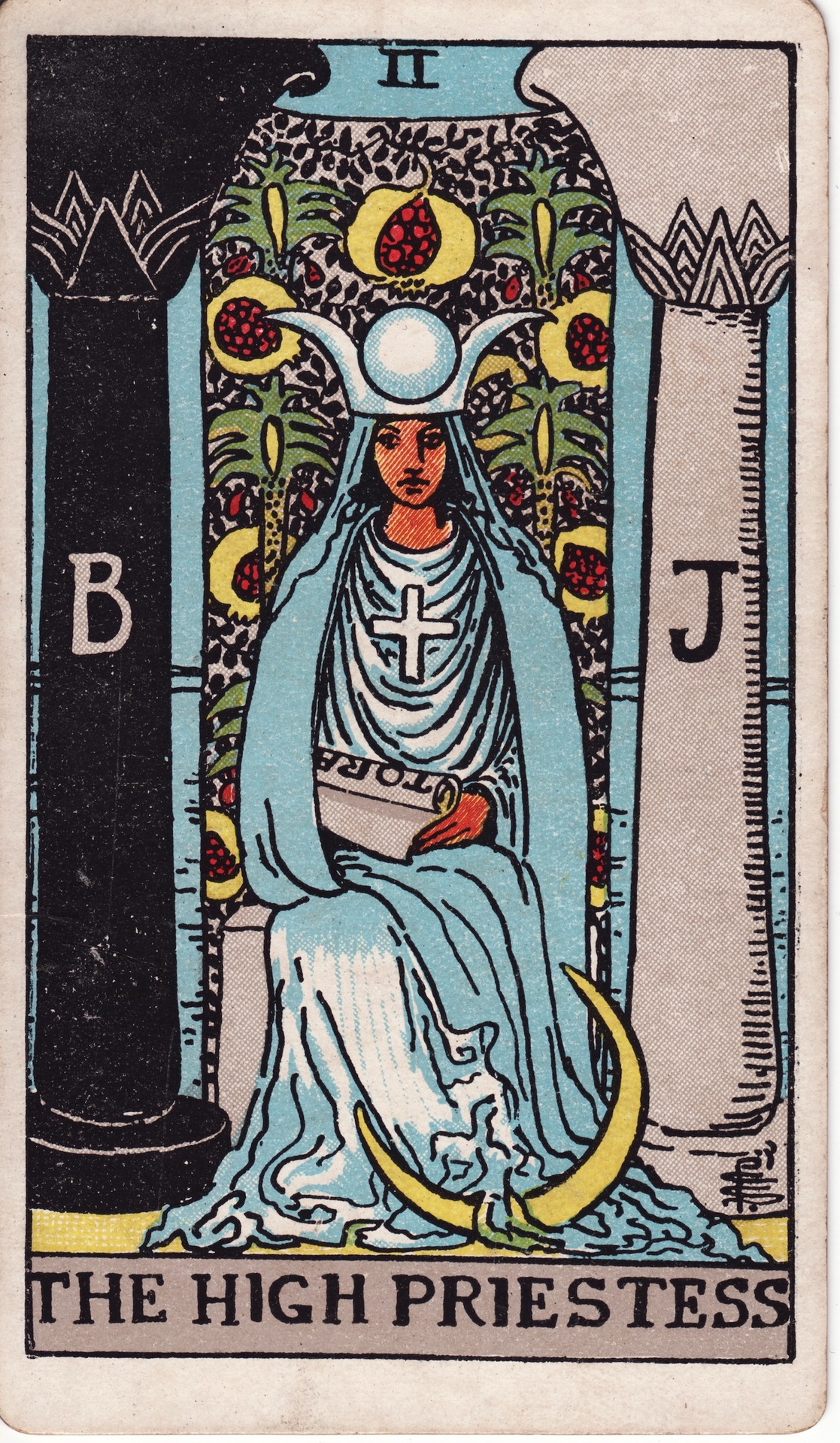
The High Priestess — original Rider–Waite–Smith artwork by Pamela Colman Smith

II / Major Arcana

The High Priestess

Intuition · mystery · inner knowing

UPRIGHT
Quiet attention, intuition and patience reveal what direct action cannot. Some information may still be concealed or not ready to emerge.
REVERSED
Disconnected intuition, secrecy or inner confusion may cloud judgment. Make room to listen, without mistaking every feeling for evidence.
SYMBOLISM
Black and white pillars frame opposing forces. The veil decorated with pomegranates guards mystery; the partly hidden scroll signifies sacred knowledge and the crescent moon intuition.
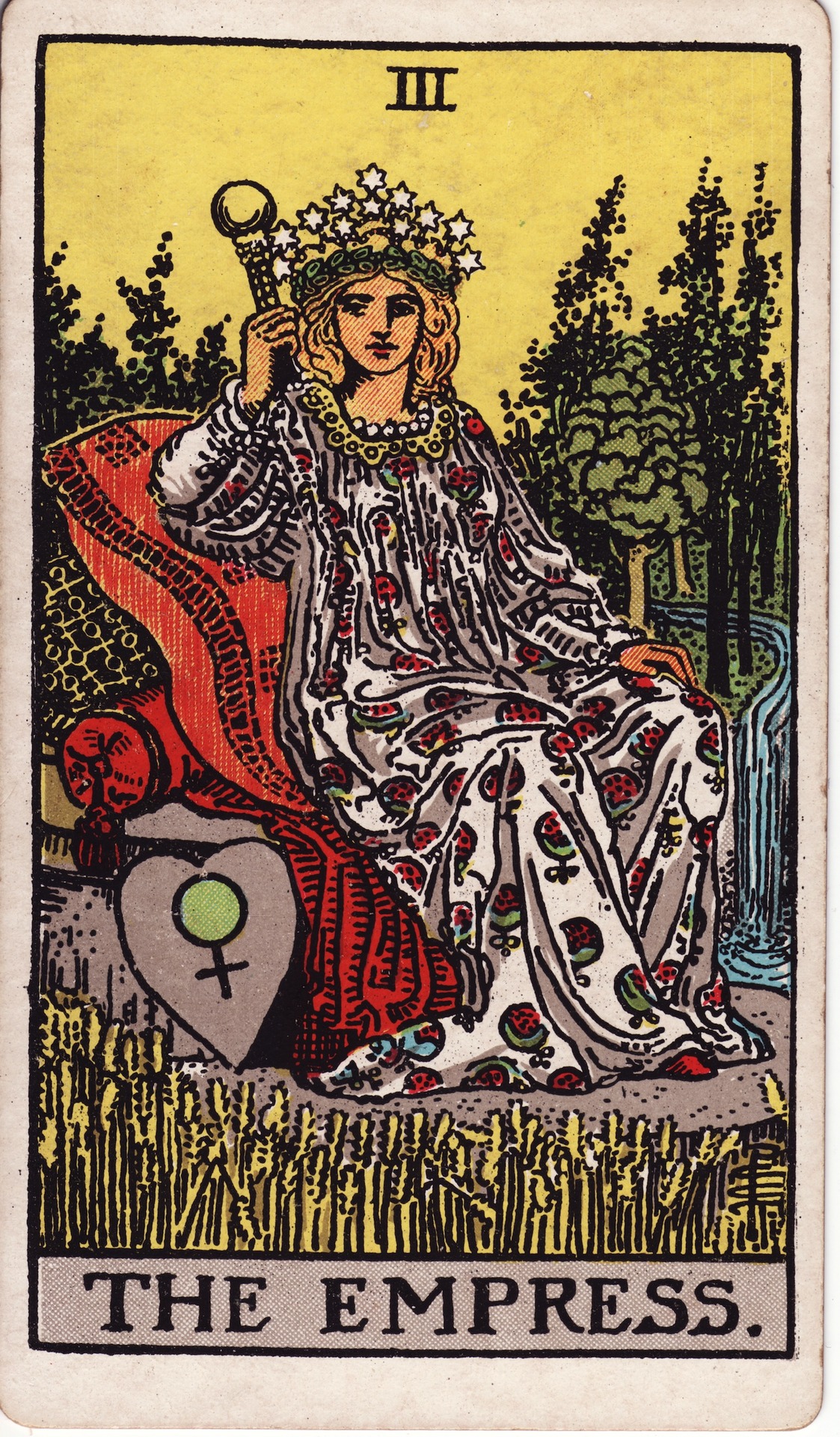
The Empress — original Rider–Waite–Smith artwork by Pamela Colman Smith

III / Major Arcana

The Empress

Nurture · fertility · abundance

UPRIGHT
Growth comes through care, creativity and connection with the body and natural world. Receive nourishment as well as offering it.
REVERSED
Creative stagnation, overgiving or dependence may deplete you. Restore boundaries and attend to neglected needs.
SYMBOLISM
Wheat and lush vegetation signify fertility and sustenance. The Venus emblem links the card with beauty and love; twelve stars connect earthly abundance with celestial cycles.
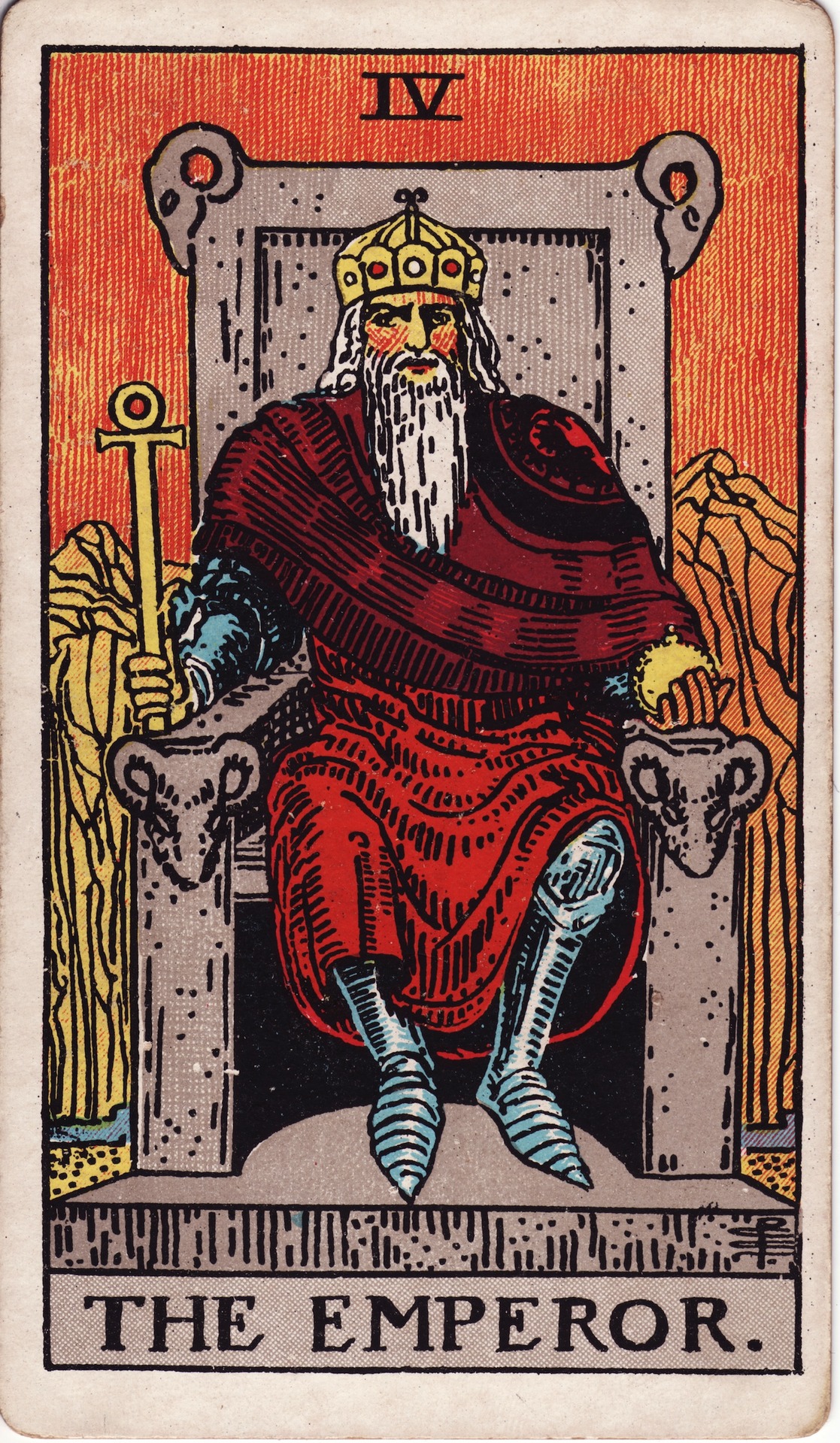
The Emperor — original Rider–Waite–Smith artwork by Pamela Colman Smith

IV / Major Arcana

The Emperor

Structure · authority · stability

UPRIGHT
Order, responsibility and clear boundaries establish a reliable foundation. Lead with consistency and protect what depends on you.
REVERSED
Rigidity, domination or a lack of discipline can destabilize authority. Examine whether structure supports life or merely controls it.
SYMBOLISM
The stone throne and barren mountains emphasize endurance. Ram heads associate the figure with Aries; armor beneath the robe suggests protection and readiness.
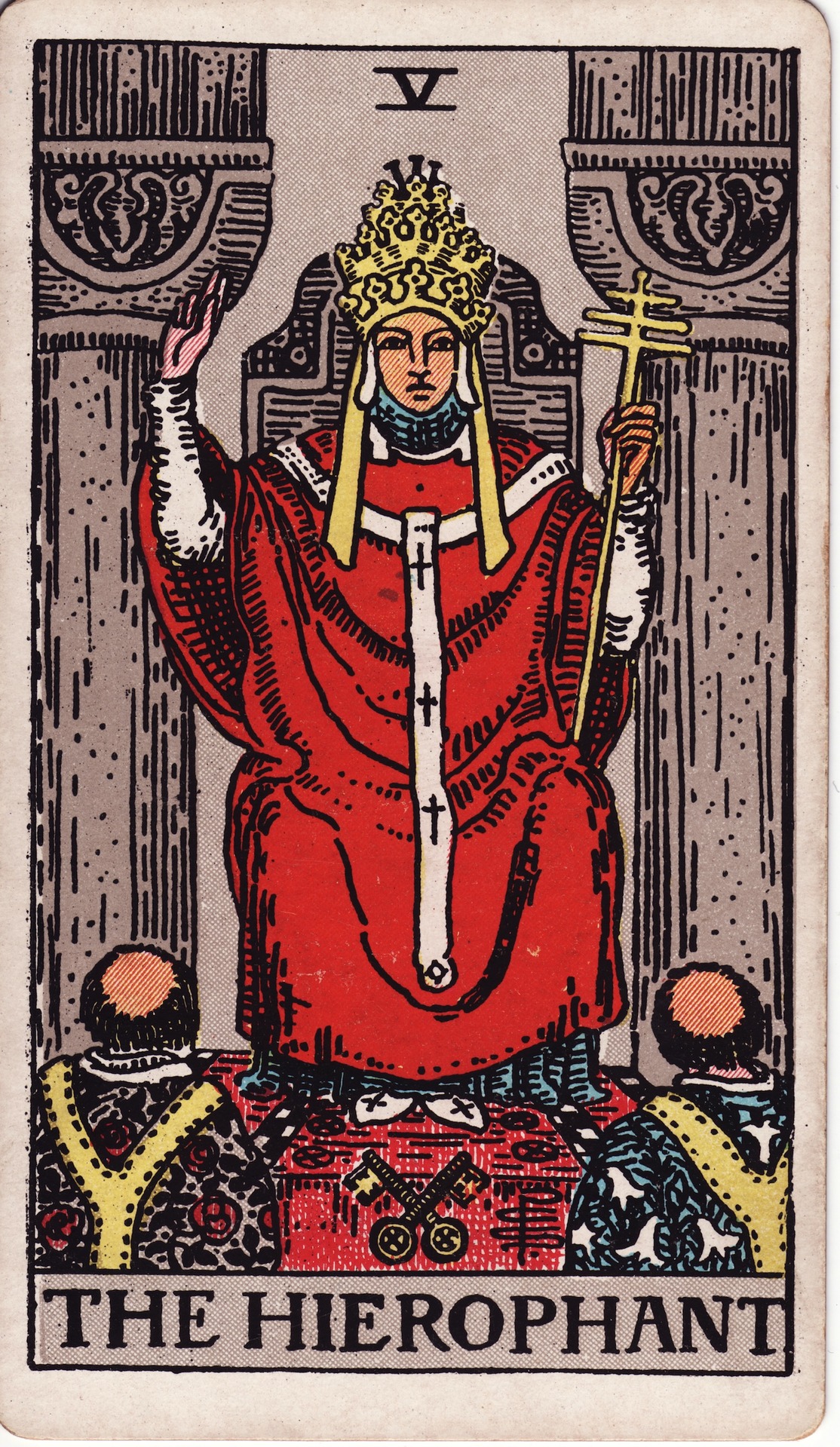
The Hierophant — original Rider–Waite–Smith artwork by Pamela Colman Smith

V / Major Arcana

The Hierophant

Tradition · teaching · shared values

UPRIGHT
Established knowledge, spiritual teaching and community offer guidance. Consider the commitments and traditions that shape your values.
REVERSED
Conformity, dogma or a need to question inherited beliefs may arise. Find a practice whose meaning you can genuinely accept.
SYMBOLISM
The crossed keys signify access to sacred understanding. Two students represent transmission of tradition; the triple crown and raised blessing express spiritual authority.
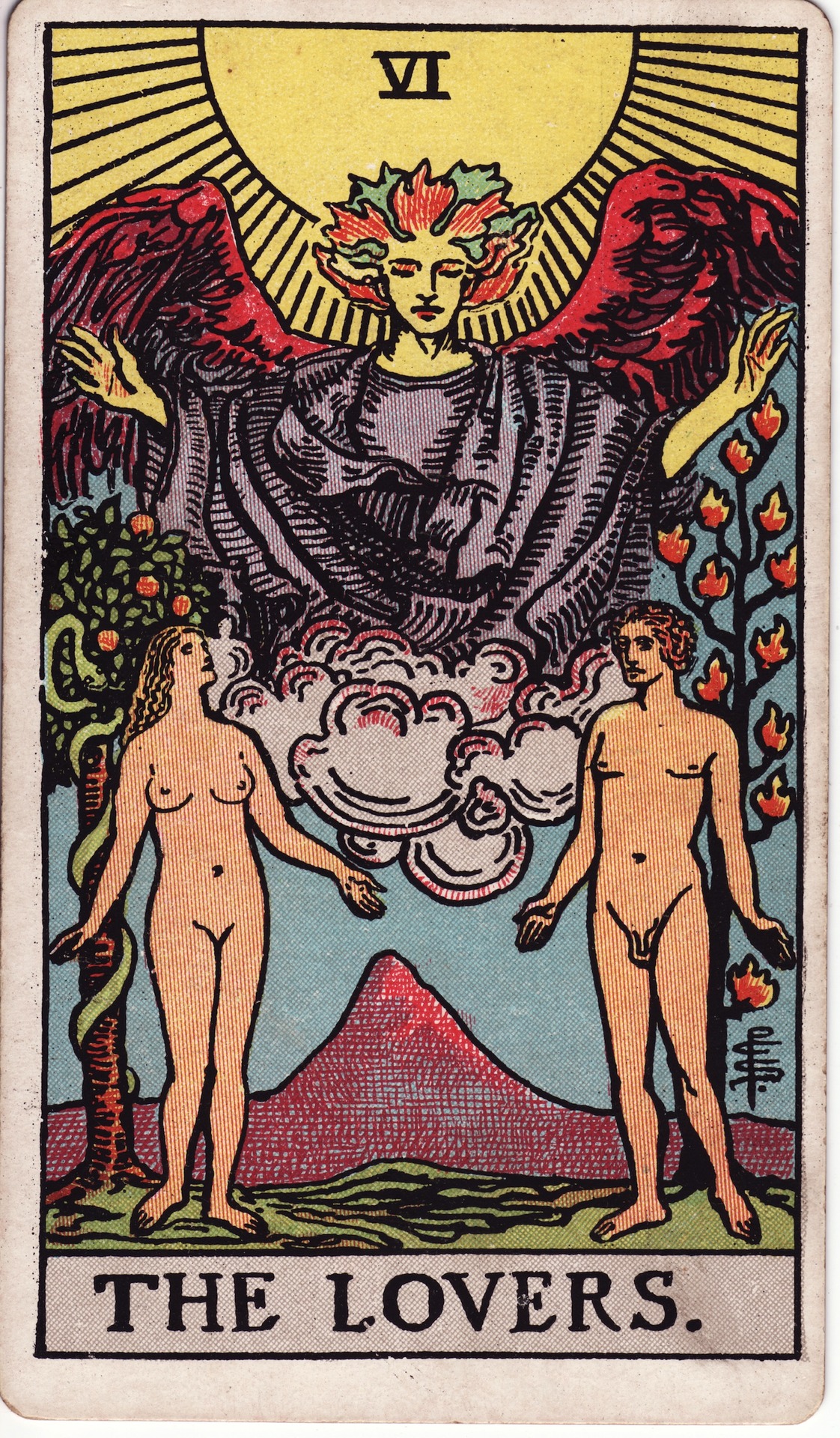
The Lovers — original Rider–Waite–Smith artwork by Pamela Colman Smith

VI / Major Arcana

The Lovers

Union · choice · alignment

UPRIGHT
Relationships and consequential choices ask for honesty and alignment with your values. Mutual trust matters as much as attraction.
REVERSED
Disharmony, divided loyalties or conflicting values can strain a bond. A choice may require clarity rather than avoidance.
SYMBOLISM
The angel watches over two unclothed figures, suggesting openness. The serpent and fruit tree evoke temptation and knowledge, while the mountain emphasizes a shared challenge.
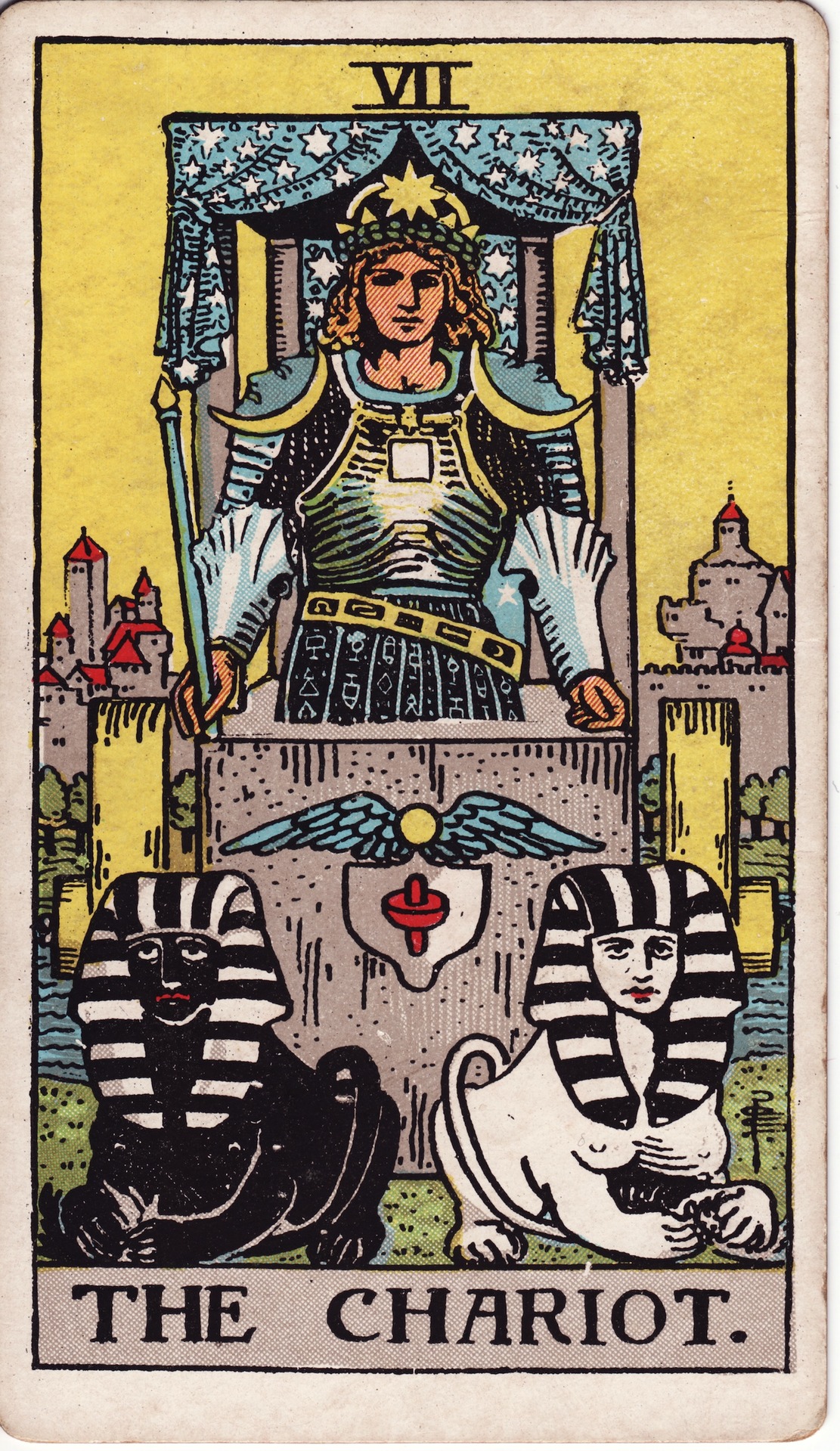
The Chariot — original Rider–Waite–Smith artwork by Pamela Colman Smith

VII / Major Arcana

The Chariot

Direction · resolve · victory

UPRIGHT
Determination and self-command can carry opposing impulses toward a common goal. Progress depends on direction, not force alone.
REVERSED
Loss of control, aggression or conflicting aims can stall movement. Regain your bearings before accelerating.
SYMBOLISM
Black and white sphinxes represent opposing forces. The starry canopy suggests higher guidance; the armored driver holds no visible reins, emphasizing mastery through will.
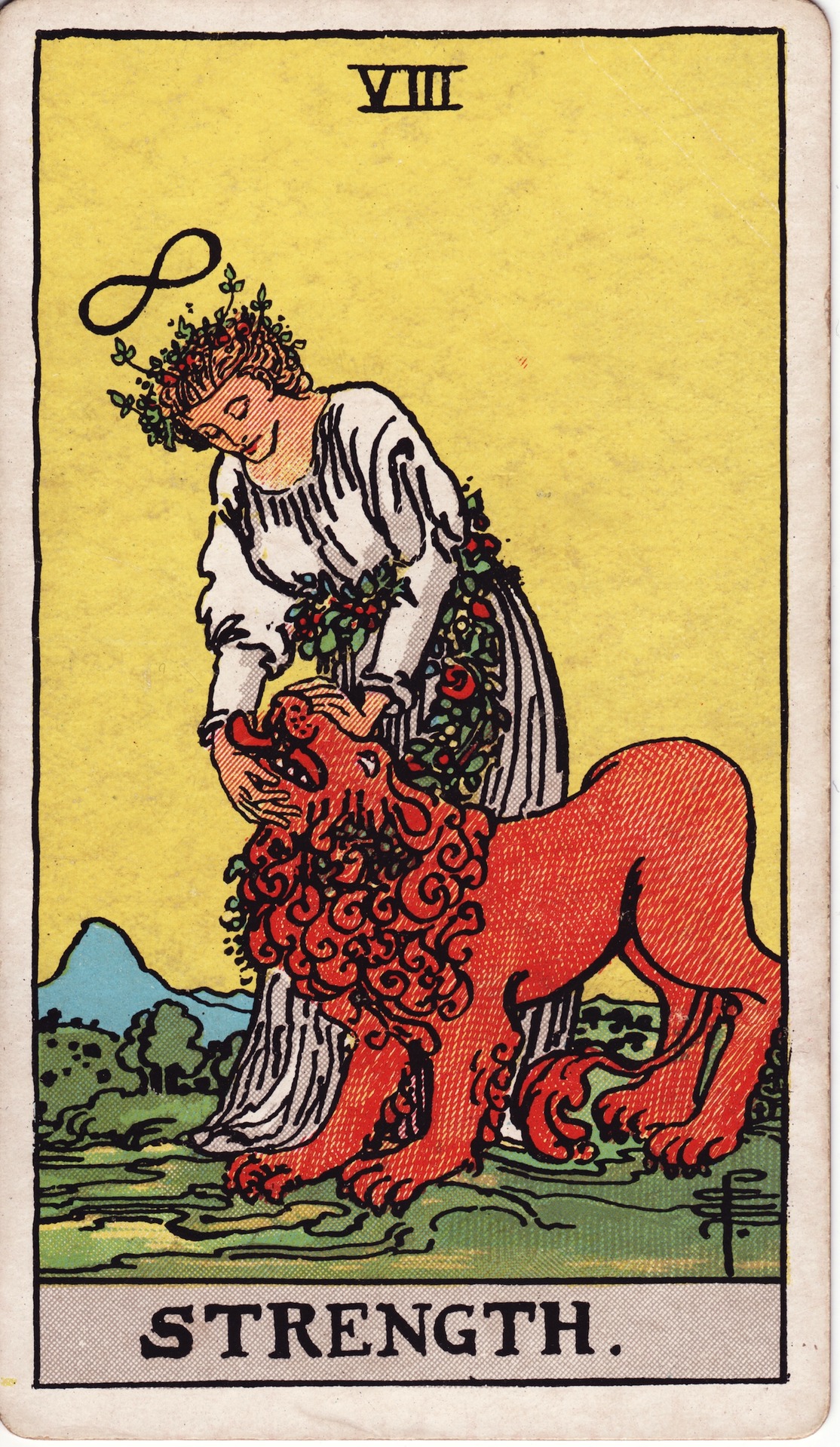
Strength — original Rider–Waite–Smith artwork by Pamela Colman Smith

VIII / Major Arcana

Strength

Courage · patience · compassion

UPRIGHT
Gentle courage and emotional steadiness succeed where coercion fails. Meet instinct and difficulty with patience rather than suppression.
REVERSED
Self-doubt, unchecked impulses or exhaustion may diminish confidence. Strength can mean asking for support and responding without aggression.
SYMBOLISM
A woman calmly tends a lion, joining compassion with instinct. The infinity sign and floral garland suggest spiritual strength and harmony rather than conquest.
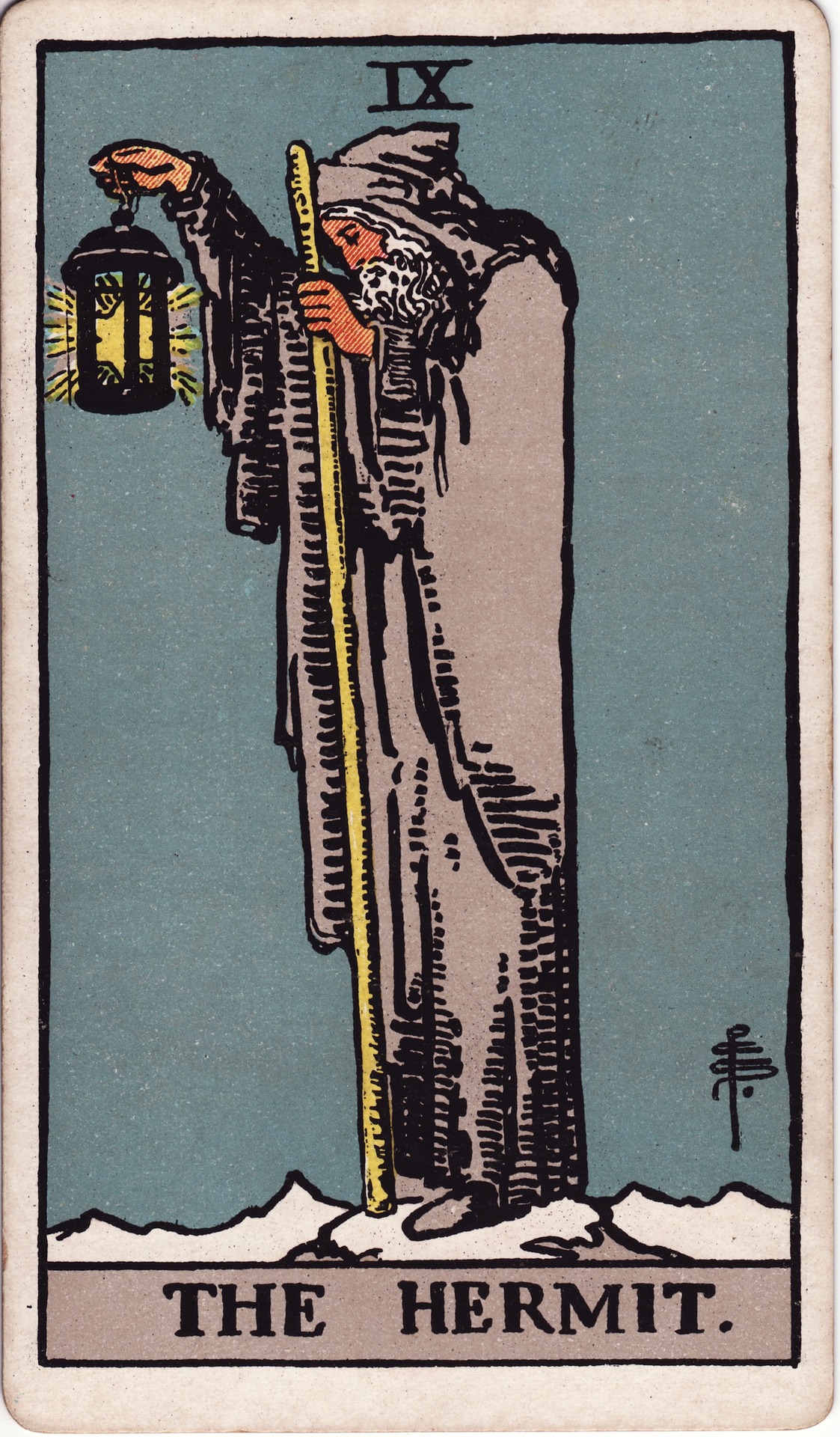
The Hermit — original Rider–Waite–Smith artwork by Pamela Colman Smith

IX / Major Arcana

The Hermit

Solitude · wisdom · discernment

UPRIGHT
Withdrawal and careful reflection can clarify your next step. Seek inner guidance or the counsel of someone with lived wisdom.
REVERSED
Isolation, avoidance or refusal of guidance can turn solitude into stagnation. Consider when it is time to reconnect.
SYMBOLISM
The lantern contains a six-pointed star, a light of wisdom. The staff supports the traveler; the snowy height suggests the distance and discipline of contemplation.
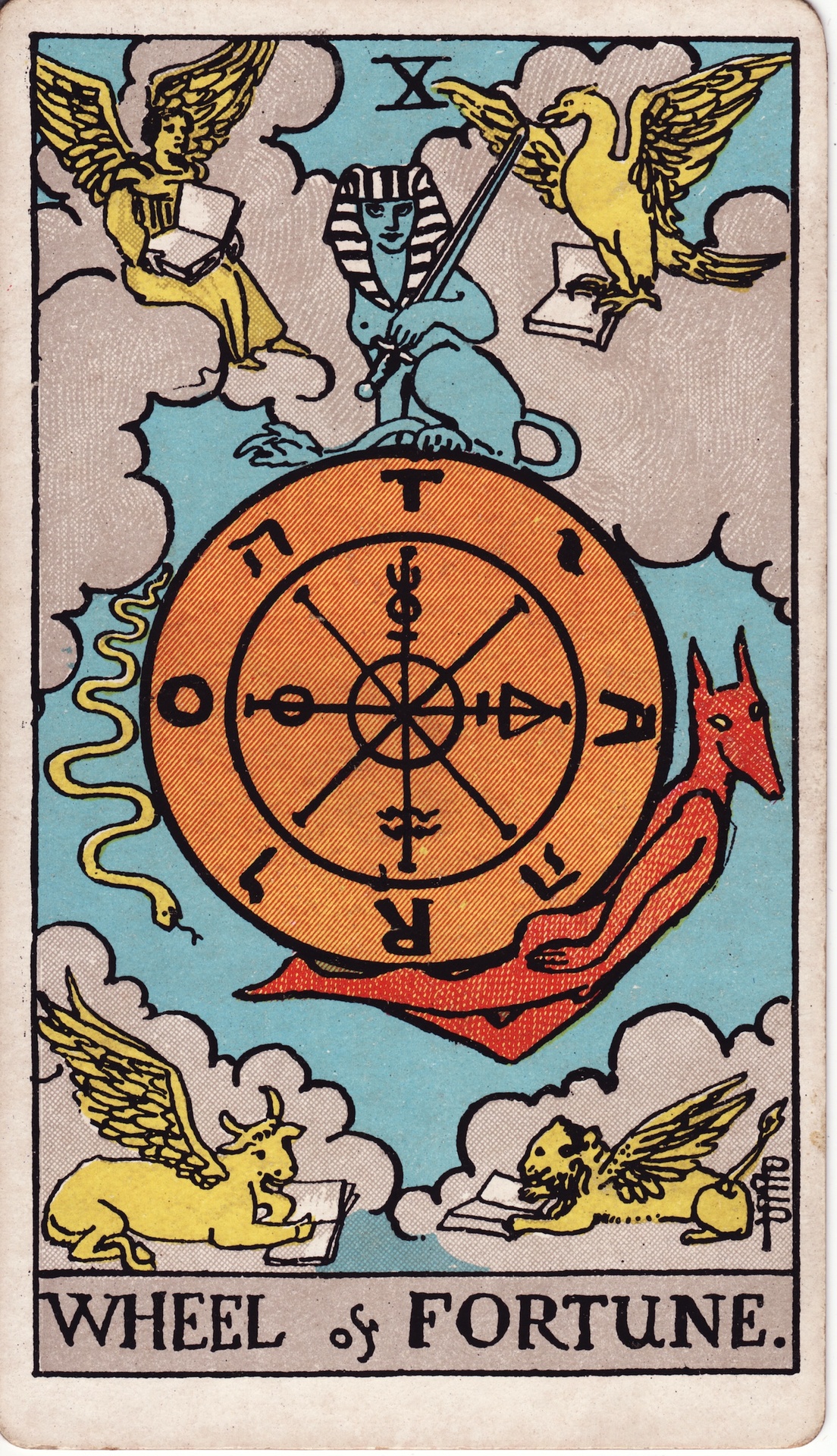
Wheel of Fortune — original Rider–Waite–Smith artwork by Pamela Colman Smith

X / Major Arcana

Wheel of Fortune

Cycles · change · turning points

UPRIGHT
Circumstances are turning, often beyond personal control. Respond to changing conditions with flexibility and awareness of recurring patterns.
REVERSED
Resistance to change, setbacks or repeating cycles may be present. Focus on your response rather than trying to control every outcome.
SYMBOLISM
The wheel is surrounded by ascending and descending figures. A sphinx represents balance amid change; the four winged beings in the corners hold books and evoke fixed signs and sacred knowledge.
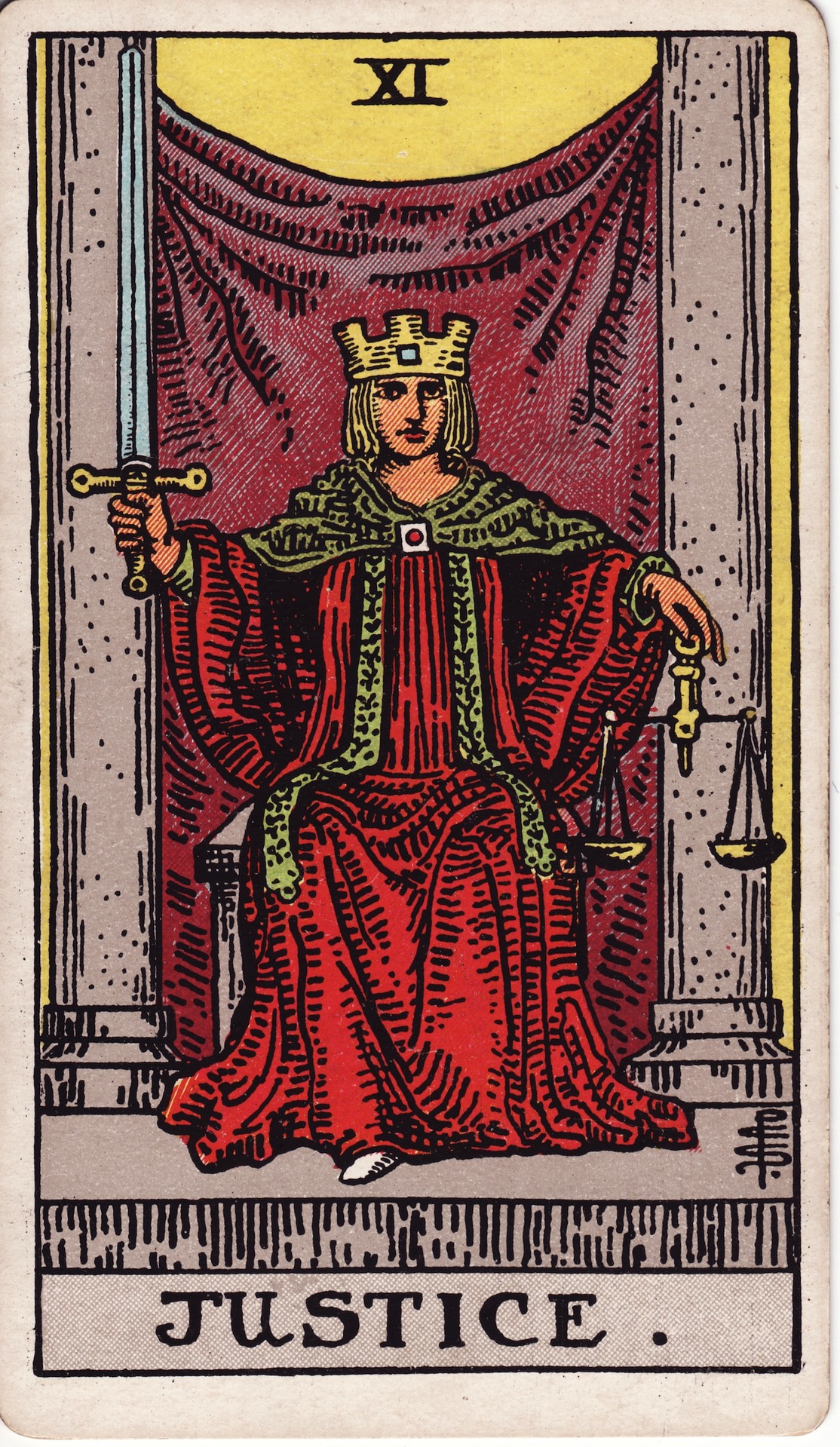
Justice — original Rider–Waite–Smith artwork by Pamela Colman Smith

XI / Major Arcana

Justice

Fairness · truth · accountability

UPRIGHT
Clear judgment, responsibility and fair dealing are required. Weigh the evidence and recognize how choices produce consequences.
REVERSED
Bias, dishonesty or avoidance of accountability may distort a decision. Seek a fuller picture before passing judgment.
SYMBOLISM
The scales weigh competing claims; the upright sword represents decisive truth. The seated figure between pillars emphasizes impartiality and established law.
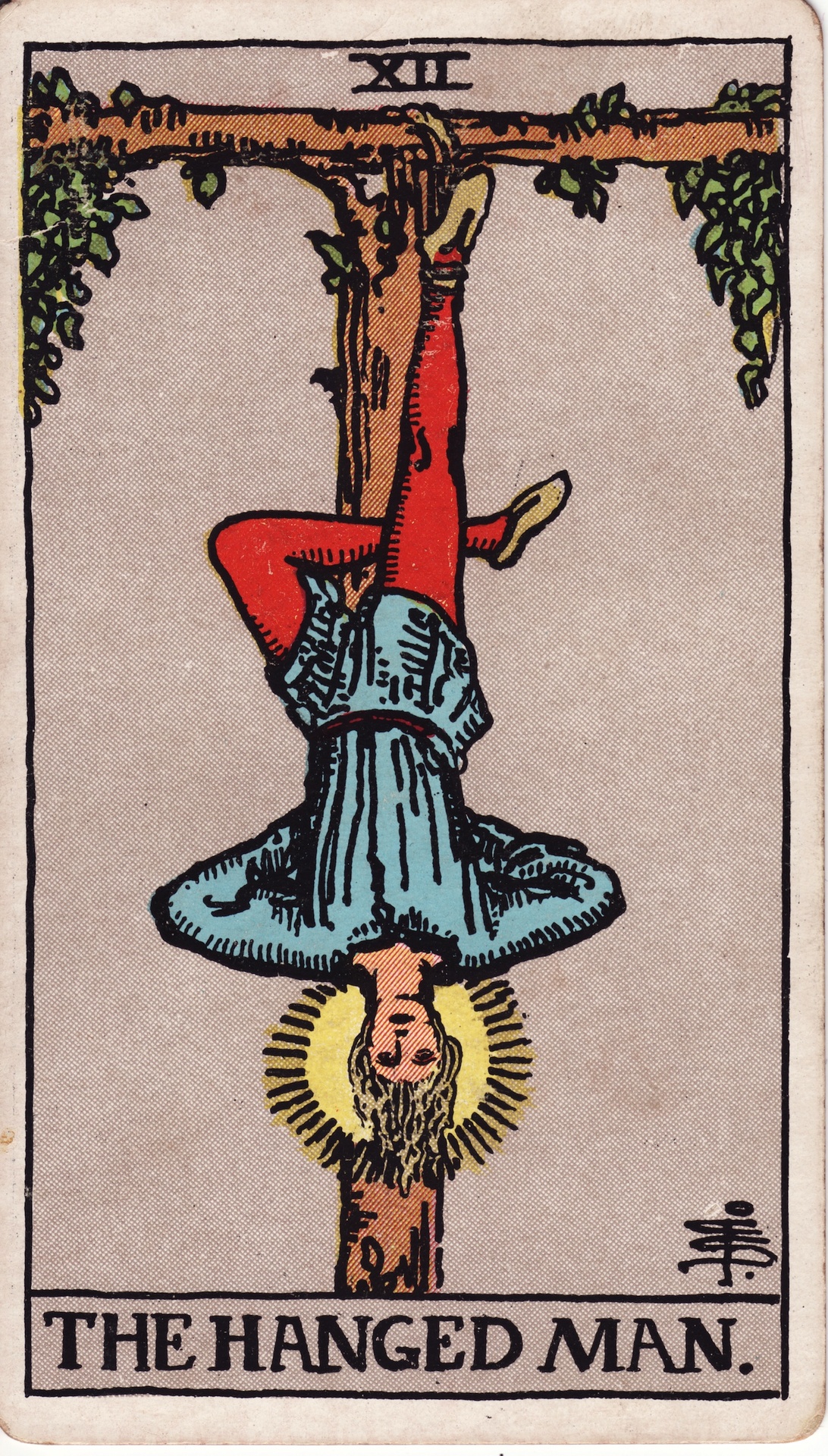
The Hanged Man — original Rider–Waite–Smith artwork by Pamela Colman Smith

XII / Major Arcana

The Hanged Man

Surrender · pause · perspective

UPRIGHT
A voluntary pause or release of control offers a different view. What looks like delay may create room for insight.
REVERSED
Unproductive waiting, resistance or sacrifice without purpose can keep you suspended. Ask what the pause is actually teaching you.
SYMBOLISM
The figure hangs by one foot yet wears a serene expression and halo. The living tree and crossed leg suggest that suspension can be transformative rather than merely punitive.
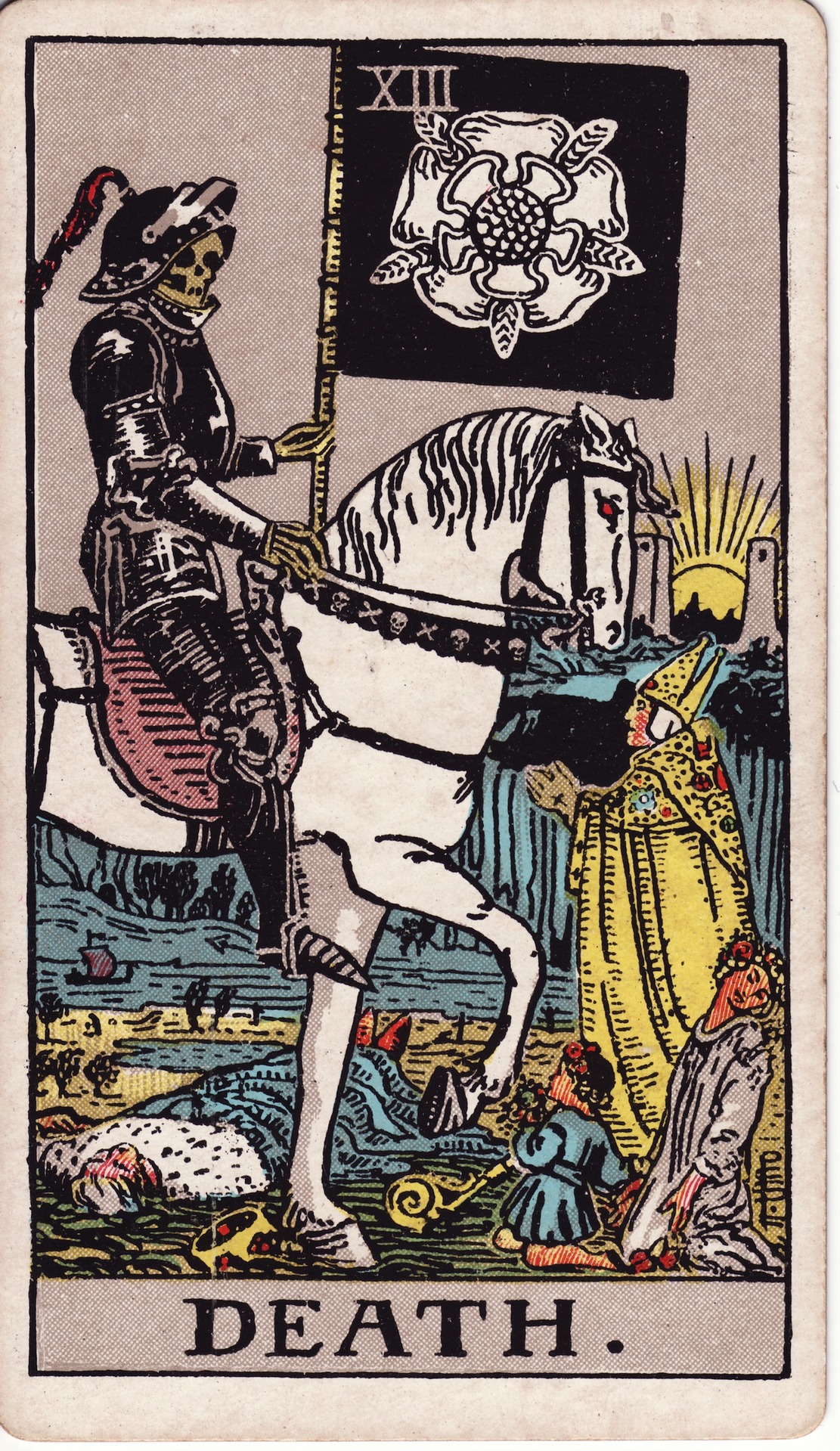
Death — original Rider–Waite–Smith artwork by Pamela Colman Smith

XIII / Major Arcana

Death

Endings · transition · renewal

UPRIGHT
An old phase gives way to transformation. Letting something end creates room for renewal; this card is not a literal prediction of death.
REVERSED
Resistance to an ending, stagnation or unfinished transition may prolong discomfort. Identify what has already outlived its purpose.
SYMBOLISM
The armored skeleton rides a white horse past figures of different ranks. A white rose on the black banner suggests renewal; a rising sun beyond two towers signals life after transition.
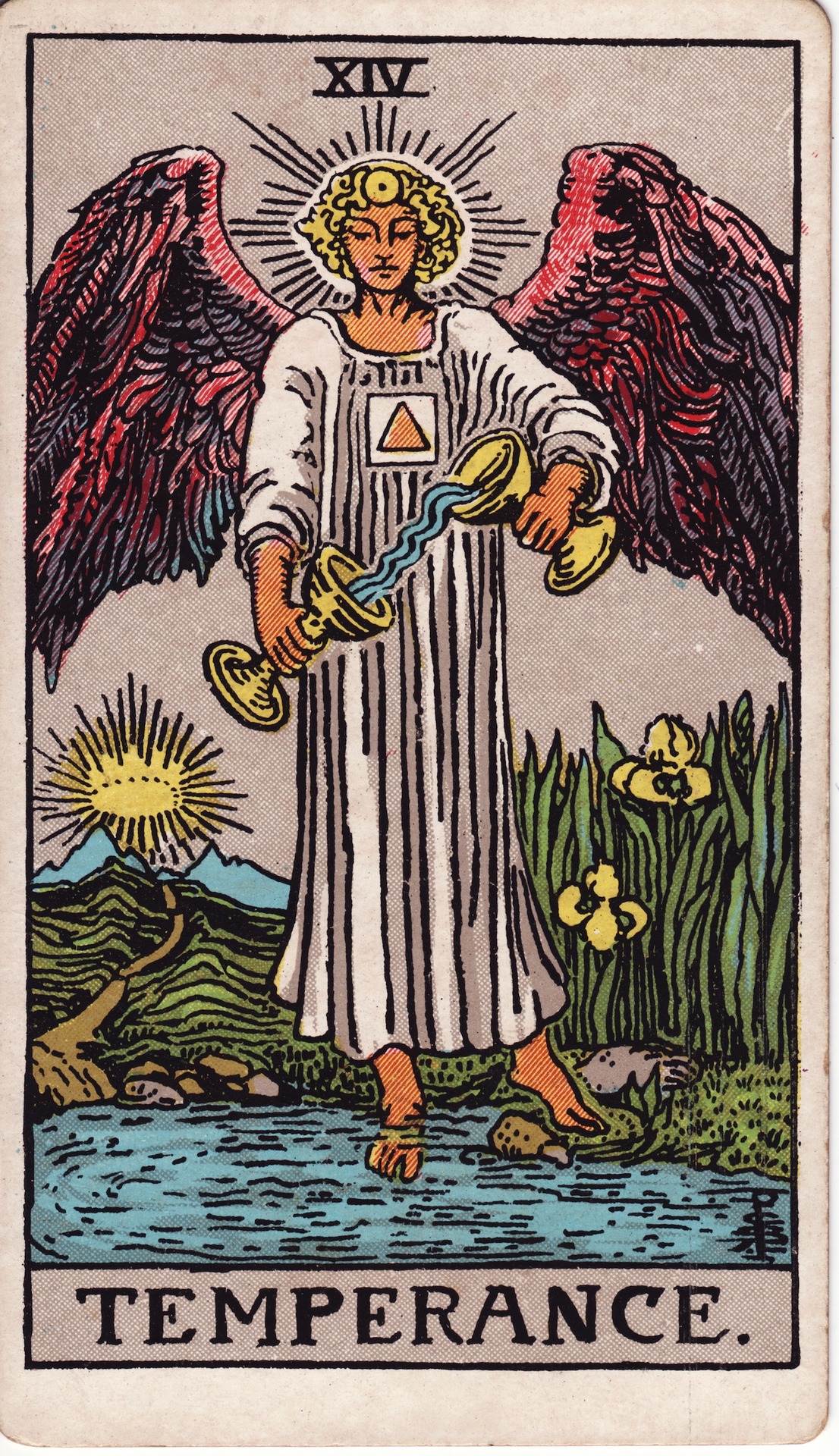
Temperance — original Rider–Waite–Smith artwork by Pamela Colman Smith

XIV / Major Arcana

Temperance

Moderation · balance · integration

UPRIGHT
Patient adjustment and cooperation reconcile different needs. A sustainable rhythm develops through proportion, not extremes.
REVERSED
Excess, imbalance or impatience can disrupt harmony. Revisit your pace and the elements that need to work together.
SYMBOLISM
The angel pours water between cups, blending opposites. One foot rests on land and one in water; the path toward a distant crown suggests purposeful integration.
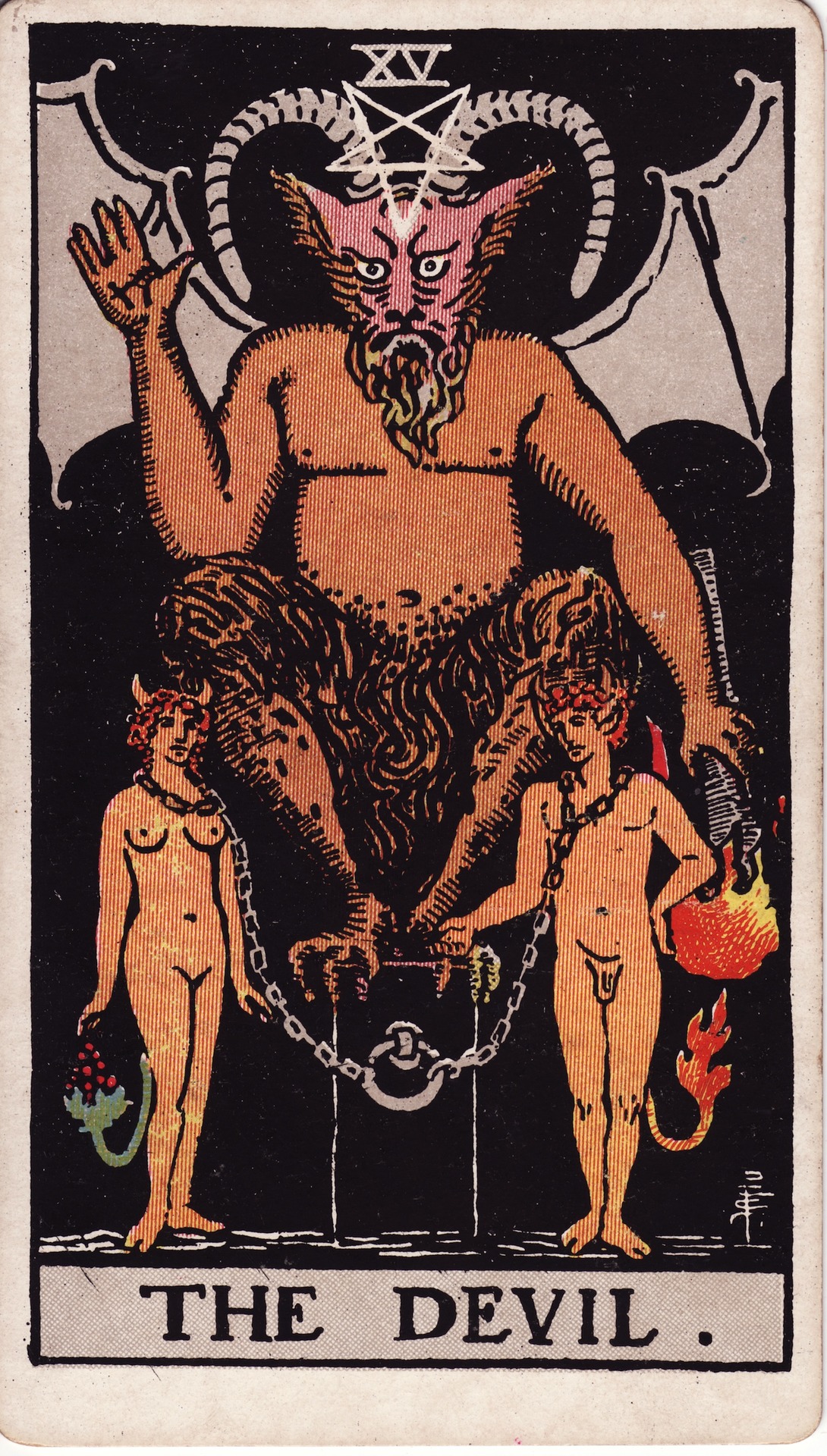
The Devil — original Rider–Waite–Smith artwork by Pamela Colman Smith

XV / Major Arcana

The Devil

Attachment · bondage · materialism

UPRIGHT
Attachments, compulsions or unequal power can restrict freedom. Notice the habits and agreements that keep you bound.
REVERSED
Recognizing a limiting attachment can open a path to release. Freedom may require honest confrontation with an entrenched pattern.
SYMBOLISM
Two figures wear loose chains beneath a horned figure. The inverted pentagram and downward torch suggest energy turned toward material fixation; the loose chains imply possible release.
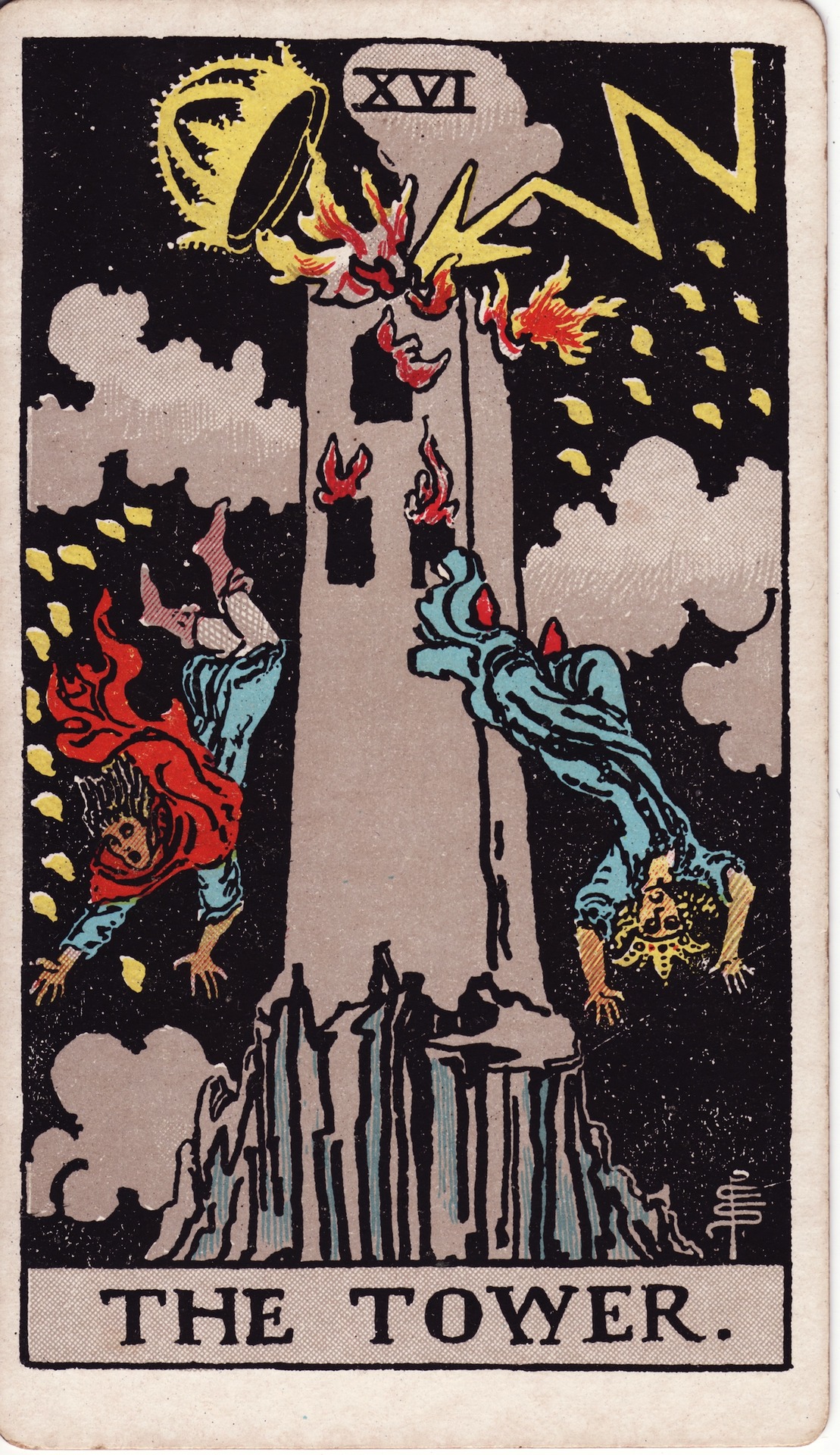
The Tower — original Rider–Waite–Smith artwork by Pamela Colman Smith

XVI / Major Arcana

The Tower

Disruption · revelation · upheaval

UPRIGHT
A sudden revelation or breakdown exposes an unstable structure. Difficult change can clear away assumptions that no longer hold.
REVERSED
Fear of upheaval, a narrowly avoided crisis or a private restructuring may be at work. Address weaknesses rather than postponing them.
SYMBOLISM
Lightning strikes the tower and dislodges its crown. Falling figures and flames dramatize the collapse of constructed certainty and the force of revelation.
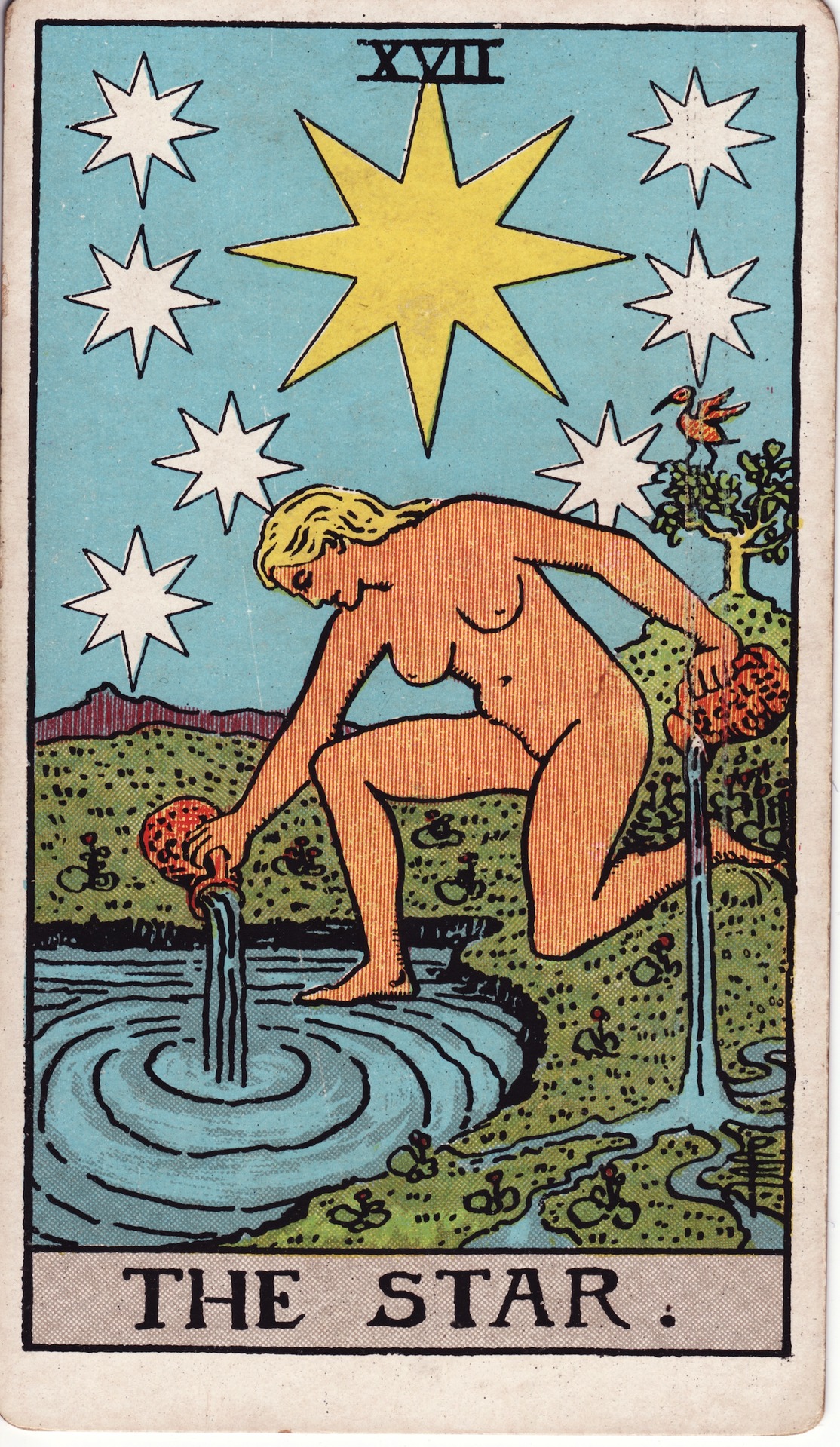
The Star — original Rider–Waite–Smith artwork by Pamela Colman Smith

XVII / Major Arcana

The Star

Hope · renewal · openness

UPRIGHT
After difficulty, hope and a sense of possibility can return. Restore trust through quiet care, generosity and renewed connection.
REVERSED
Discouragement or loss of faith may obscure available support. Begin rebuilding hope through small, grounded acts.
SYMBOLISM
The unclothed figure pours water onto land and into a pool. Seven small stars surround one larger star; water and open posture suggest replenishment and unguarded sincerity.
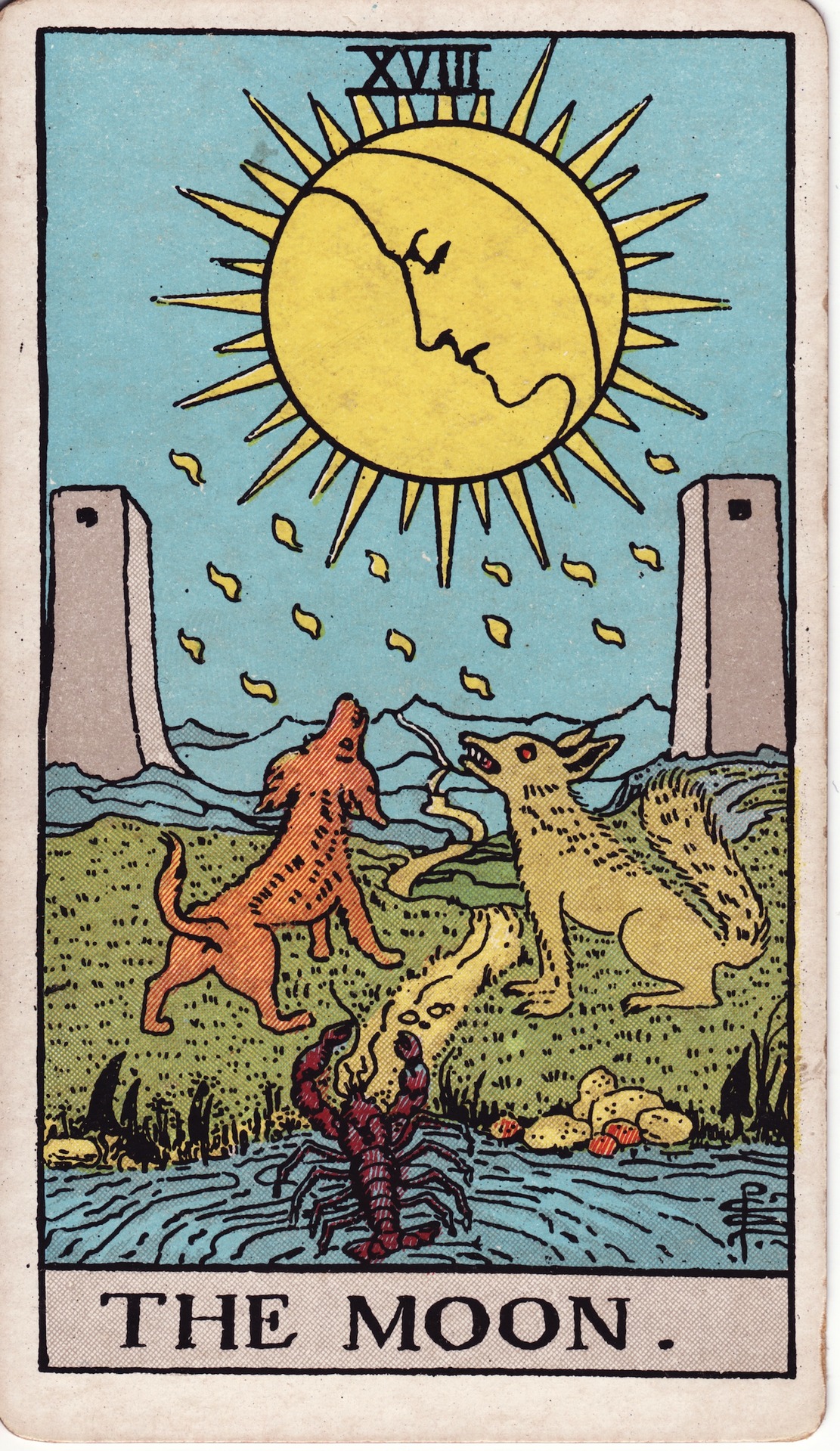
The Moon — original Rider–Waite–Smith artwork by Pamela Colman Smith

XVIII / Major Arcana

The Moon

Uncertainty · dreams · intuition

UPRIGHT
Appearances may be incomplete and emotions unusually vivid. Navigate uncertainty carefully, distinguishing intuition from fear or projection.
REVERSED
Confusion may begin to clear, or an unacknowledged fear may surface. Verify your impressions rather than rushing to certainty.
SYMBOLISM
A dog and wolf stand between two towers, joining tame and wild instincts. A crayfish emerges from water; the winding path leads through the unfamiliar under reflected moonlight.
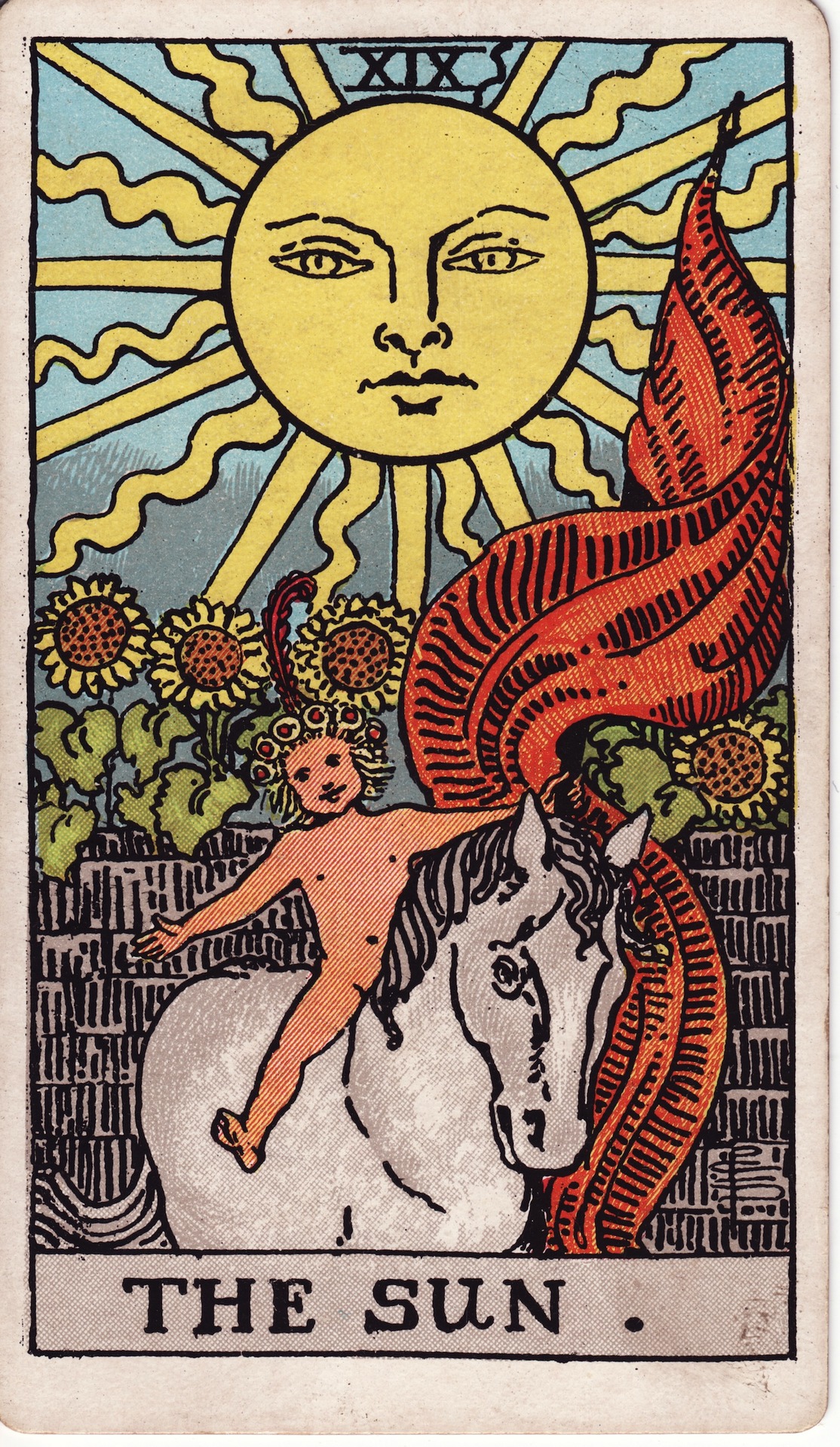
The Sun — original Rider–Waite–Smith artwork by Pamela Colman Smith

XIX / Major Arcana

The Sun

Joy · vitality · clarity

UPRIGHT
Clarity, warmth and confidence support growth. Enjoy what is visible and life-giving without needing to complicate it.
REVERSED
Diminished enthusiasm, delayed happiness or overconfidence may obscure a positive situation. Look for a simpler and more realistic source of joy.
SYMBOLISM
A child rides a white horse beneath a radiant sun. Sunflowers and the red banner suggest vitality; the garden wall marks a boundary beyond which life continues.
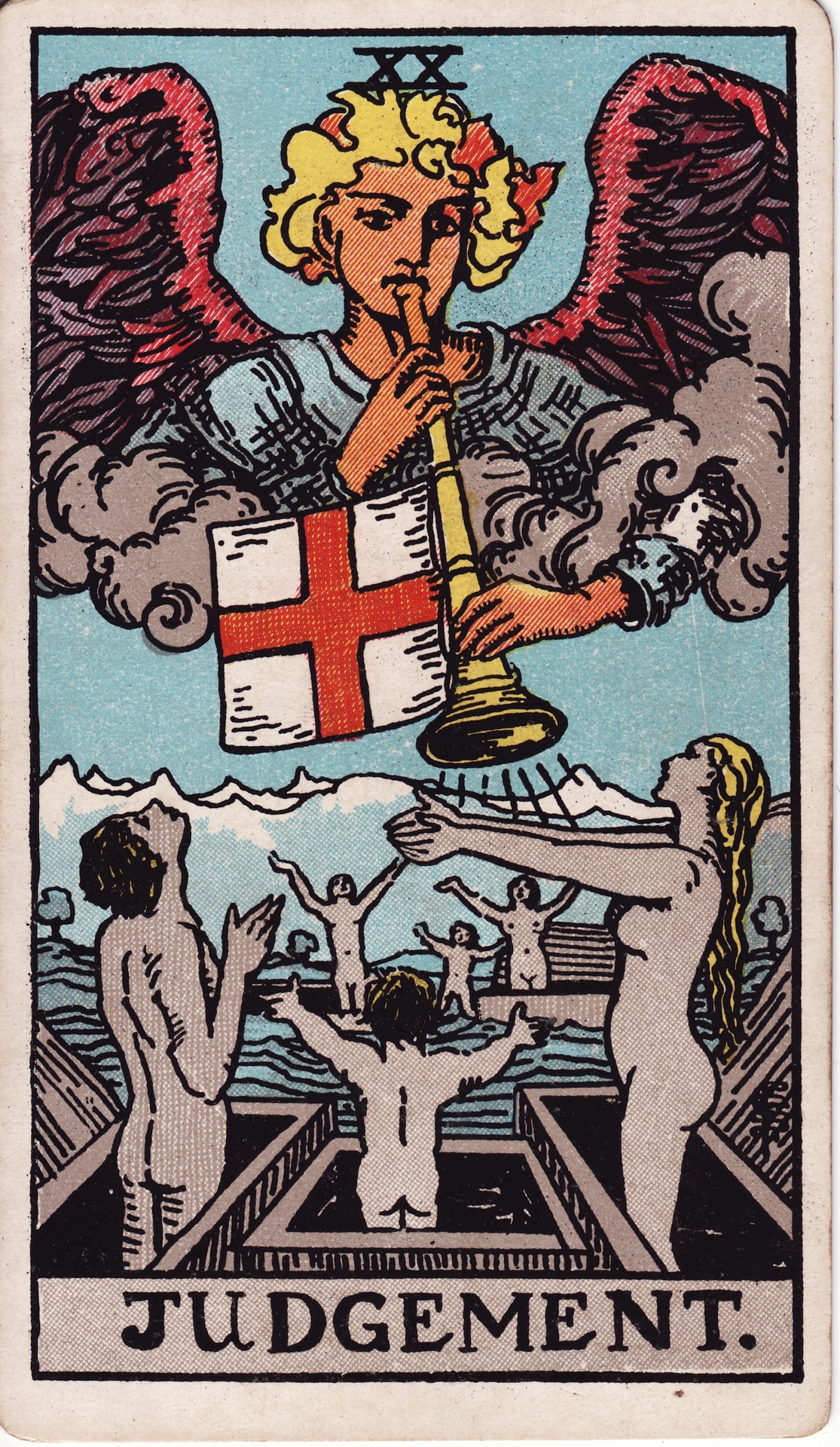
Judgement — original Rider–Waite–Smith artwork by Pamela Colman Smith

XX / Major Arcana

Judgement

Awakening · reckoning · calling

UPRIGHT
Honest self-review and a renewed sense of calling invite change. Respond to what experience has taught you rather than remaining in an old identity.
REVERSED
Self-criticism, denial or reluctance to answer a calling can delay renewal. Accountability need not become condemnation.
SYMBOLISM
An angel sounds a trumpet as figures rise from coffins. The image evokes awakening, release from former conditions and a summons to a different way of living.
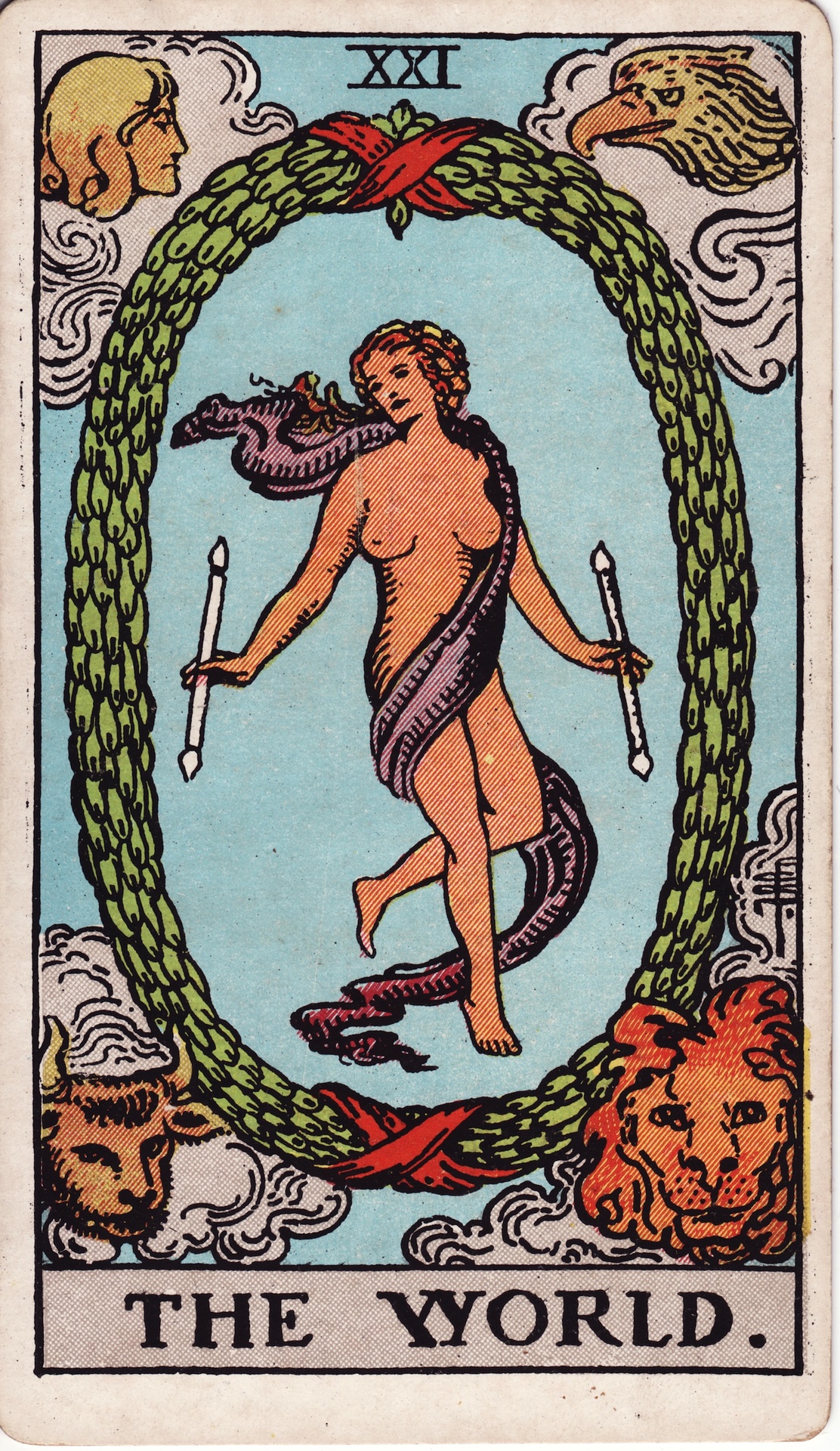
The World — original Rider–Waite–Smith artwork by Pamela Colman Smith

XXI / Major Arcana

The World

Completion · integration · wholeness

UPRIGHT
A cycle reaches fulfillment, bringing integration and earned perspective. Acknowledge the achievement before beginning another journey.
REVERSED
An unfinished task, lack of closure or delayed completion may remain. Attend to the final step instead of seeking a new beginning too soon.
SYMBOLISM
A dancing figure is enclosed by a laurel wreath and holds two wands. Four corner beings recall the Wheel of Fortune, now framing a sense of harmony and completion.

Wands

14

Fire — inspiration, ambition, creative energy and action.

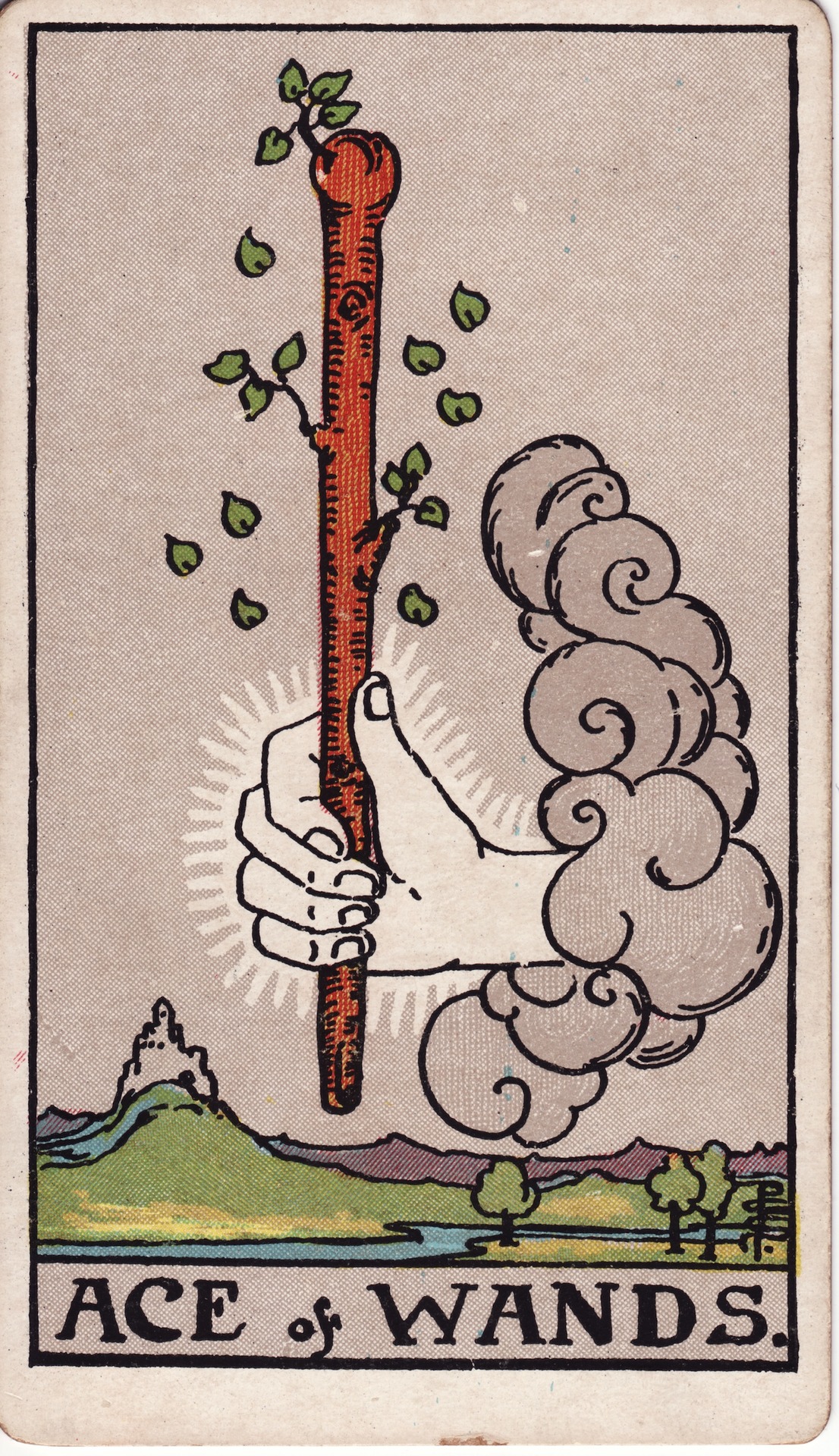
Ace of Wands — original Rider–Waite–Smith artwork by Pamela Colman Smith

A · † / Wands

Ace of Wands

Inspiration · potential · initiative

UPRIGHT
A creative impulse or new enterprise offers fertile potential. Give the spark a practical first action.
REVERSED
A false start, depleted motivation or delayed inspiration may need patience. Reconnect with the purpose before forcing momentum.
SYMBOLISM
A hand extends a sprouting wand from a cloud. Falling leaves and a green landscape suggest living potential; the distant castle hints at what the beginning might build.
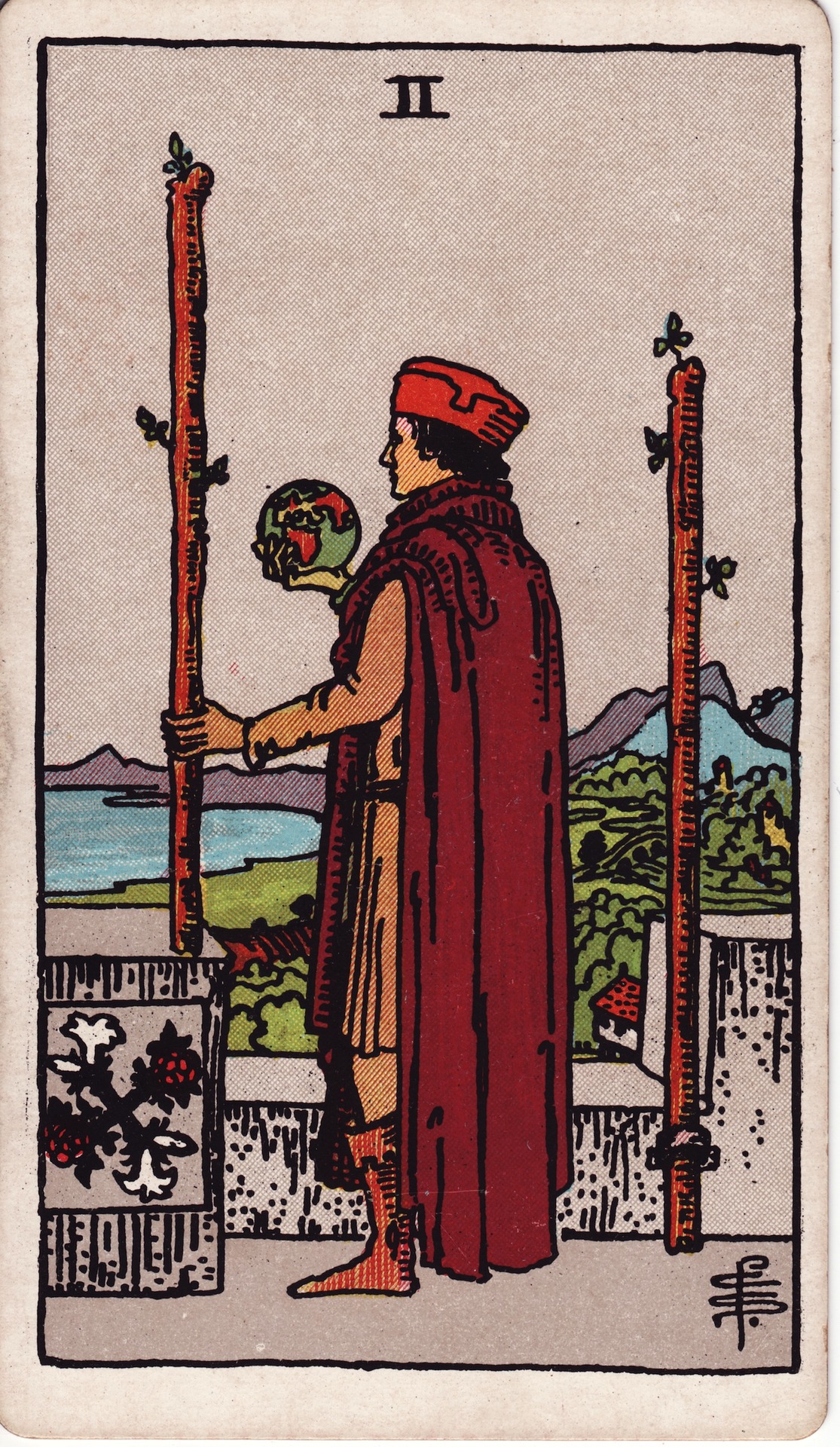
Two of Wands — original Rider–Waite–Smith artwork by Pamela Colman Smith

II · † / Wands

Two of Wands

Planning · vision · possibility

UPRIGHT
Survey your options and plan beyond familiar territory. Progress asks for a considered choice between security and expansion.
REVERSED
Fear of the unknown, narrow planning or indecision may limit your range. Check whether your ambition has a realistic next step.
SYMBOLISM
A figure holds a globe while looking outward from a battlement. One wand is fixed to the wall and one held freely, contrasting established ground with exploration.
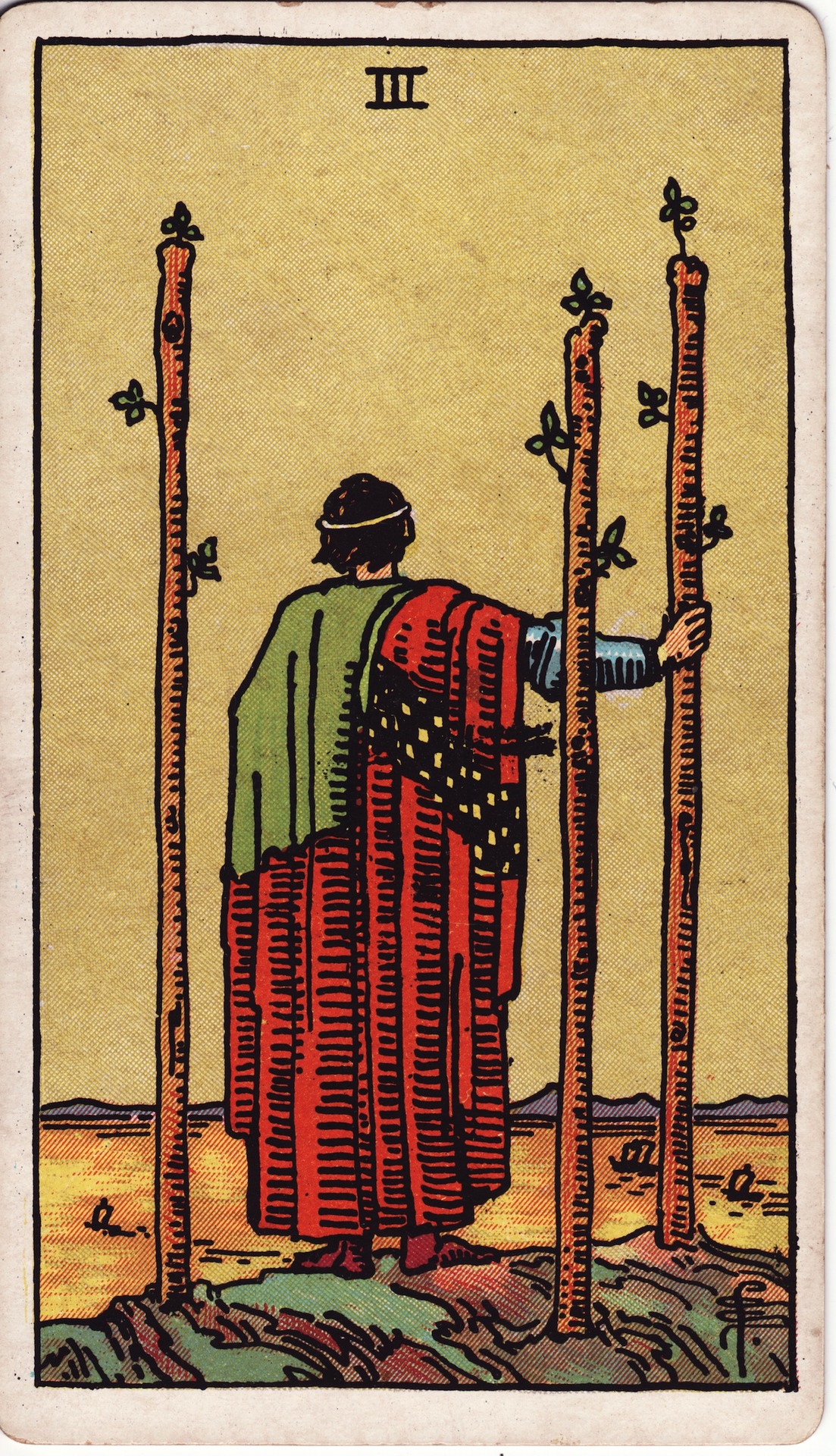
Three of Wands — original Rider–Waite–Smith artwork by Pamela Colman Smith

III · † / Wands

Three of Wands

Expansion · foresight · enterprise

UPRIGHT
Early effort begins to open wider possibilities. Watch for opportunities and prepare for the results of what you have set in motion.
REVERSED
Delays, limited foresight or obstacles to expansion may require revised expectations. Review the foundation before reaching further.
SYMBOLISM
A figure stands above the sea watching ships. Three planted wands suggest established effort; the broad horizon emphasizes trade, distance and future development.
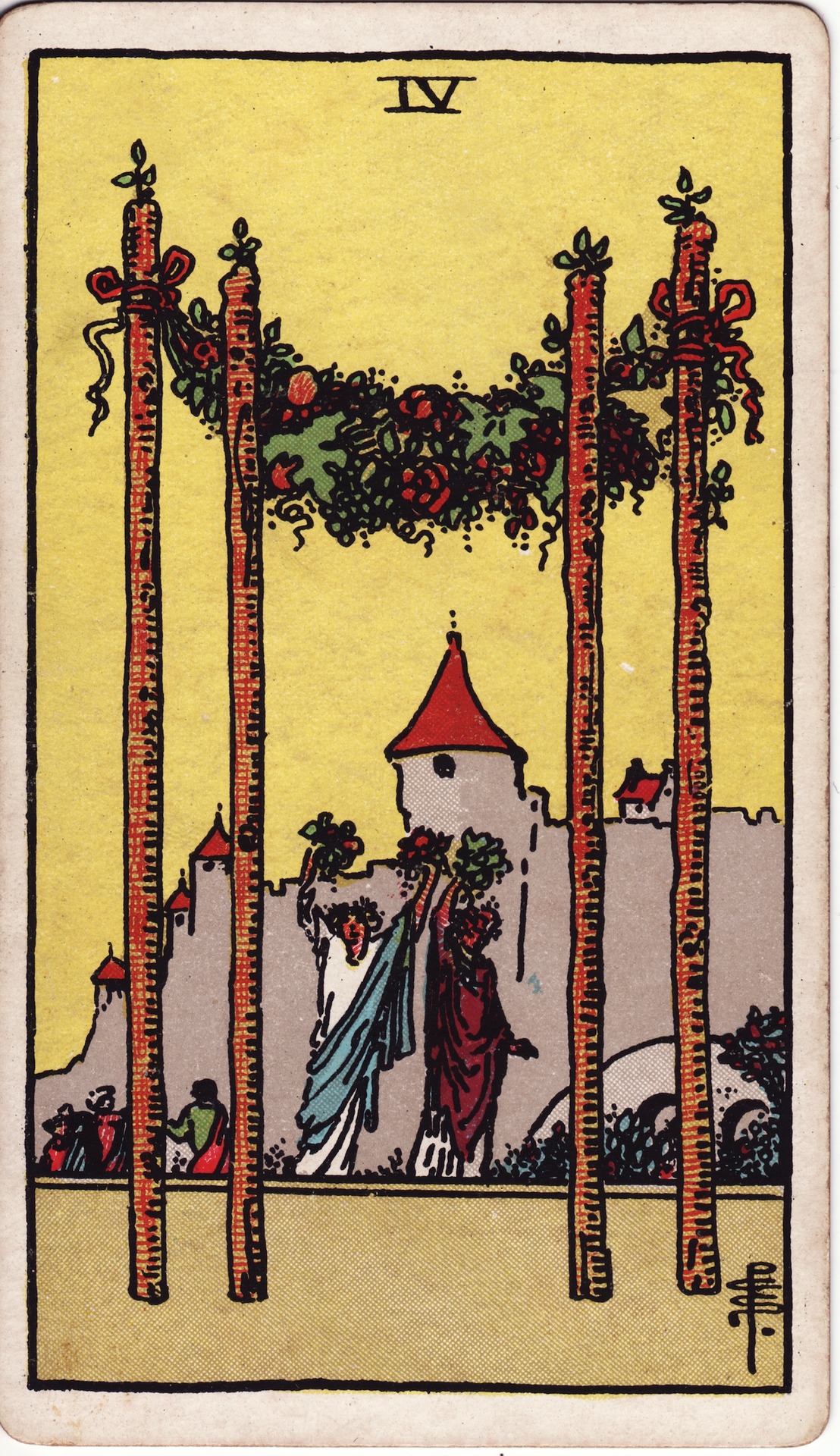
Four of Wands — original Rider–Waite–Smith artwork by Pamela Colman Smith

IV · † / Wands

Four of Wands

Celebration · home · belonging

UPRIGHT
A milestone, welcoming community or stable home deserves celebration. Shared joy can strengthen a lasting foundation.
REVERSED
Domestic tension, an unsettled transition or postponed celebration may affect belonging. Clarify what makes a space feel supportive.
SYMBOLISM
Four wands hold a floral canopy while figures raise bouquets. The castle and gathered people evoke a homecoming, communal welcome and the fruits of stability.
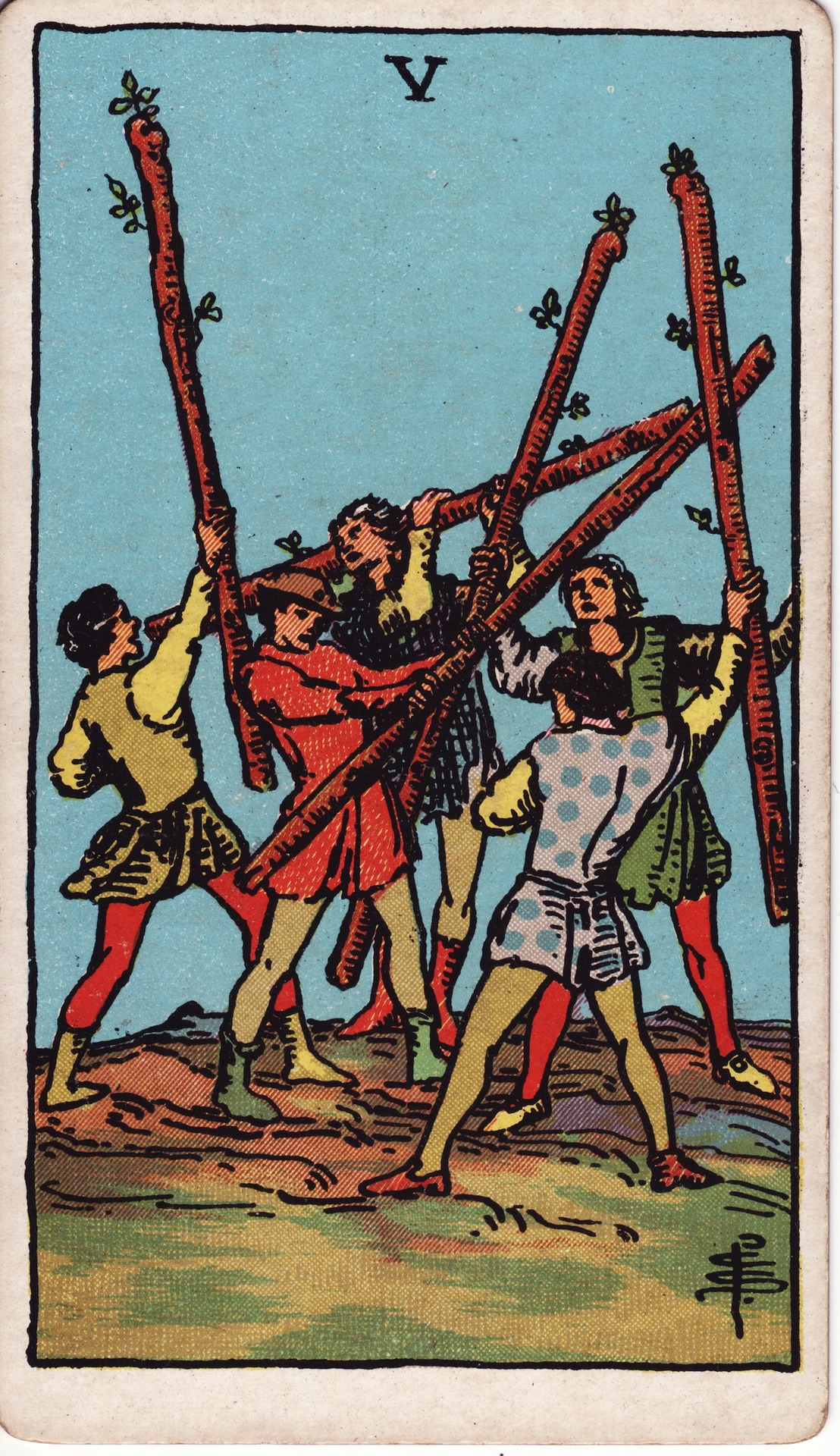
Five of Wands — original Rider–Waite–Smith artwork by Pamela Colman Smith

V · † / Wands

Five of Wands

Competition · friction · challenge

UPRIGHT
Different aims or voices create friction. Productive competition can develop skill if conflict remains fair and purposeful.
REVERSED
Conflict avoidance or escalating rivalry may prevent useful cooperation. Establish shared rules and distinguish disagreement from hostility.
SYMBOLISM
Five figures brandish wands in a crowded scene. Their varied clothes and uncoordinated movement suggest competing energies rather than an organized battle.
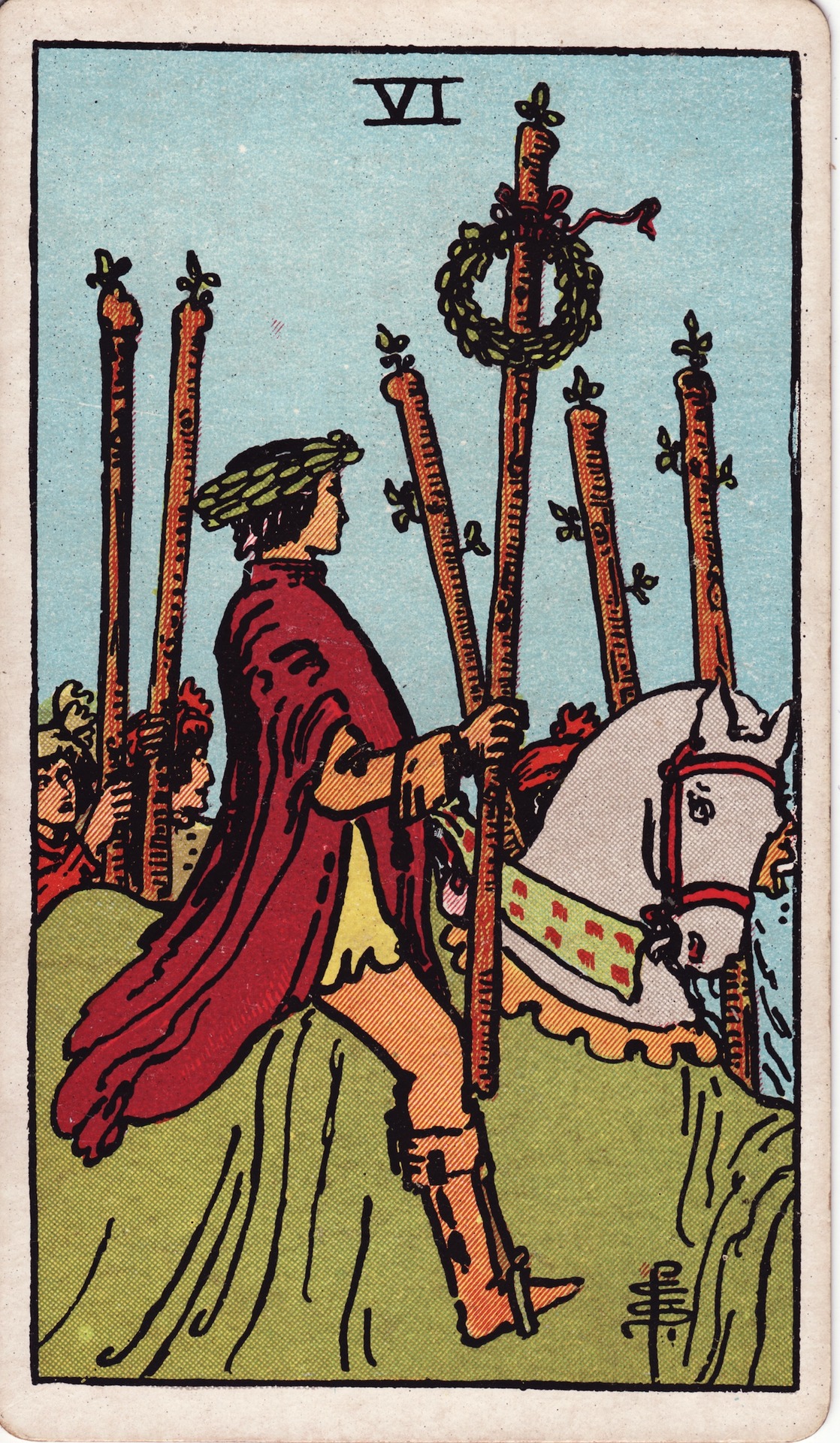
Six of Wands — original Rider–Waite–Smith artwork by Pamela Colman Smith

VI · † / Wands

Six of Wands

Recognition · success · confidence

UPRIGHT
An achievement receives recognition and support. Accept the acknowledgment while remembering the work and people behind it.
REVERSED
A setback, lack of recognition or pride can unsettle confidence. Separate the value of your effort from applause.
SYMBOLISM
A rider crowned with laurel carries a wreath-topped wand. The surrounding crowd makes victory public, emphasizing leadership and collective recognition.
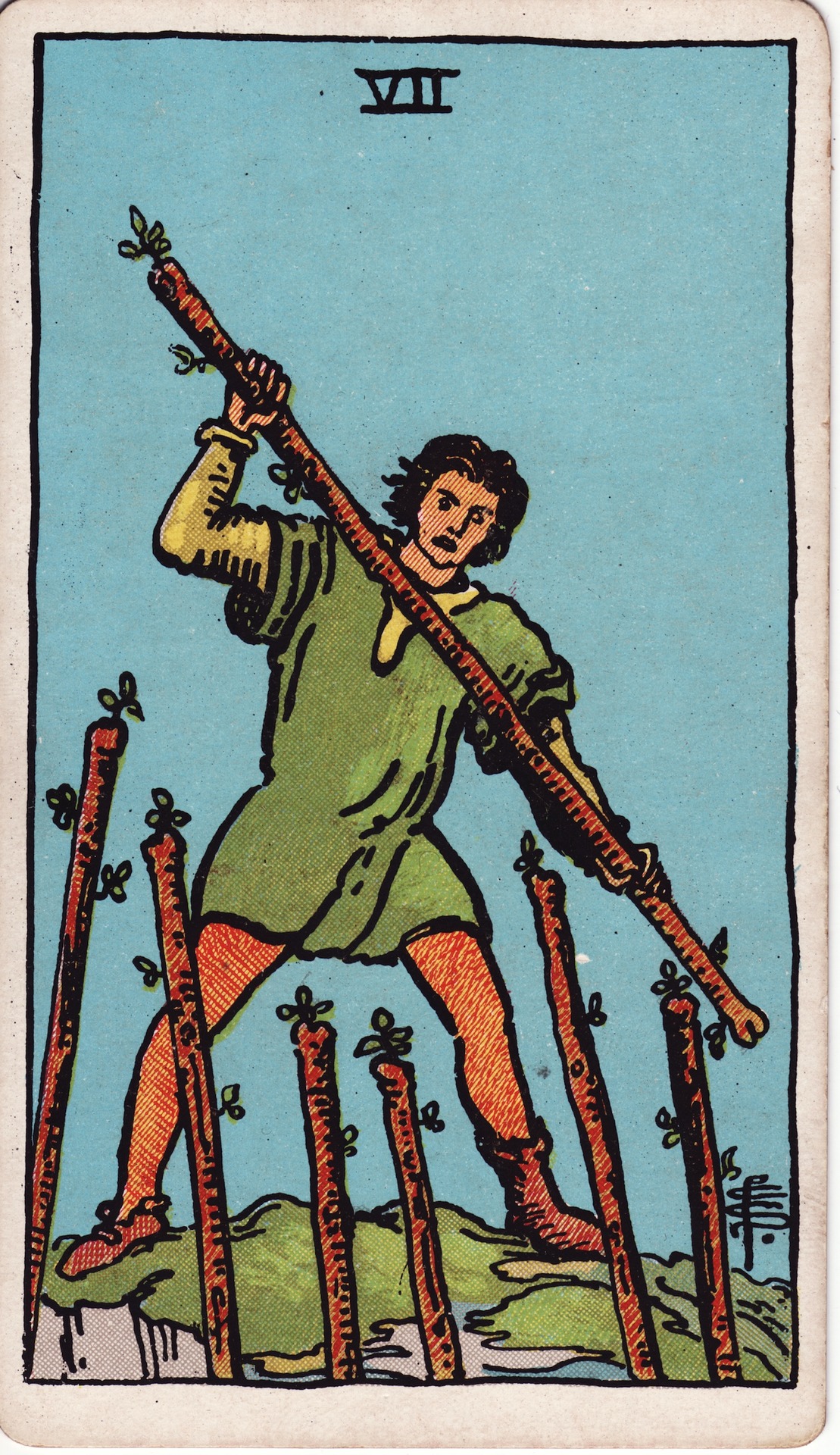
Seven of Wands — original Rider–Waite–Smith artwork by Pamela Colman Smith

VII · † / Wands

Seven of Wands

Defense · conviction · perseverance

UPRIGHT
Protect your position amid challenge. Courage and clear priorities help you hold ground without fighting every battle.
REVERSED
Overwhelm, defensiveness or exhaustion may undermine your stance. Decide what is worth defending and where support is needed.
SYMBOLISM
A figure stands on higher ground against six rising wands. Mismatched footwear suggests being caught unprepared, while the elevation gives a hard-earned advantage.
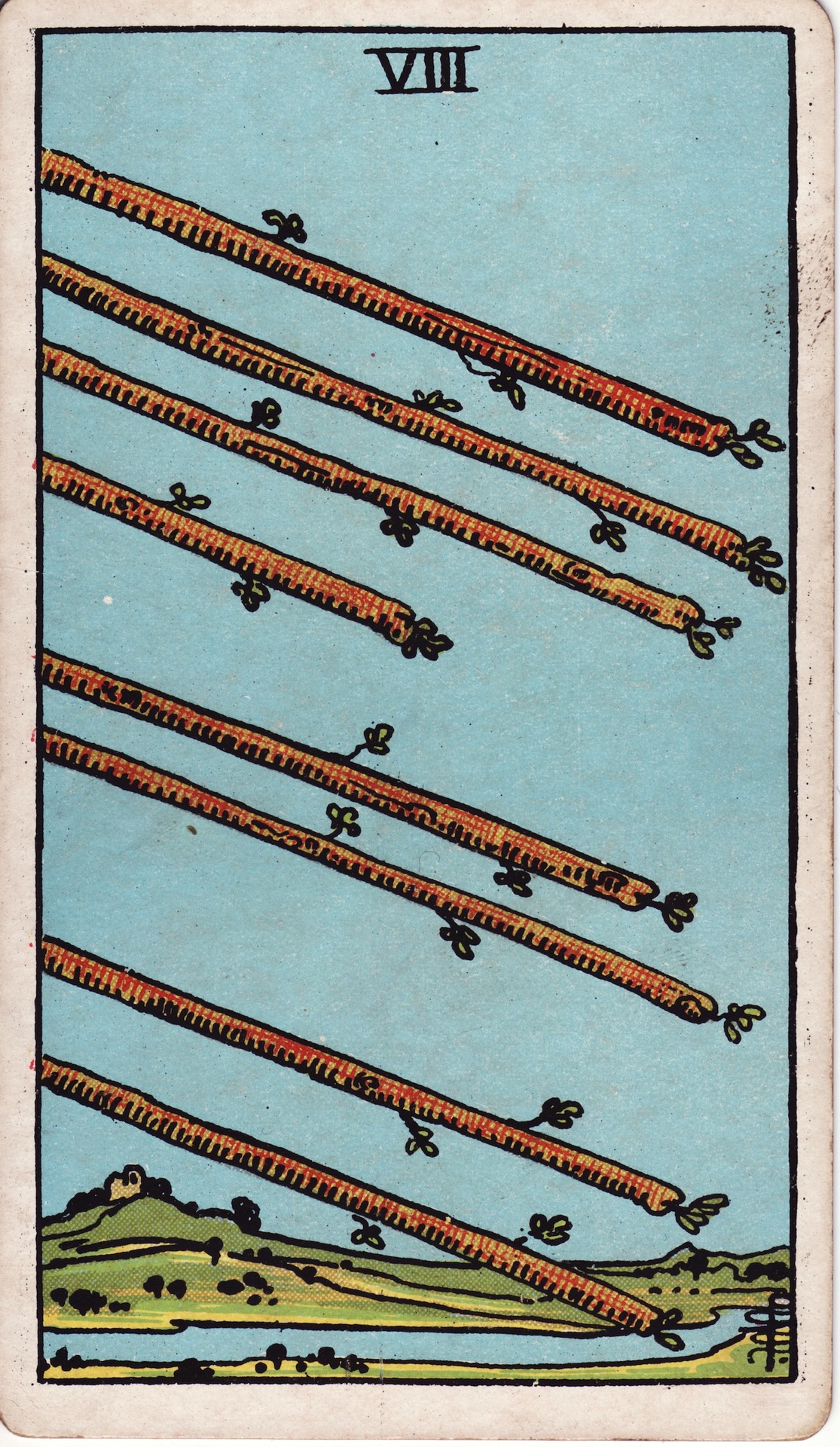
Eight of Wands — original Rider–Waite–Smith artwork by Pamela Colman Smith

VIII · † / Wands

Eight of Wands

Speed · movement · messages

UPRIGHT
Events, communication or travel gather pace. Act with focus as obstacles give way to swift development.
REVERSED
Delays, miscommunication or rushed action can scatter energy. Confirm direction before responding at speed.
SYMBOLISM
Eight wands fly together through an open sky above a river. The absence of human figures highlights momentum itself and an unobstructed trajectory.
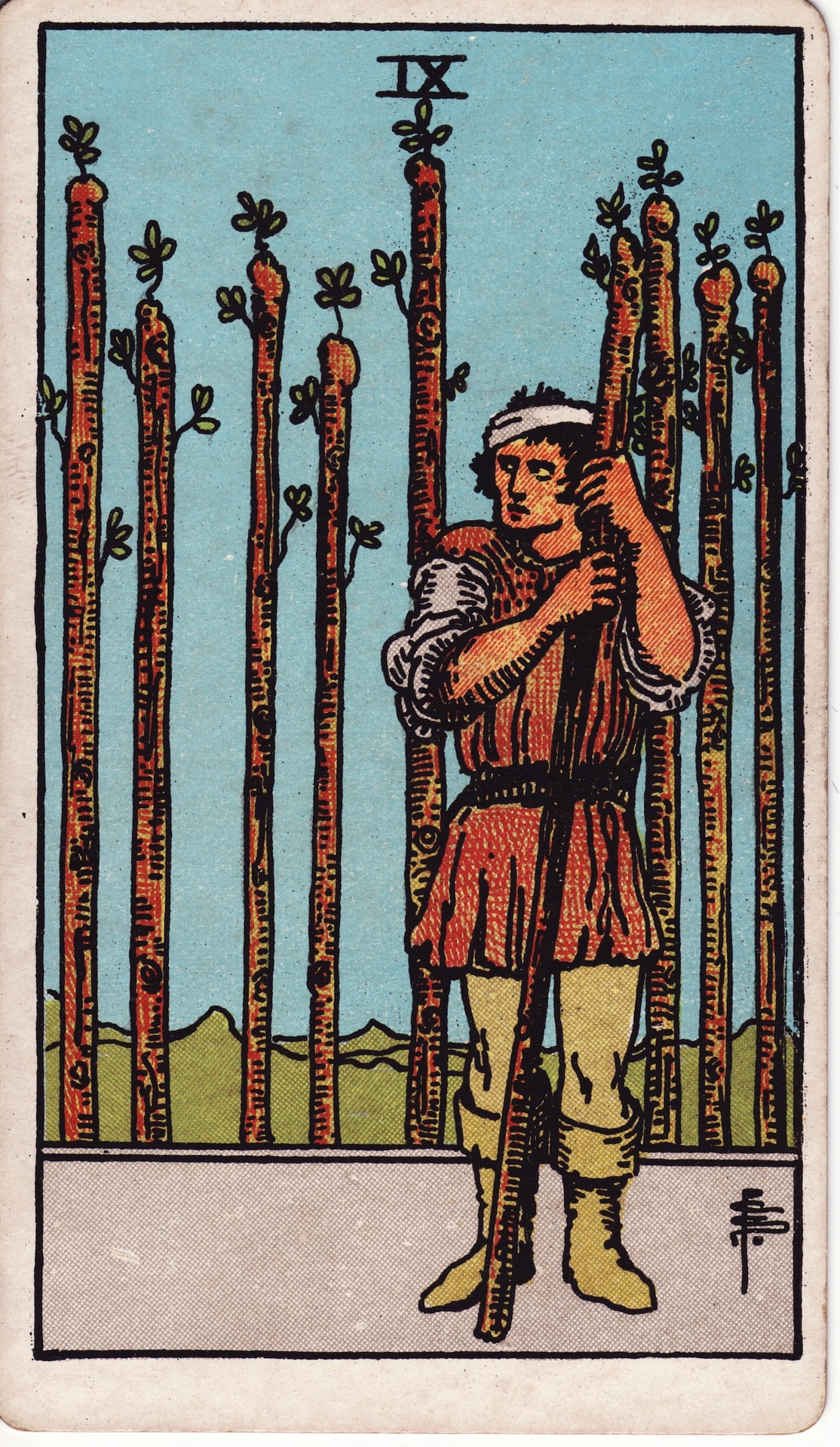
Nine of Wands — original Rider–Waite–Smith artwork by Pamela Colman Smith

IX · † / Wands

Nine of Wands

Resilience · vigilance · boundaries

UPRIGHT
Experience has made you cautious, but perseverance remains possible. Protect your energy while assessing the challenge realistically.
REVERSED
Burnout, suspicion or rigid defenses may make every demand feel like a threat. Recovery can be more useful than another show of endurance.
SYMBOLISM
A bandaged figure grips a wand before a row of eight others. The wound records past struggle; the upright barrier conveys vigilance and a defended position.
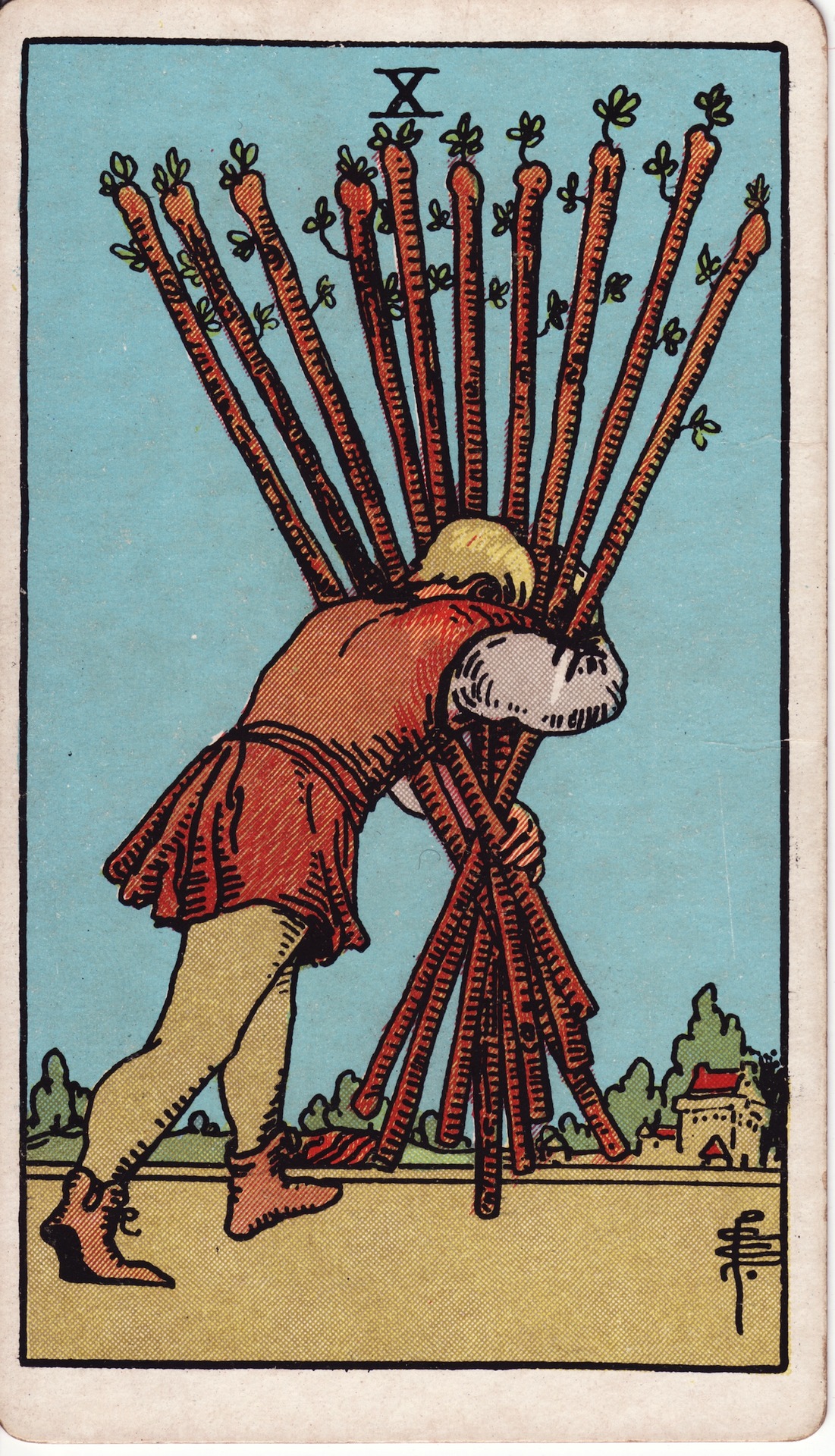
Ten of Wands — original Rider–Waite–Smith artwork by Pamela Colman Smith

X · † / Wands

Ten of Wands

Burden · responsibility · overwork

UPRIGHT
Success or obligation has become heavy to carry. Reorganize responsibilities and distinguish commitment from unnecessary overload.
REVERSED
A burden may be released, refused or intensified by reluctance to delegate. Review what truly belongs to you.
SYMBOLISM
A bent figure carries ten wands toward a town. The load obstructs the view ahead, suggesting how responsibility can narrow perspective even near a destination.
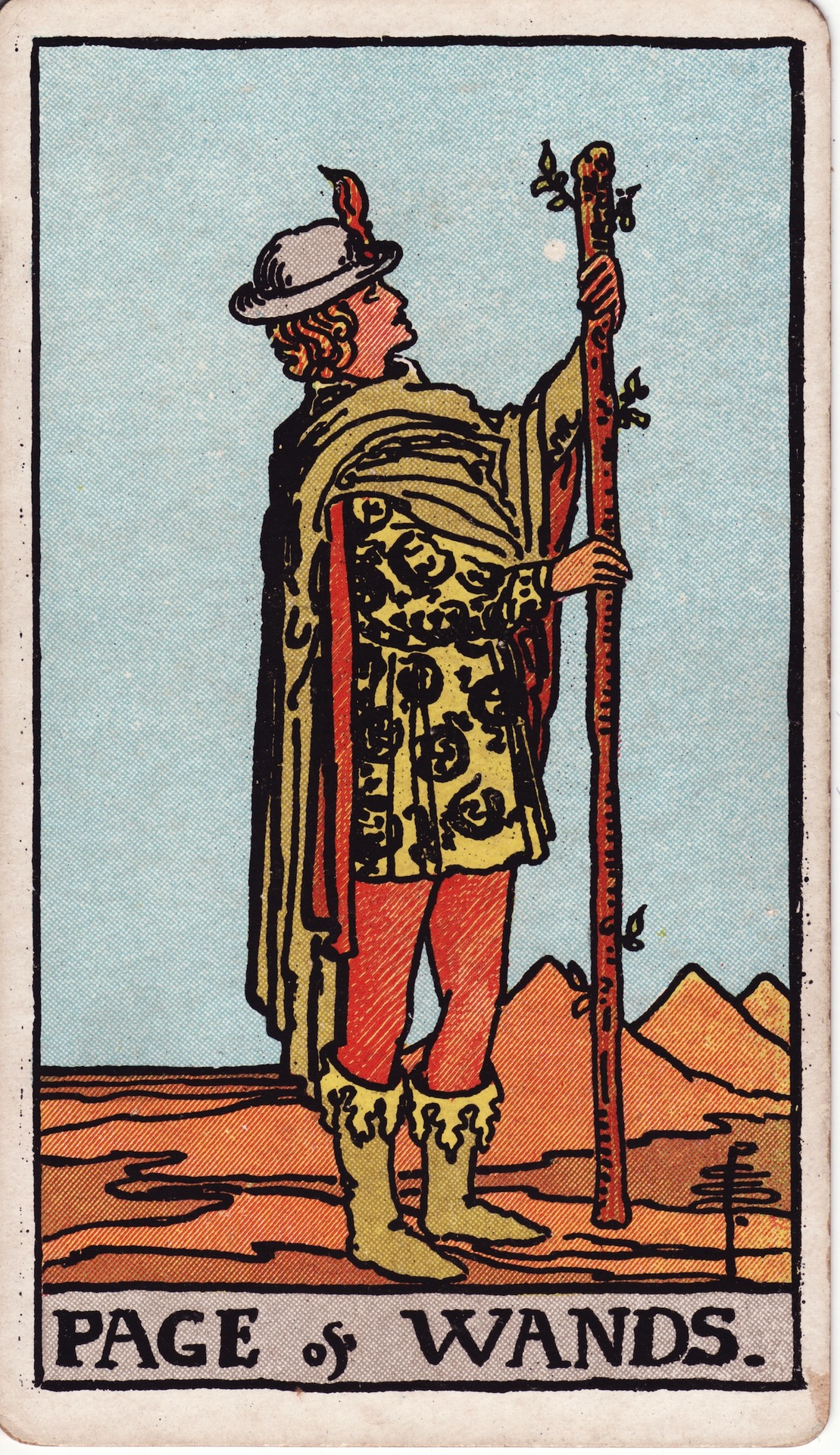
Page of Wands — original Rider–Waite–Smith artwork by Pamela Colman Smith

P · † / Wands

Page of Wands

Curiosity · discovery · enthusiasm

UPRIGHT
An adventurous message or fresh interest invites exploration. Begin as a learner and give enthusiasm room to develop.
REVERSED
Restlessness, immature plans or inconsistent effort can dissipate inspiration. Experiment without promising more than you can sustain.
SYMBOLISM
A young figure examines a sprouting staff in a desert. Salamanders on the clothing associate the suit with fire; the open landscape emphasizes undiscovered possibility.
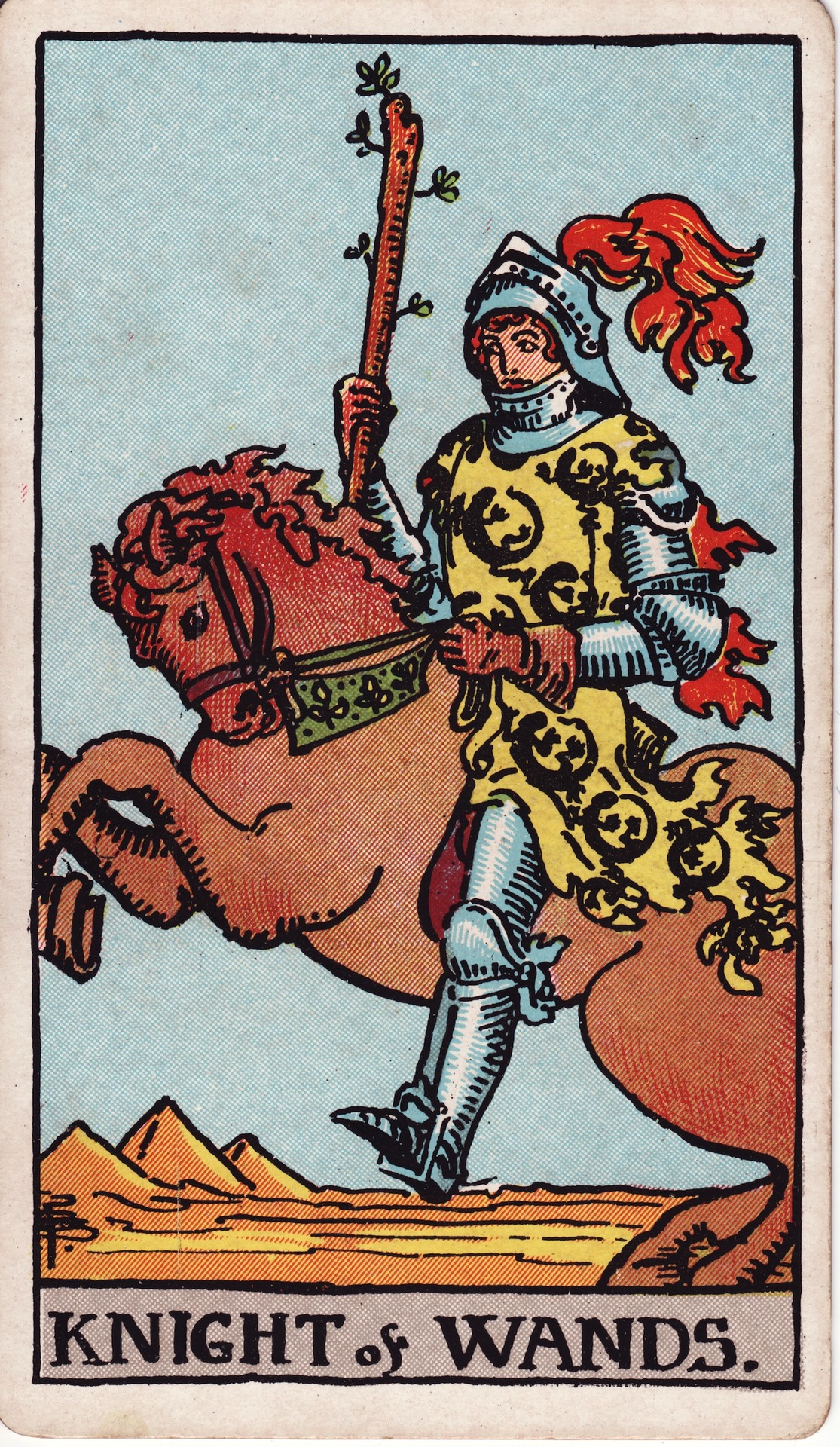
Knight of Wands — original Rider–Waite–Smith artwork by Pamela Colman Smith

Kn · † / Wands

Knight of Wands

Adventure · drive · boldness

UPRIGHT
Energetic action and a willingness to explore bring movement. Channel passion into a direction that can withstand the initial rush.
REVERSED
Impulsiveness, frustration or unreliable follow-through may create disruption. Slow down enough to consider consequences.
SYMBOLISM
A rearing horse and windblown plumes convey haste. The rider's salamander-patterned tunic and desert setting reinforce fiery energy and a restless quest.
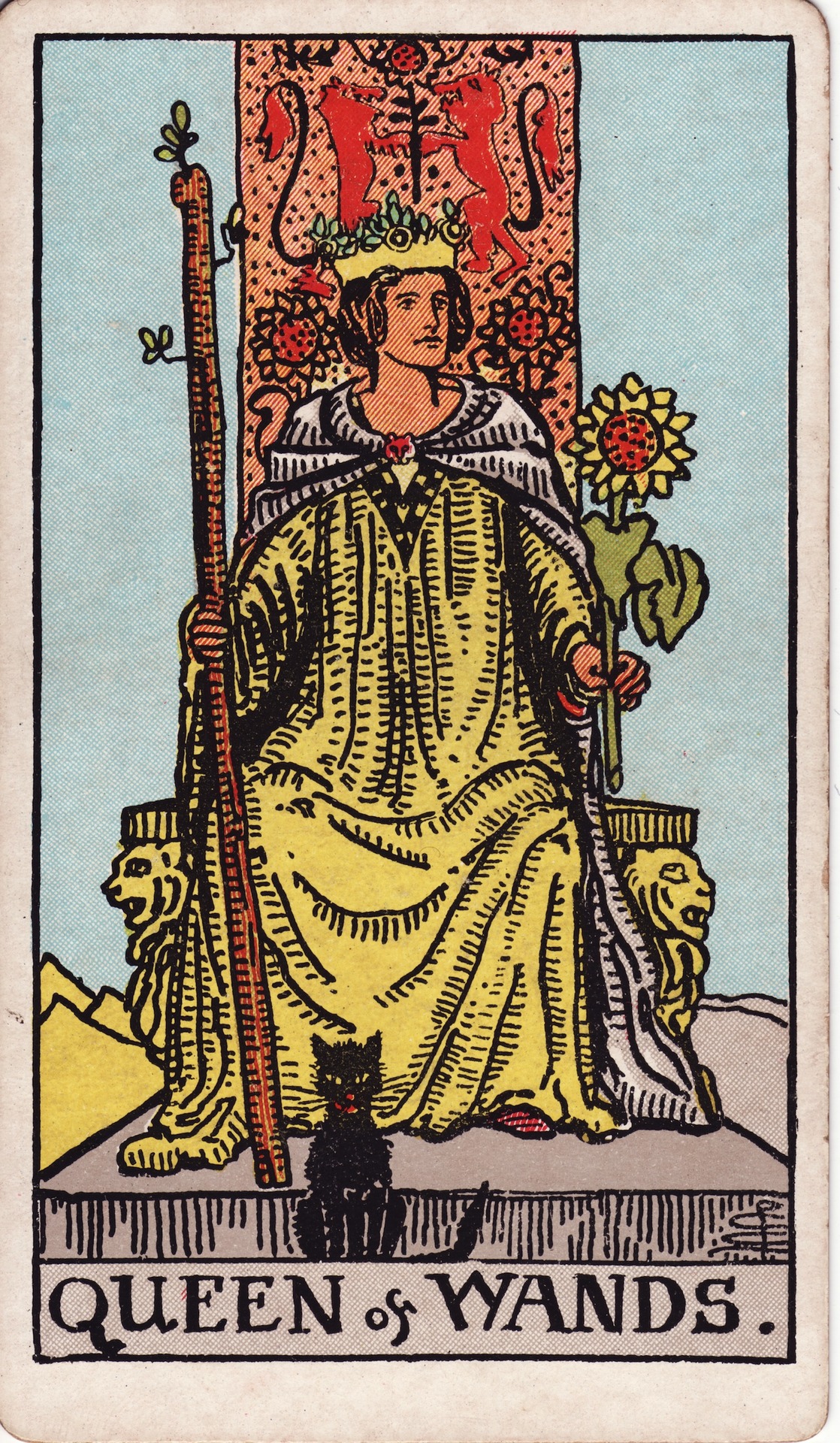
Queen of Wands — original Rider–Waite–Smith artwork by Pamela Colman Smith

Q · † / Wands

Queen of Wands

Confidence · warmth · independence

UPRIGHT
Self-assurance, generosity and creative vitality help you lead naturally. Make room for both independence and connection.
REVERSED
Insecurity, jealousy or demanding attention can distort confidence. Return to self-trust rather than controlling how others respond.
SYMBOLISM
The queen holds a sunflower and wand on a lion-decorated throne. A black cat at her feet adds an element of instinct and mystery to the bright, outward energy.
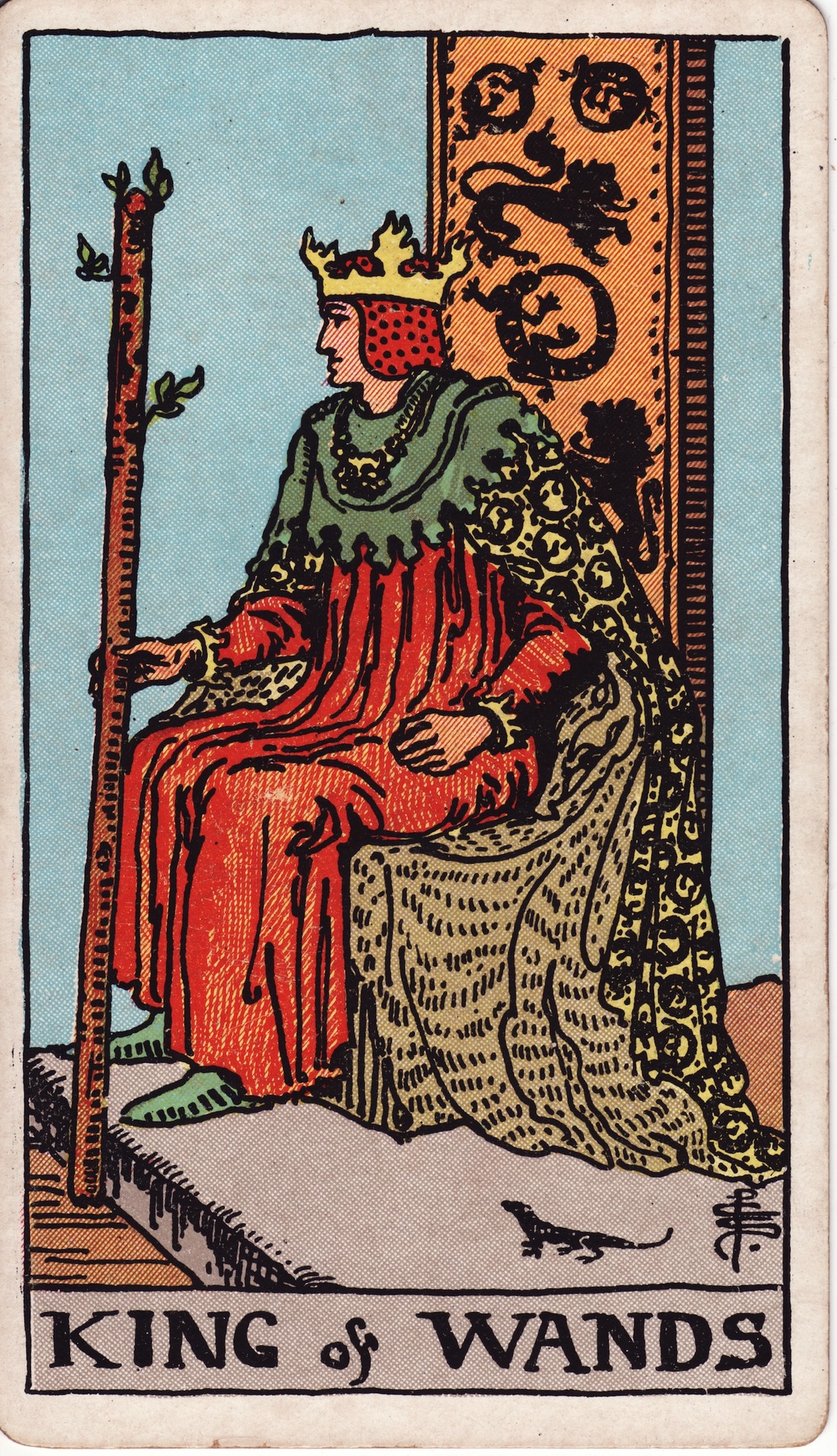
King of Wands — original Rider–Waite–Smith artwork by Pamela Colman Smith

K · † / Wands

King of Wands

Vision · leadership · enterprise

UPRIGHT
Lead with a clear vision, courage and the ability to inspire others. Creative authority requires responsibility as well as ambition.
REVERSED
Domineering behavior, impulsive leadership or unrealistic expectations can alienate support. Match your vision with consistent conduct.
SYMBOLISM
Lions and salamanders decorate the throne and robe. The sprouting wand represents active creative power; the upright posture suggests readiness to turn vision into action.

Cups

14

Water — feeling, relationships, imagination and the inner life.

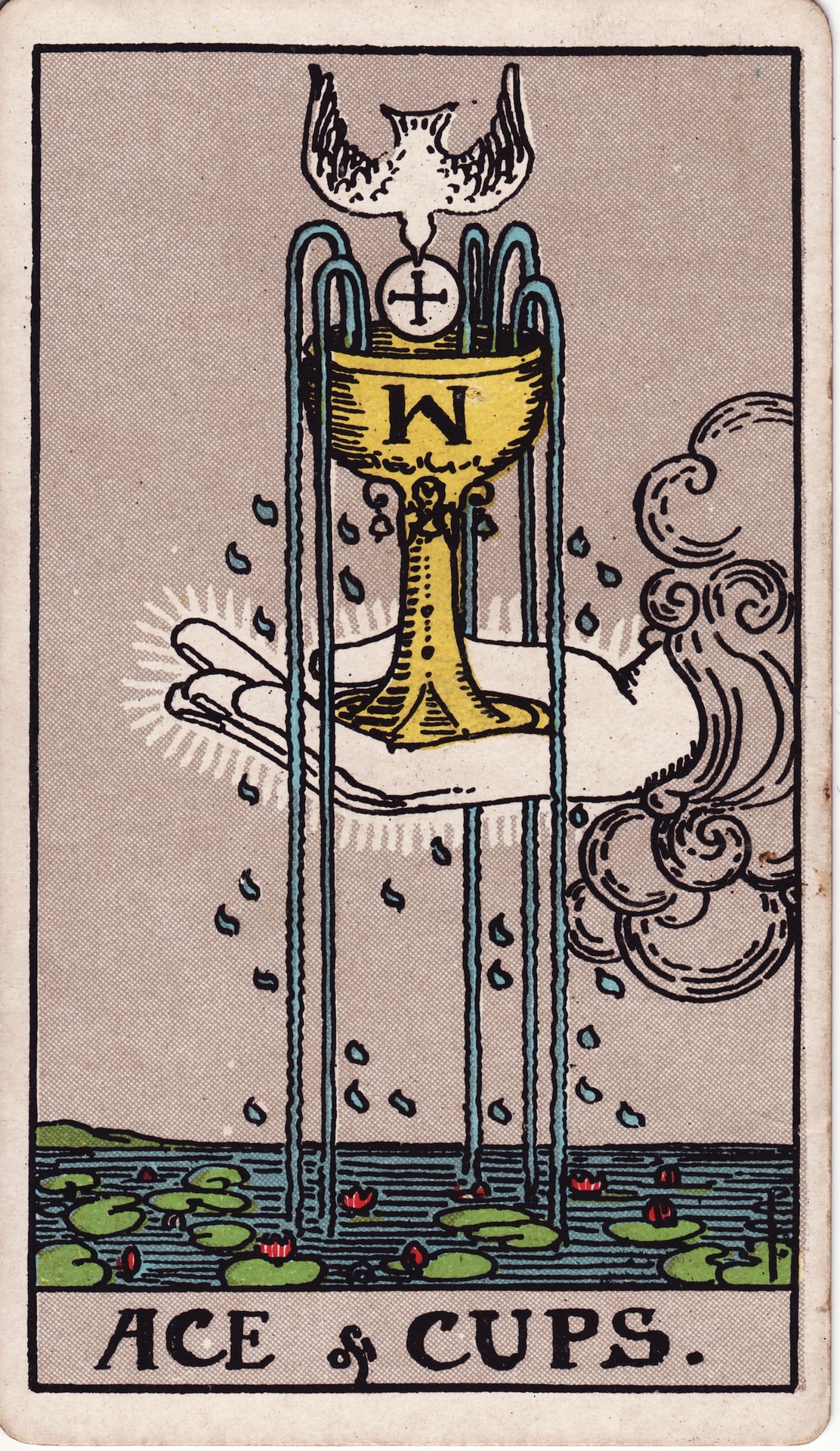
Ace of Cups — original Rider–Waite–Smith artwork by Pamela Colman Smith

A · ♆ / Cups

Ace of Cups

Love · receptivity · new feeling

UPRIGHT
Emotional openness, compassion or a new relationship can begin. Allow feeling to flow without demanding a predetermined outcome.
REVERSED
Blocked feelings, emotional depletion or an inward turning of affection may need care. Replenish yourself before giving more.
SYMBOLISM
An overflowing cup rests in a hand above water and lilies. Five streams convey abundance; the dove descending toward the cup adds a spiritual dimension to emotional renewal.
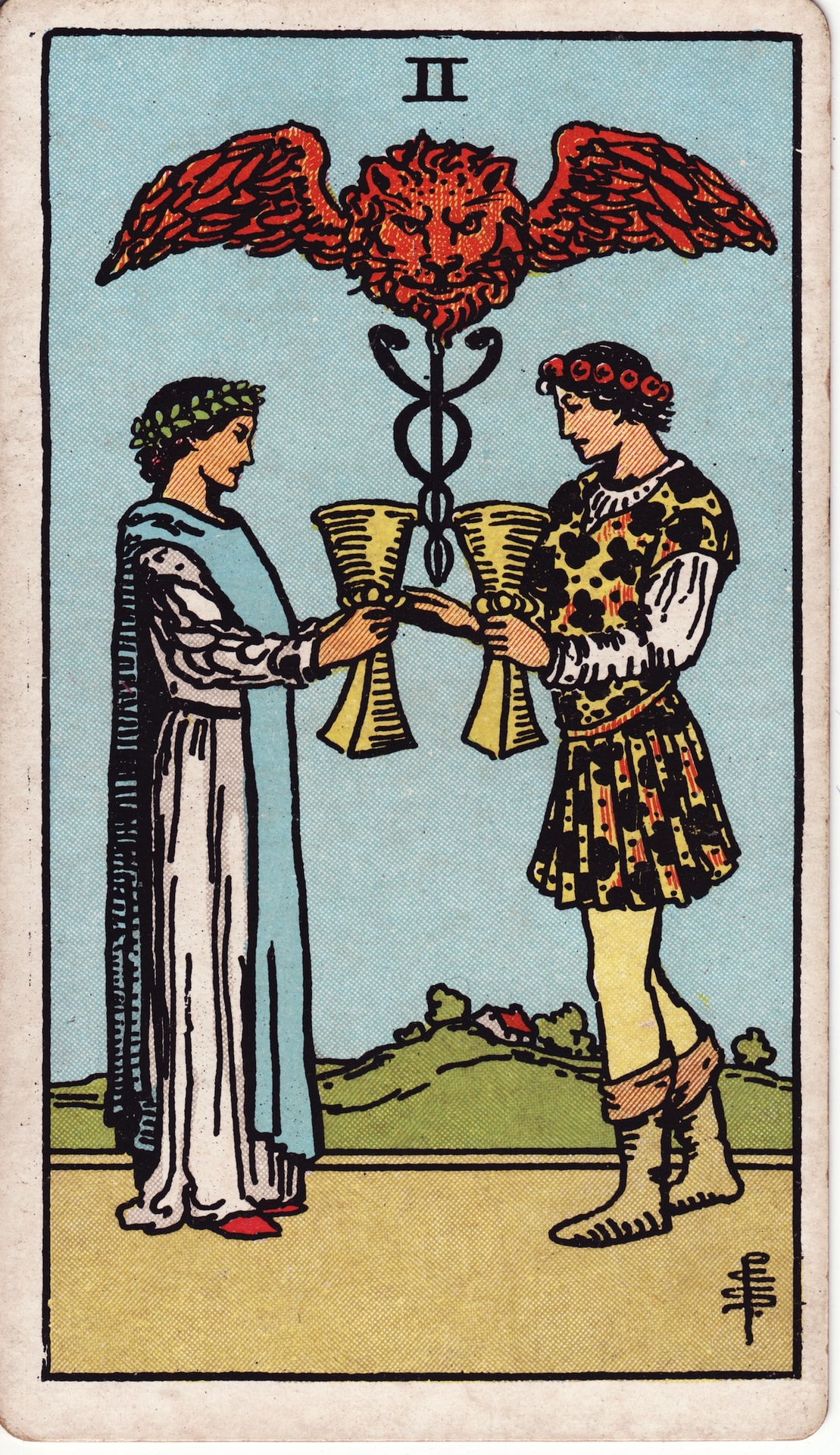
Two of Cups — original Rider–Waite–Smith artwork by Pamela Colman Smith

II · ♆ / Cups

Two of Cups

Partnership · reciprocity · connection

UPRIGHT
Mutual affection, respect or agreement supports a meaningful bond. Meet another person as an equal, with honest exchange.
REVERSED
Imbalance, misunderstanding or a broken agreement can strain connection. Restore reciprocity rather than relying on attraction alone.
SYMBOLISM
Two figures exchange cups beneath a caduceus and winged lion's head. The balanced stance emphasizes mutual recognition and the joining of different energies.
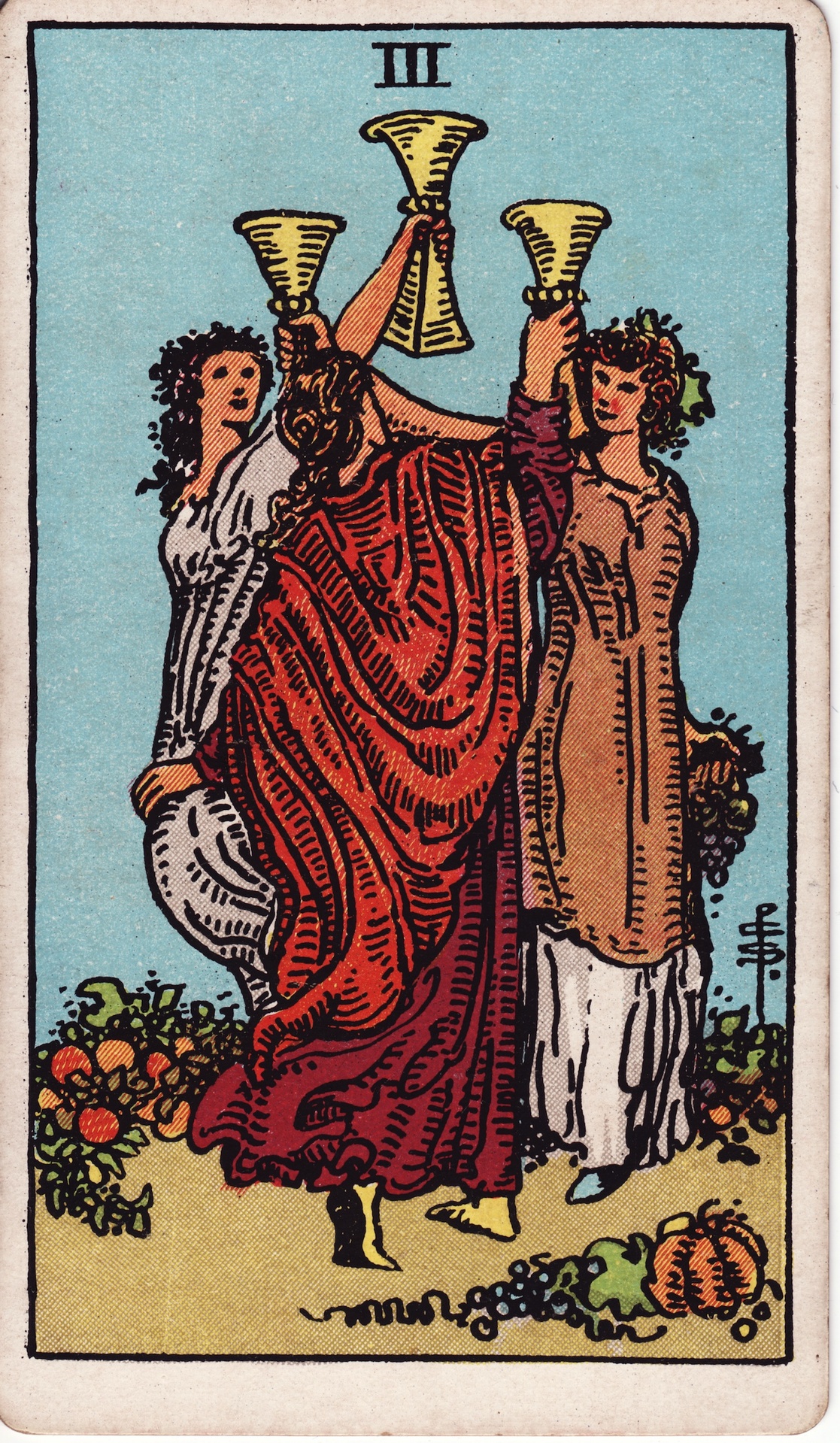
Three of Cups — original Rider–Waite–Smith artwork by Pamela Colman Smith

III · ♆ / Cups

Three of Cups

Friendship · celebration · community

UPRIGHT
Friendship and shared celebration provide emotional nourishment. Recognize the people whose presence makes joy and recovery possible.
REVERSED
Exclusion, gossip or overindulgence can unsettle a group. Consider whether your social circle supports genuine connection.
SYMBOLISM
Three figures raise their cups in a circle amid fruit and flowers. The harvest imagery and shared gesture suggest abundance enjoyed together.
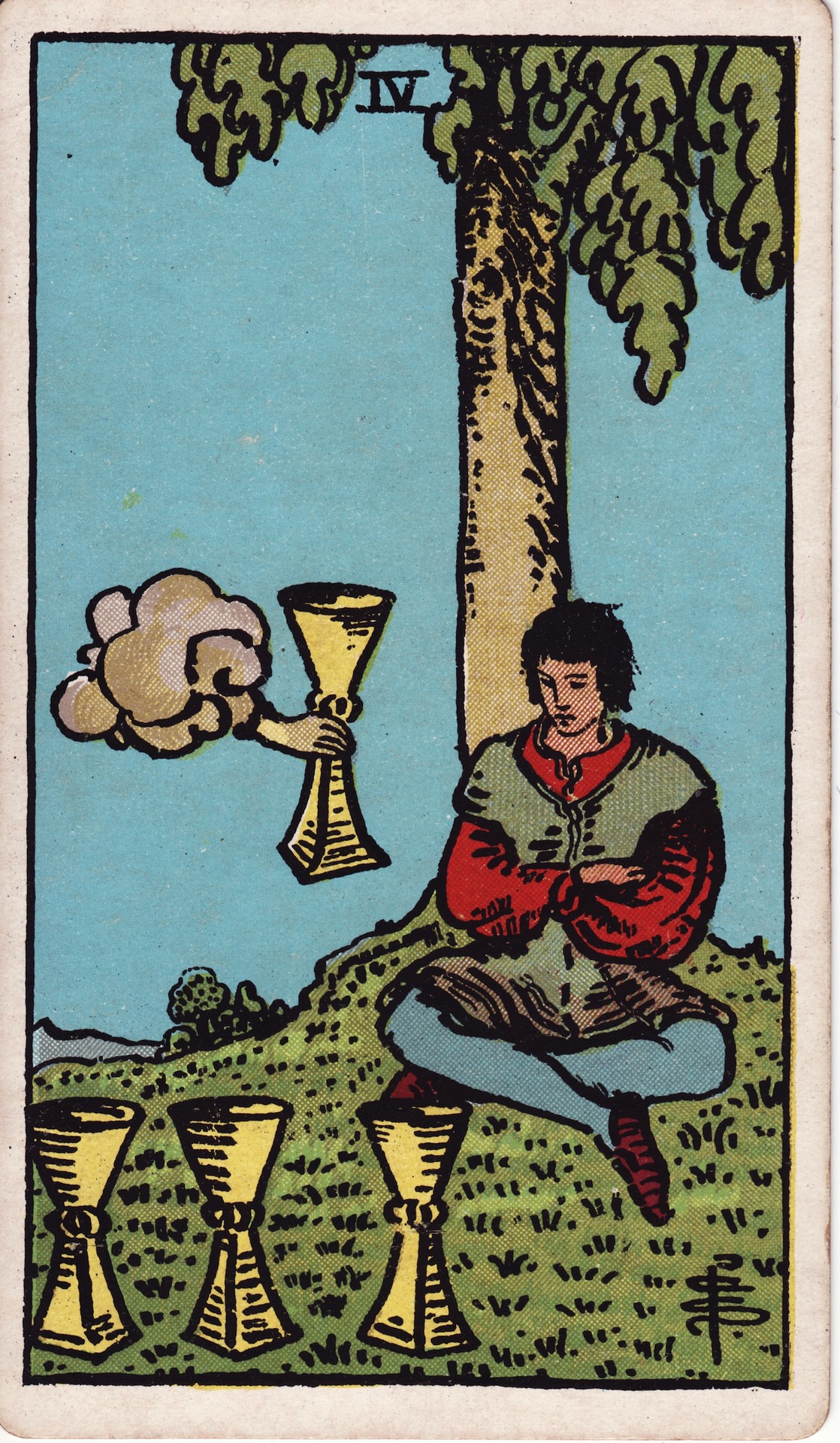
Four of Cups — original Rider–Waite–Smith artwork by Pamela Colman Smith

IV · ♆ / Cups

Four of Cups

Apathy · contemplation · reevaluation

UPRIGHT
Withdrawal or dissatisfaction invites a closer look at what you need. An available offer may be overlooked while attention stays on disappointment.
REVERSED
Renewed interest or prolonged disengagement may emerge from a period of retreat. Choose which opportunities deserve another look.
SYMBOLISM
A seated figure looks toward three cups while a cloud-hand offers a fourth. Crossed limbs and the sheltering tree suggest inward attention and a possibility not yet received.
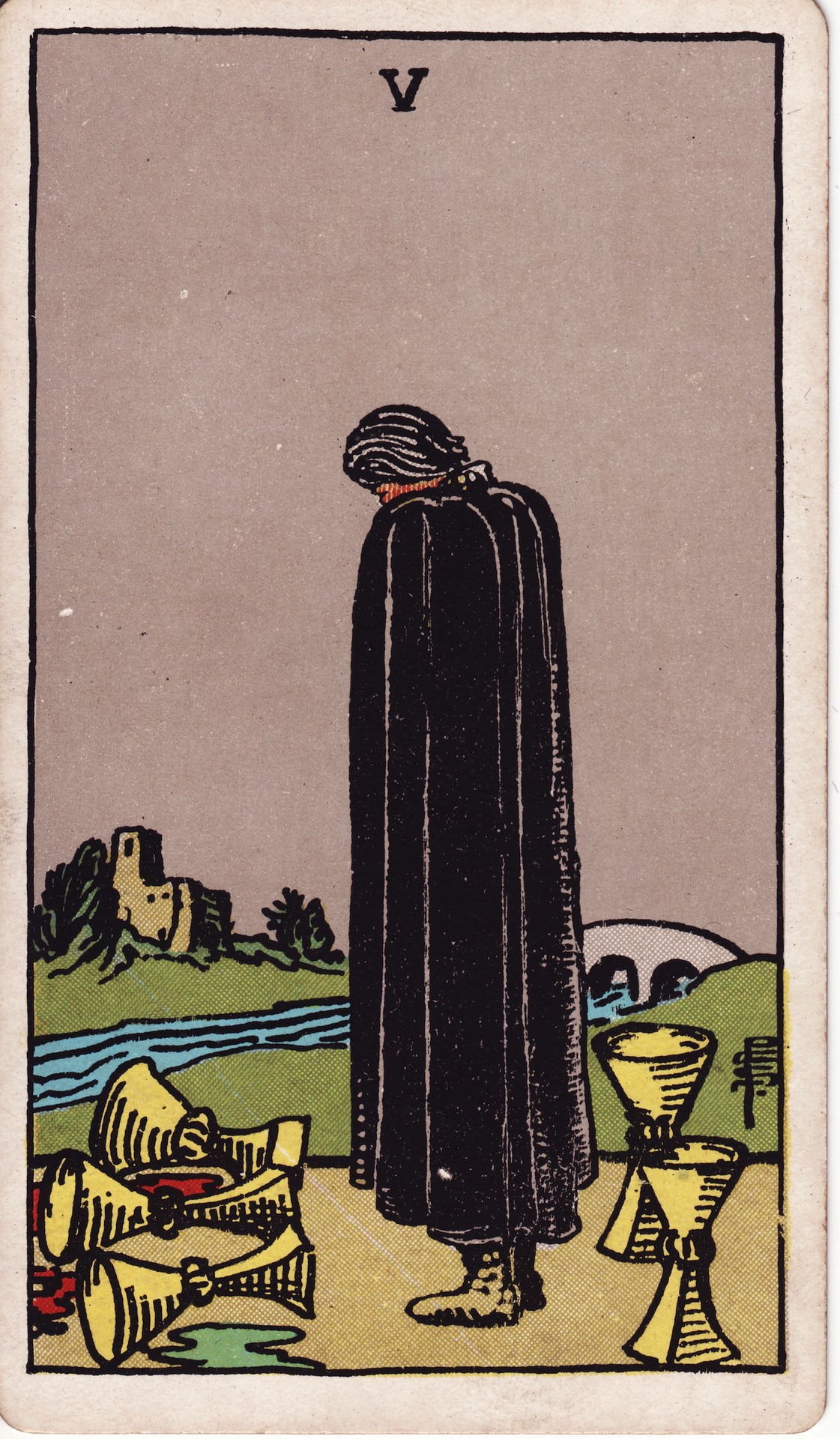
Five of Cups — original Rider–Waite–Smith artwork by Pamela Colman Smith

V · ♆ / Cups

Five of Cups

Loss · grief · disappointment

UPRIGHT
Acknowledge loss without letting it erase what remains. Grief and gratitude can coexist; recovery begins with seeing the whole scene.
REVERSED
Acceptance, reconciliation or difficulty releasing regret may become central. Turn toward remaining support at a manageable pace.
SYMBOLISM
A cloaked figure faces three spilled cups while two stand behind. A bridge leads across the river toward shelter, suggesting a route beyond the immediate loss.
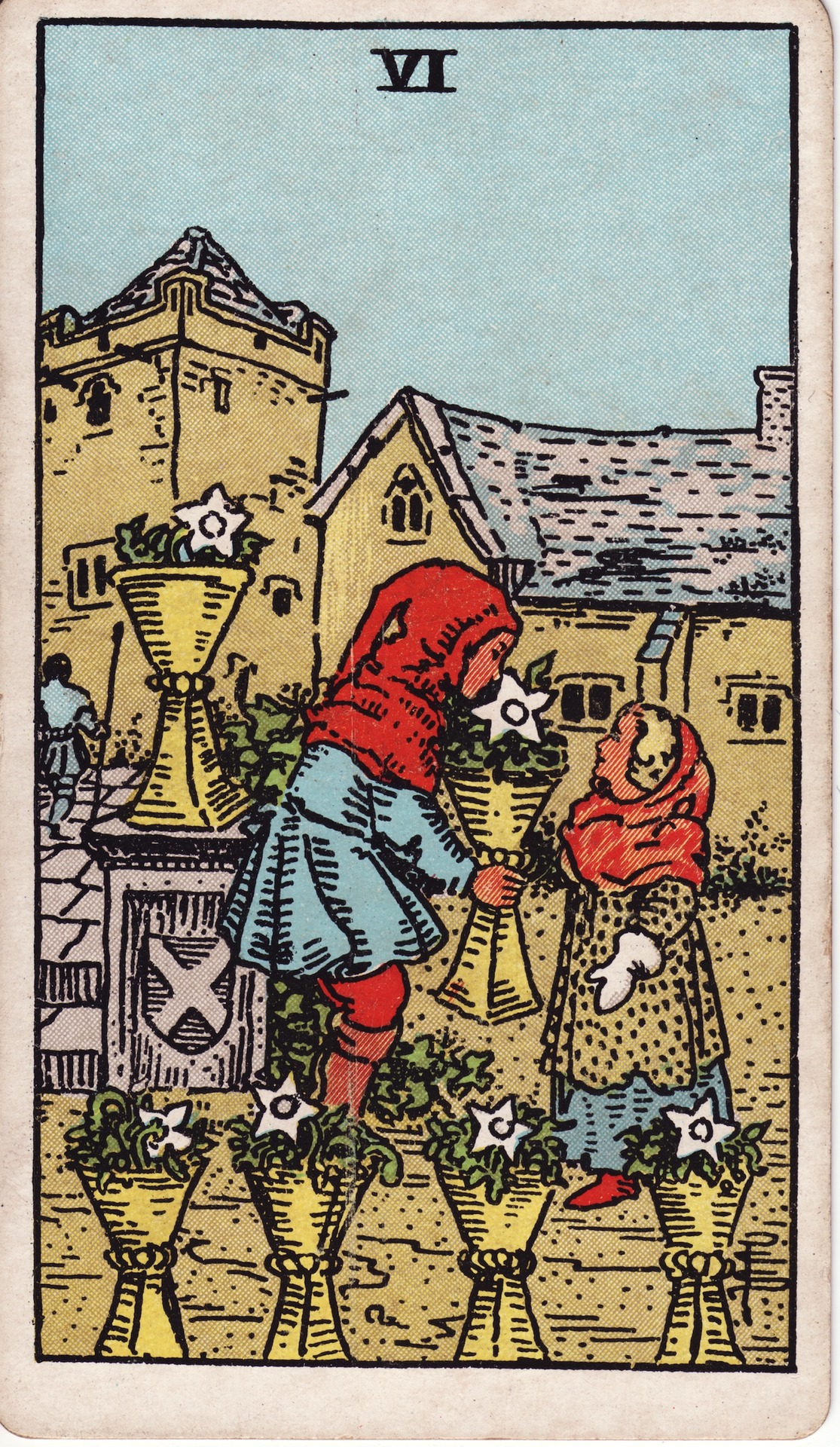
Six of Cups — original Rider–Waite–Smith artwork by Pamela Colman Smith

VI · ♆ / Cups

Six of Cups

Memory · kindness · innocence

UPRIGHT
Past connections, generosity or familiar comforts may nourish the present. Receive the sweetness of memory without needing to recreate it exactly.
REVERSED
Idealizing the past or difficulty leaving old roles can inhibit growth. Keep what is nurturing while allowing the present to differ.
SYMBOLISM
A child offers another a flower-filled cup in a sheltered courtyard. White flowers and the protective setting evoke innocence, simple gifts and recollection.
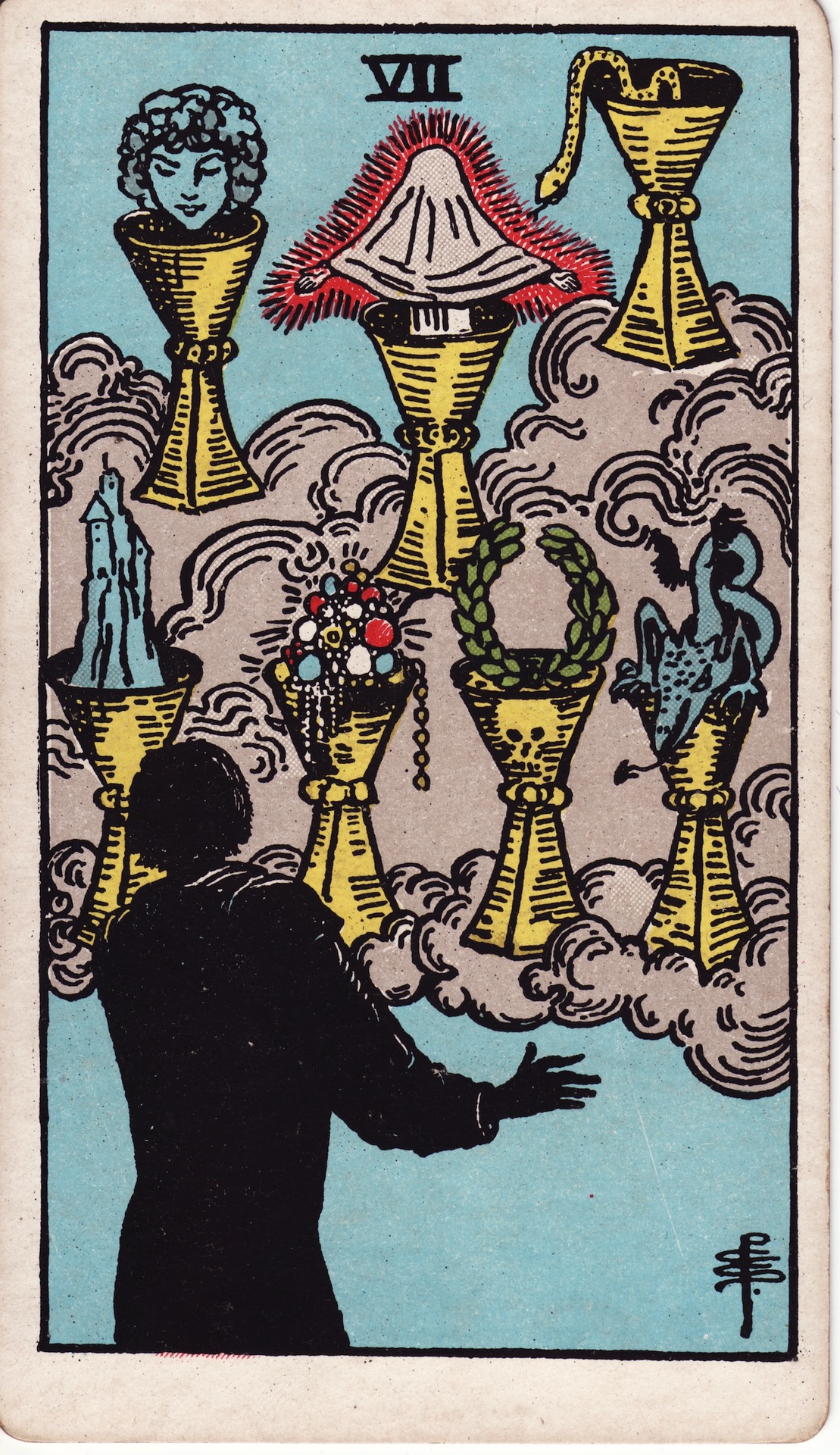
Seven of Cups — original Rider–Waite–Smith artwork by Pamela Colman Smith

VII · ♆ / Cups

Seven of Cups

Options · fantasy · discernment

UPRIGHT
Many possibilities can inspire but also confuse. Separate appealing images from choices with substance before committing.
REVERSED
Greater clarity or continued escapism can follow an abundance of options. Bring one possibility into contact with reality.
SYMBOLISM
Seven cups float on clouds, containing jewels, a laurel wreath, a castle and other visions. Their mixture of rewards and dangers suggests the ambiguity of desire.
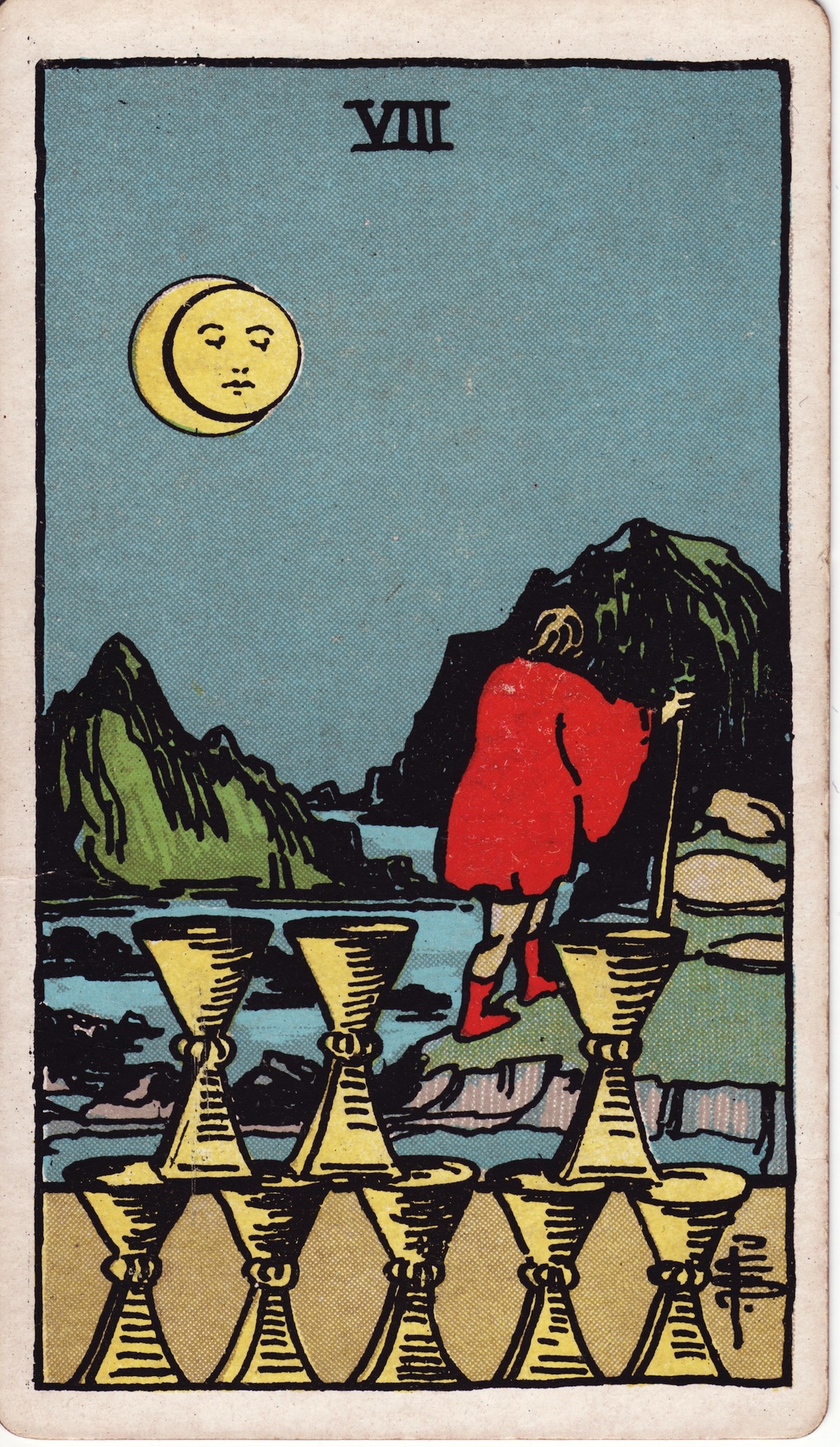
Eight of Cups — original Rider–Waite–Smith artwork by Pamela Colman Smith

VIII · ♆ / Cups

Eight of Cups

Departure · searching · letting go

UPRIGHT
Something once fulfilling may no longer be enough. A thoughtful departure makes space for a deeper search, even when much remains intact.
REVERSED
Fear of leaving, aimless withdrawal or reconsidering a departure may arise. Distinguish a purposeful search from escape.
SYMBOLISM
A cloaked traveler leaves eight cups to climb a rocky path. The moon overhead and uneven terrain suggest an inward journey away from established emotional security.
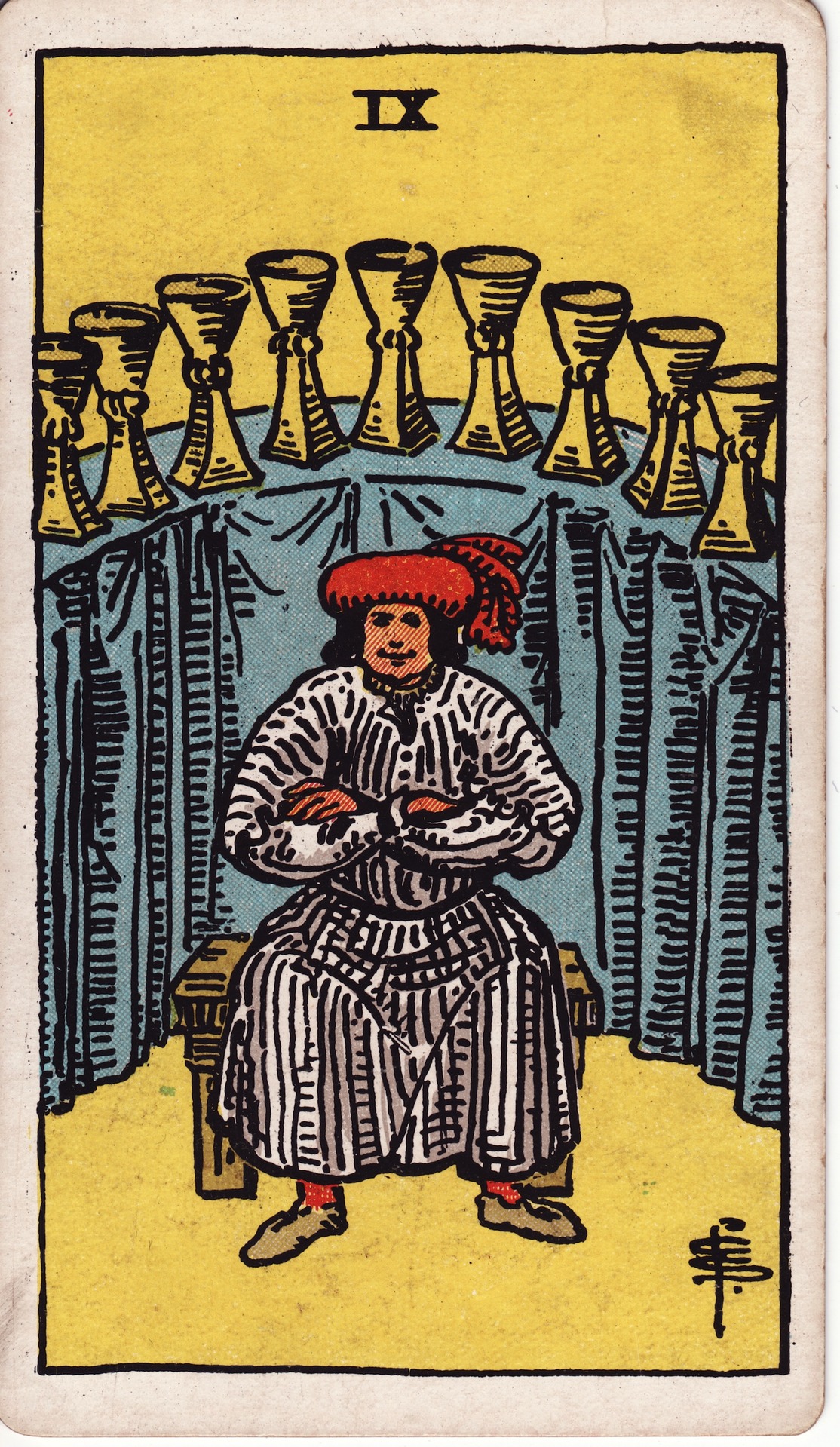
Nine of Cups — original Rider–Waite–Smith artwork by Pamela Colman Smith

IX · ♆ / Cups

Nine of Cups

Contentment · satisfaction · pleasure

UPRIGHT
Enjoy satisfaction and acknowledge a wish or effort coming to fruition. Gratitude deepens pleasure more than accumulating another desire.
REVERSED
Overindulgence, superficial satisfaction or disappointment after getting what you wanted may arise. Examine the need beneath the wish.
SYMBOLISM
A seated figure sits before an arched arrangement of nine cups. The confident posture and abundant display signify comfort, enjoyment and an attained desire.
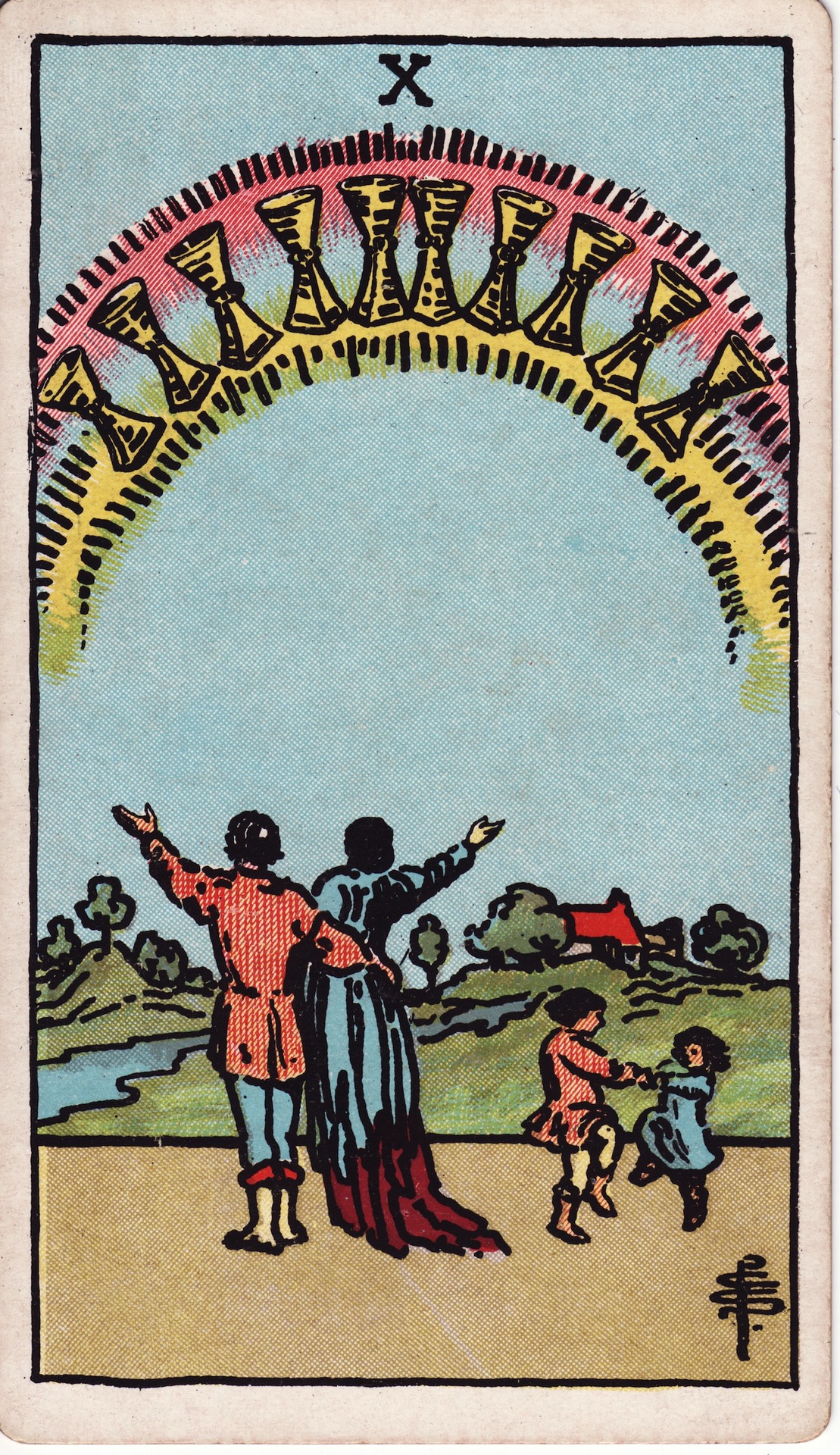
Ten of Cups — original Rider–Waite–Smith artwork by Pamela Colman Smith

X · ♆ / Cups

Ten of Cups

Harmony · family · shared happiness

UPRIGHT
Emotional fulfillment grows through belonging and shared values. Tend the relationships that make happiness sustainable.
REVERSED
Strained family expectations or a gap between an ideal and lived reality may disrupt harmony. Seek honest connection rather than a perfect picture.
SYMBOLISM
A rainbow of ten cups arches over a couple, children and a distant home. The open landscape joins emotional harmony with community and everyday life.
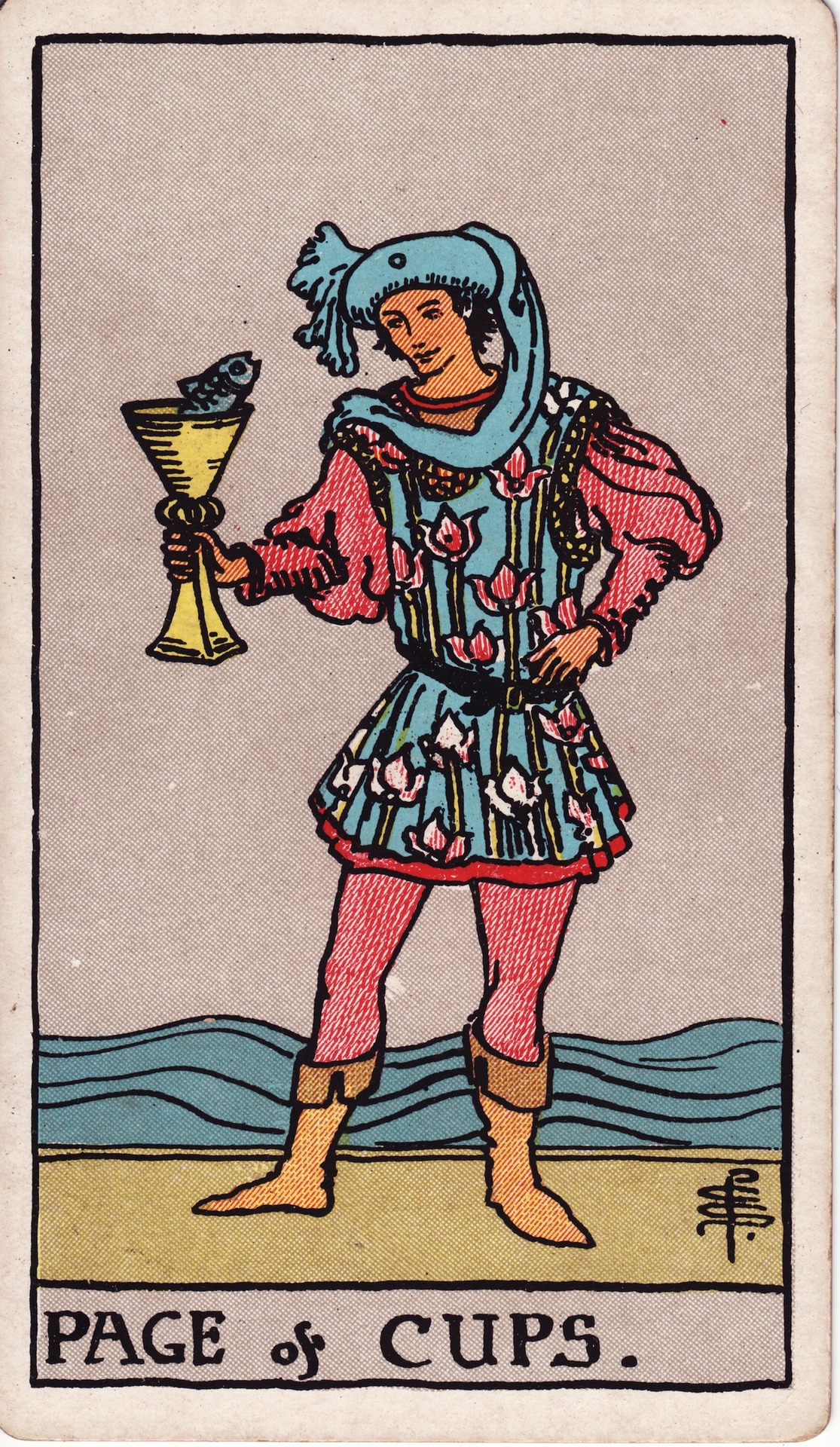
Page of Cups — original Rider–Waite–Smith artwork by Pamela Colman Smith

P · ♆ / Cups

Page of Cups

Sensitivity · imagination · surprise

UPRIGHT
A tender message, imaginative idea or new emotional awareness invites curiosity. Approach feeling with openness rather than embarrassment.
REVERSED
Emotional immaturity, creative inhibition or unrealistic expectations may need gentle attention. Let feelings be expressed without making them the whole truth.
SYMBOLISM
A fish unexpectedly emerges from the page's cup. The water and floral clothing emphasize sensitivity, imagination and something surprising from the inner world.
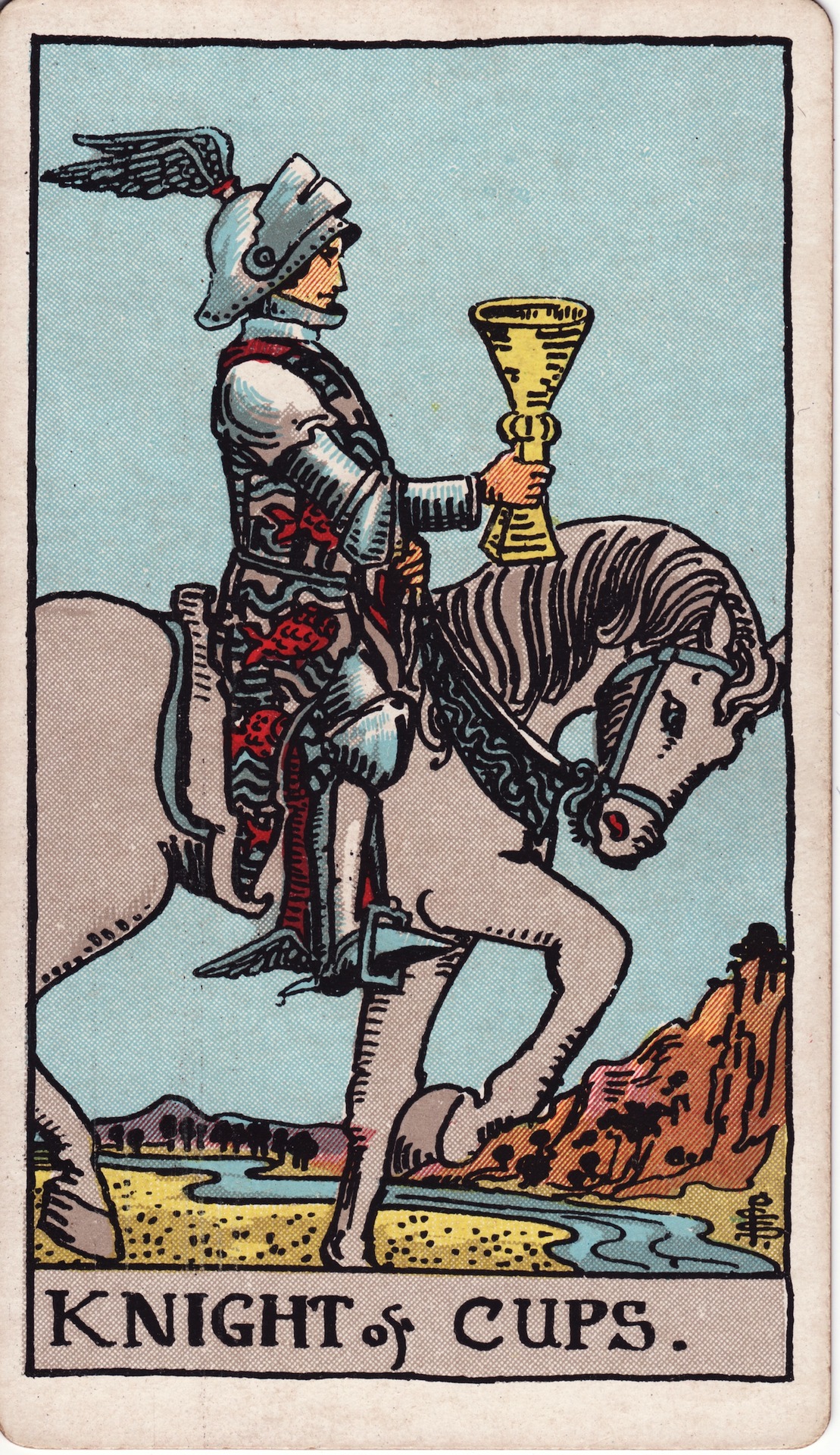
Knight of Cups — original Rider–Waite–Smith artwork by Pamela Colman Smith

Kn · ♆ / Cups

Knight of Cups

Romance · invitation · idealism

UPRIGHT
An invitation or heartfelt pursuit brings emotional movement. Let imagination enrich the journey while keeping intentions sincere.
REVERSED
Moodiness, unrealistic romance or promises without substance may disappoint. Compare the beautiful offer with the behavior behind it.
SYMBOLISM
The knight presents a cup while riding a calmly moving horse. Winged details on the helmet and boots suggest imagination; the stream links the journey with feeling.
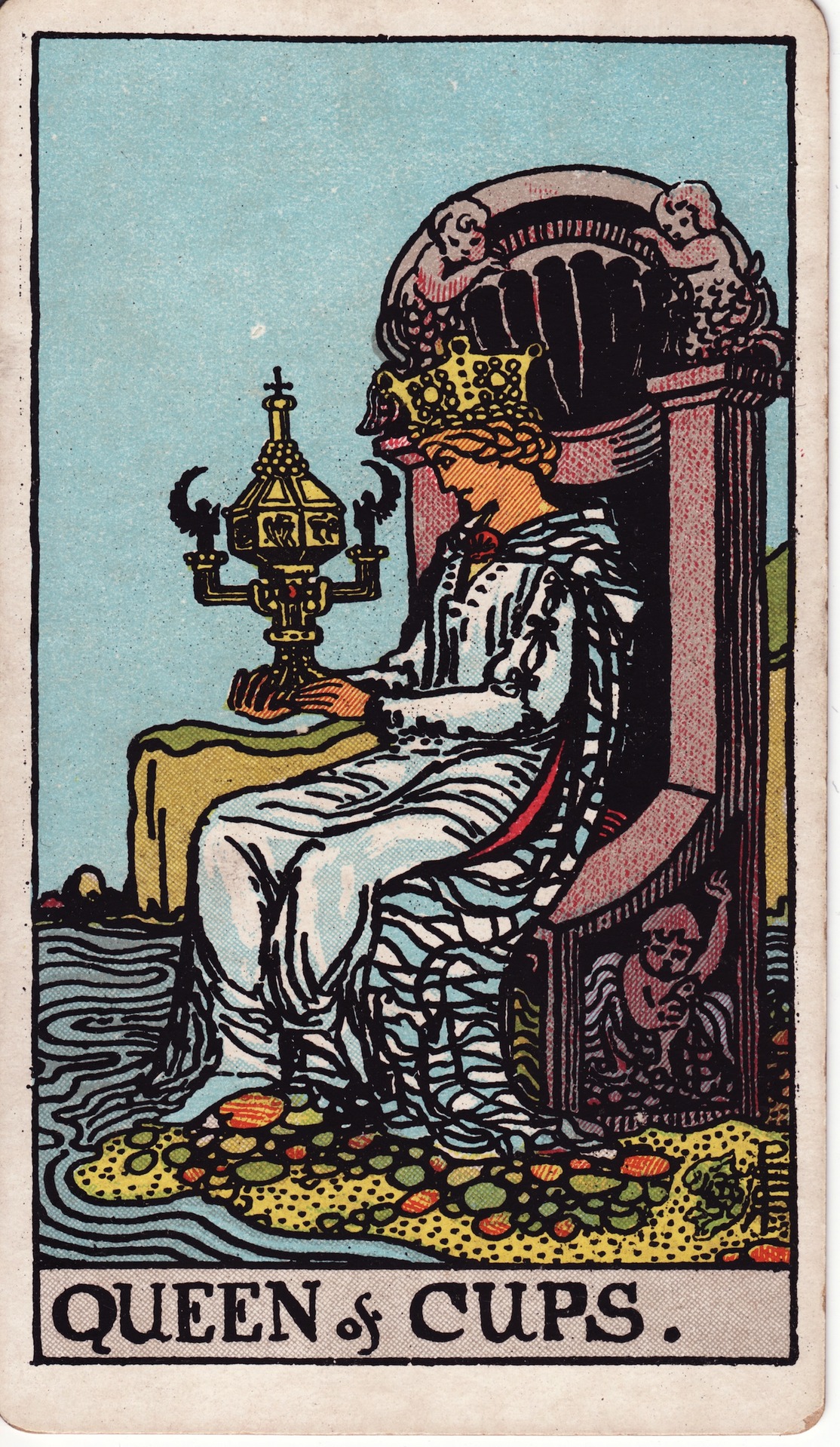
Queen of Cups — original Rider–Waite–Smith artwork by Pamela Colman Smith

Q · ♆ / Cups

Queen of Cups

Empathy · intuition · compassion

UPRIGHT
Emotional insight and compassionate attention support wise care. Listen deeply while maintaining boundaries that preserve your own wellbeing.
REVERSED
Overabsorption in others' feelings, dependence or neglected self-care may blur boundaries. Compassion needs a stable container.
SYMBOLISM
The queen contemplates an ornate, closed cup beside the sea. Water, shells and the decorated throne emphasize receptivity and the depth of inner experience.
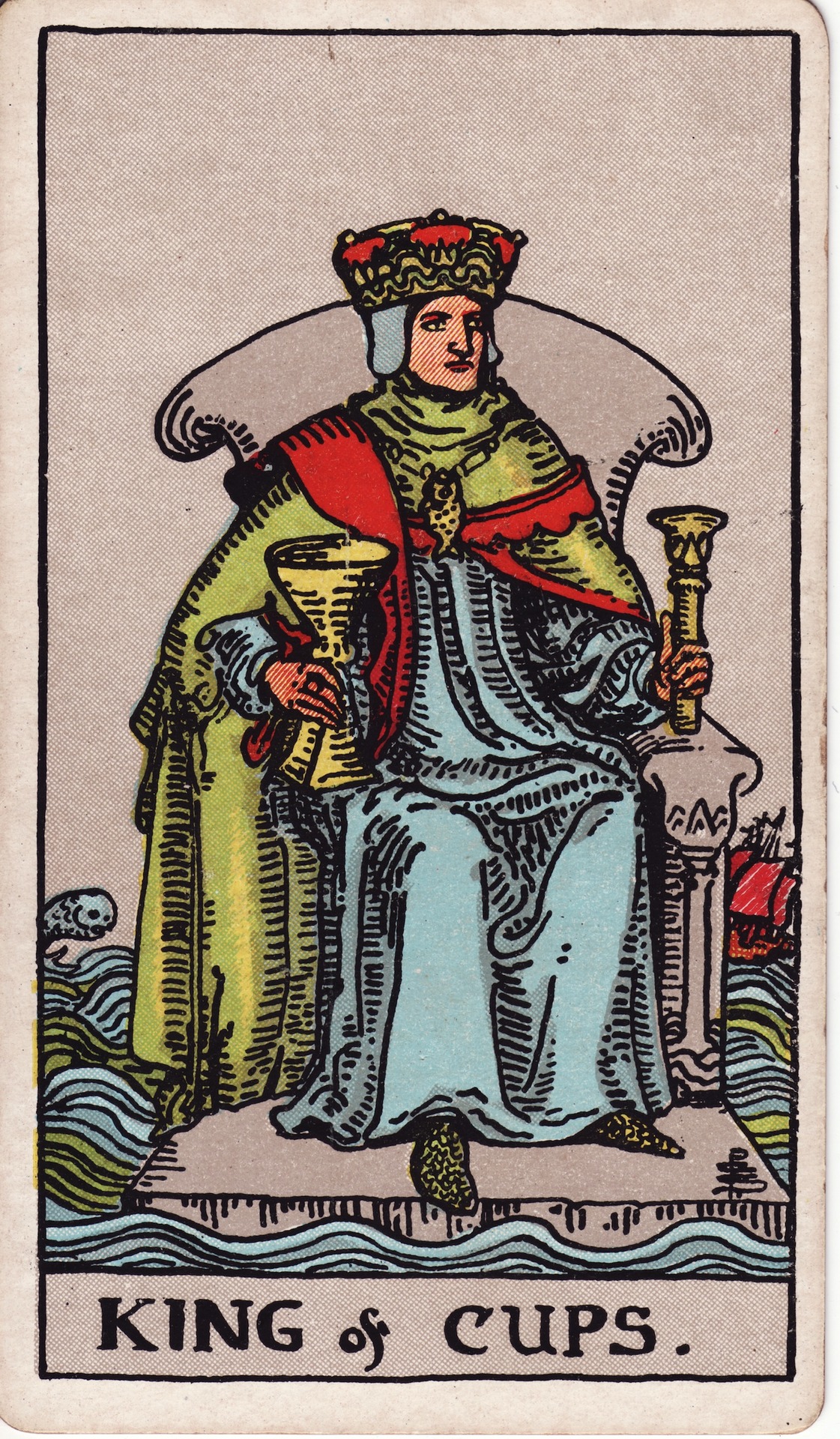
King of Cups — original Rider–Waite–Smith artwork by Pamela Colman Smith

K · ♆ / Cups

King of Cups

Emotional balance · wisdom · diplomacy

UPRIGHT
Steady feeling and measured judgment allow calm leadership. Recognize emotions without letting them dictate every response.
REVERSED
Emotional suppression, manipulation or unstable moods may distort influence. Seek honesty alongside composure.
SYMBOLISM
A king sits on a throne surrounded by choppy water, holding a cup and scepter. A ship and leaping fish move nearby, while he remains steady amid emotional currents.

Swords

14

Air — thought, communication, conflict and discernment.

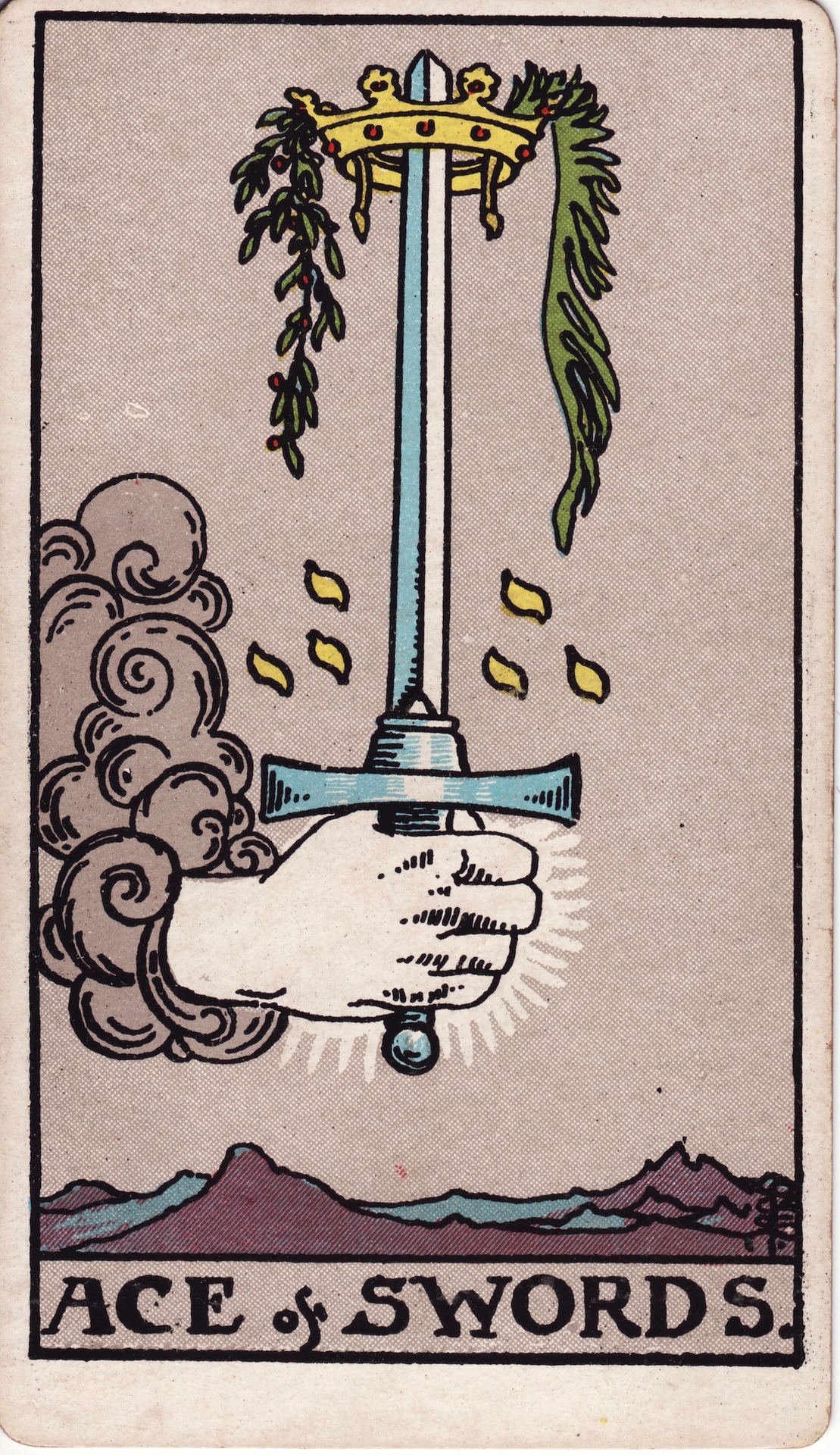
Ace of Swords — original Rider–Waite–Smith artwork by Pamela Colman Smith

A · ⚔ / Swords

Ace of Swords

Clarity · truth · breakthrough

UPRIGHT
A clear idea or truthful decision cuts through confusion. Use discernment responsibly; insight becomes useful when translated into action.
REVERSED
Confusion, harsh judgment or an untested idea may obscure the truth. Clarify the facts before making a decisive statement.
SYMBOLISM
A hand raises a sword crowned with a wreath and crown. The double-edged blade suggests the power and responsibility of thought; distant mountains evoke demanding clarity.
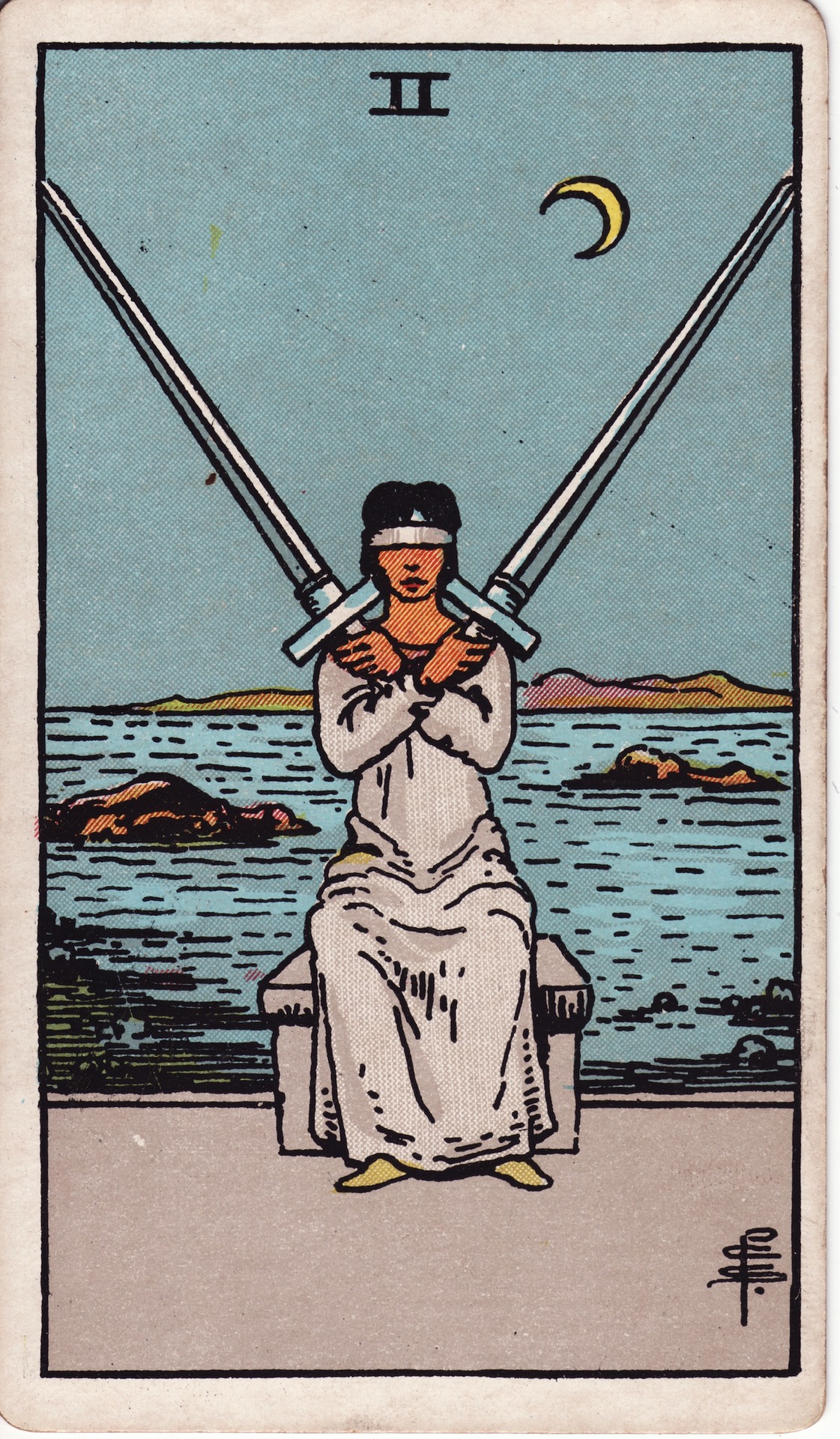
Two of Swords — original Rider–Waite–Smith artwork by Pamela Colman Smith

II · ⚔ / Swords

Two of Swords

Stalemate · indecision · guardedness

UPRIGHT
Competing views or a difficult choice have reached an impasse. Temporary stillness helps only if it leads to a more informed decision.
REVERSED
Avoidance, information overload or a decision forced by pressure may break the stalemate. Look directly at what you have been excluding.
SYMBOLISM
A blindfolded figure holds two crossed swords before water and rocks. The blocked view and balanced blades symbolize suspended judgment and defended emotion.
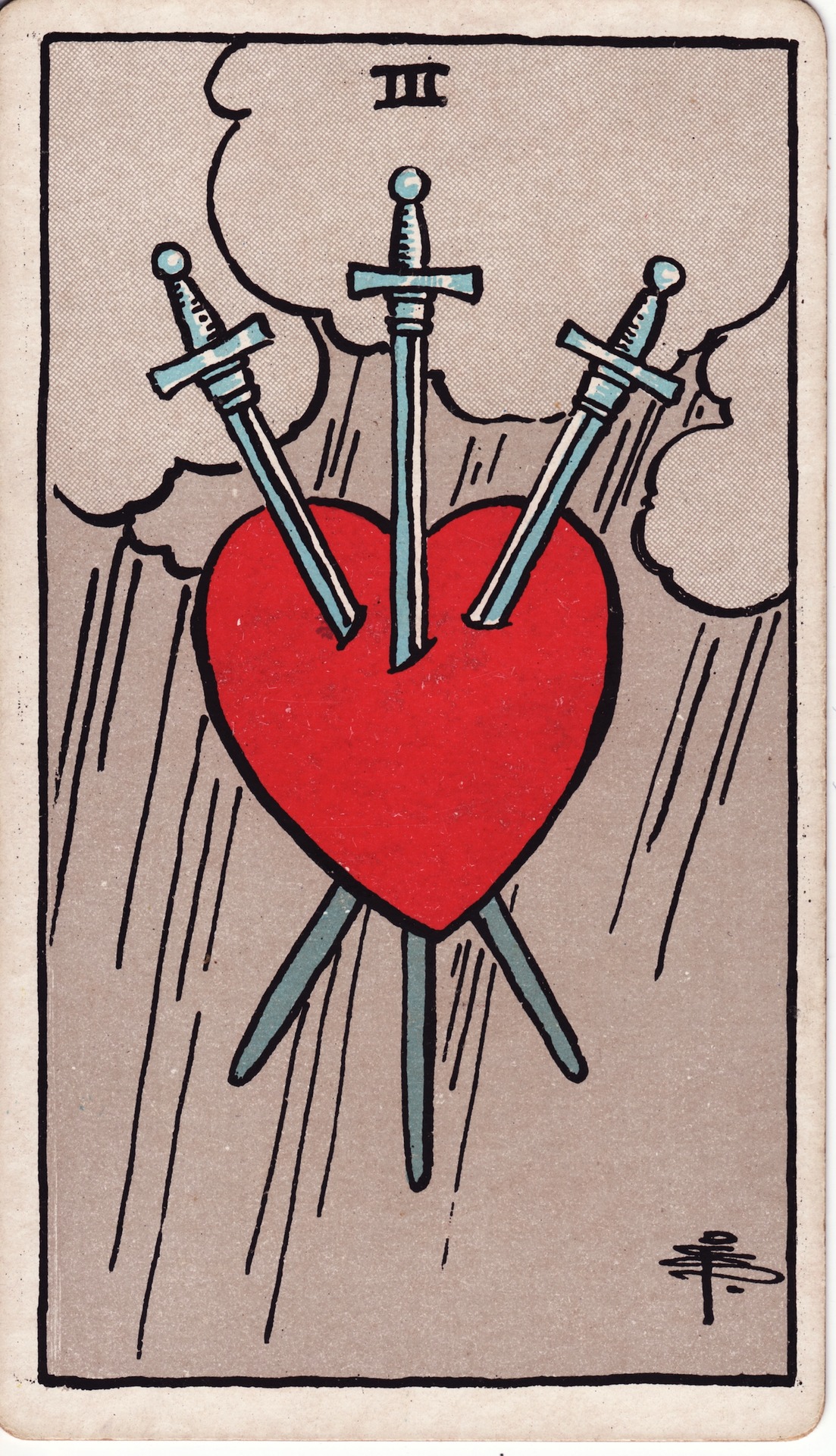
Three of Swords — original Rider–Waite–Smith artwork by Pamela Colman Smith

III · ⚔ / Swords

Three of Swords

Heartbreak · sorrow · painful truth

UPRIGHT
Loss, separation or a difficult truth asks to be acknowledged. Naming pain can begin healing without reducing you to the hurt.
REVERSED
Recovery, forgiveness or lingering resentment may become the focus. Make room for grief without continually reopening it.
SYMBOLISM
Three swords pierce a heart against rain and clouds. The direct image joins mental clarity with emotional pain and the atmosphere of sorrow.
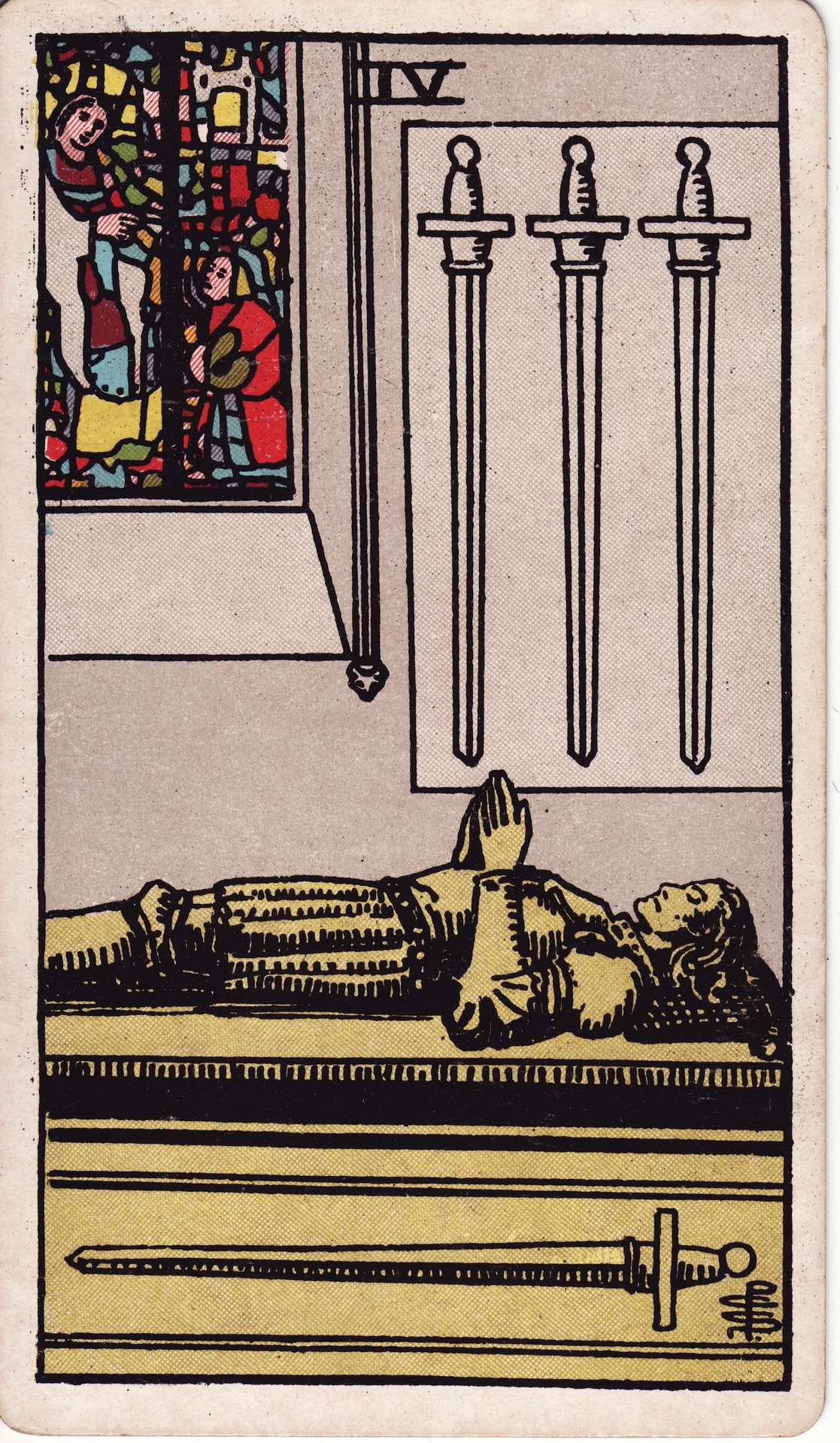
Four of Swords — original Rider–Waite–Smith artwork by Pamela Colman Smith

IV · ⚔ / Swords

Four of Swords

Rest · retreat · recovery

UPRIGHT
Rest and temporary withdrawal restore clarity after strain. Allow quiet to be purposeful rather than treating it as wasted time.
REVERSED
Restlessness, burnout or readiness to return can signal a changing need. Check whether recovery is complete before resuming demands.
SYMBOLISM
An effigy lies with hands in prayer beneath three swords, with a fourth below. The stained-glass window and chapel setting suggest sanctuary and contemplation.
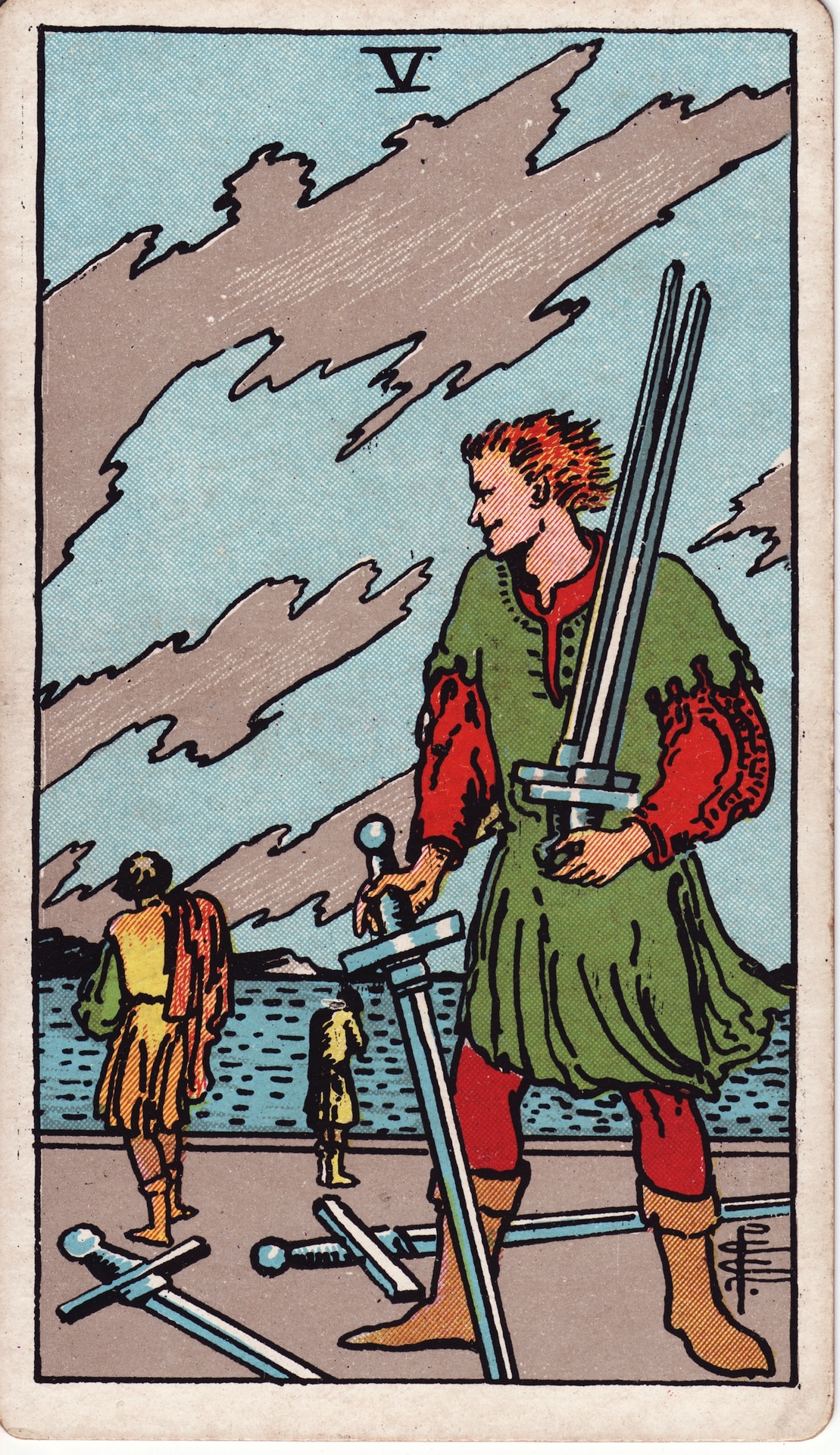
Five of Swords — original Rider–Waite–Smith artwork by Pamela Colman Smith

V · ⚔ / Swords

Five of Swords

Conflict · defeat · hollow victory

UPRIGHT
Winning at another's expense may carry a hidden cost. Examine the ethics of a conflict and whether continued fighting serves anyone.
REVERSED
Reconciliation, unresolved resentment or repeating a hostile pattern may follow. Repair needs accountability, not simply silence.
SYMBOLISM
One figure gathers swords as two others turn away beside rough water. The uncertain victory and fractured group emphasize the relational cost of conflict.
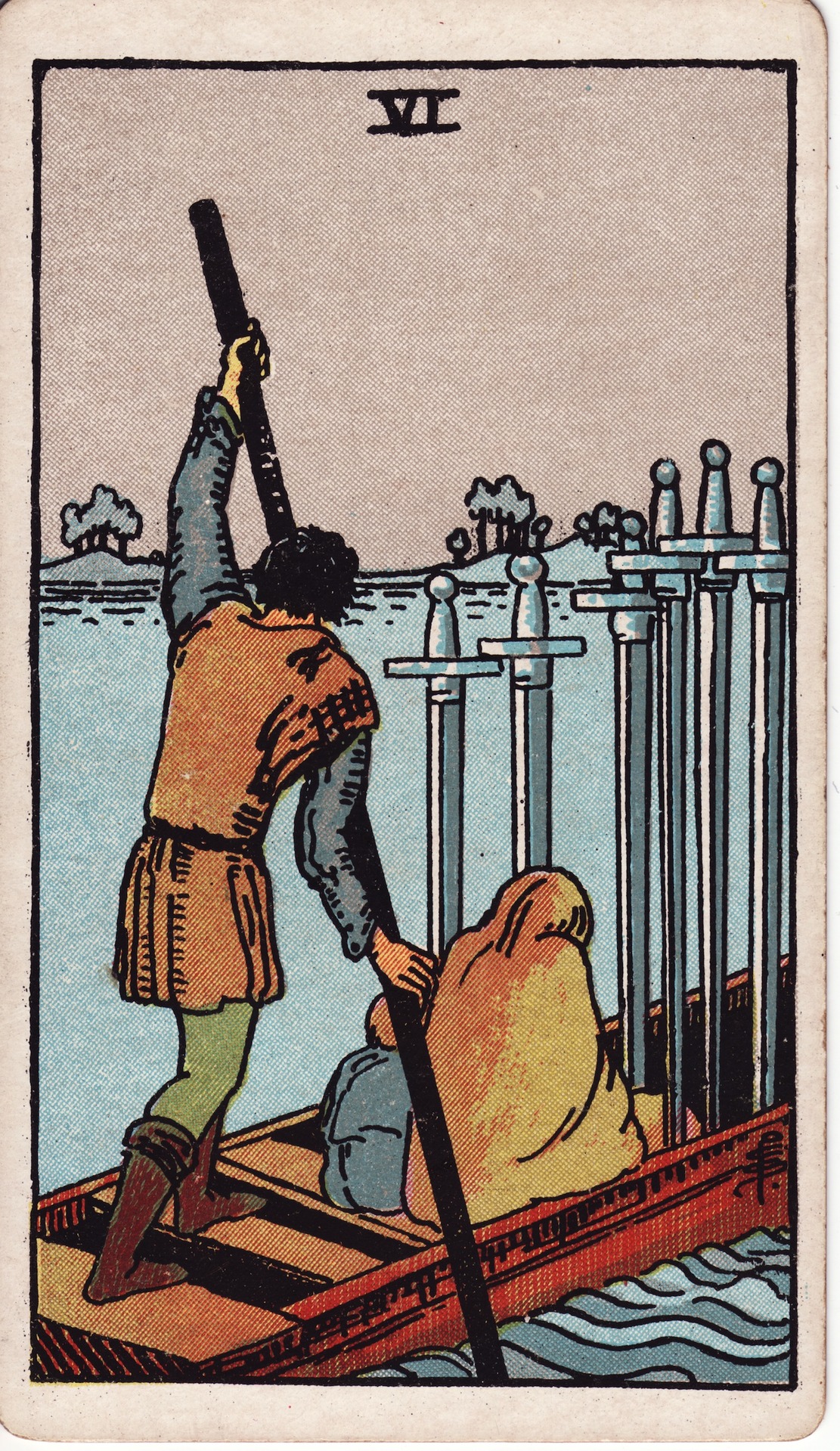
Six of Swords — original Rider–Waite–Smith artwork by Pamela Colman Smith

VI · ⚔ / Swords

Six of Swords

Transition · passage · gradual relief

UPRIGHT
A careful transition leads away from difficulty toward calmer conditions. Carry what you have learned without expecting instant relief.
REVERSED
Resistance to moving on, unfinished business or a delayed journey may slow recovery. Identify the practical obstacle to the crossing.
SYMBOLISM
A boat carries cloaked passengers and six swords across water. Rough water on one side and calmer water ahead suggest a passage that still carries sorrow.
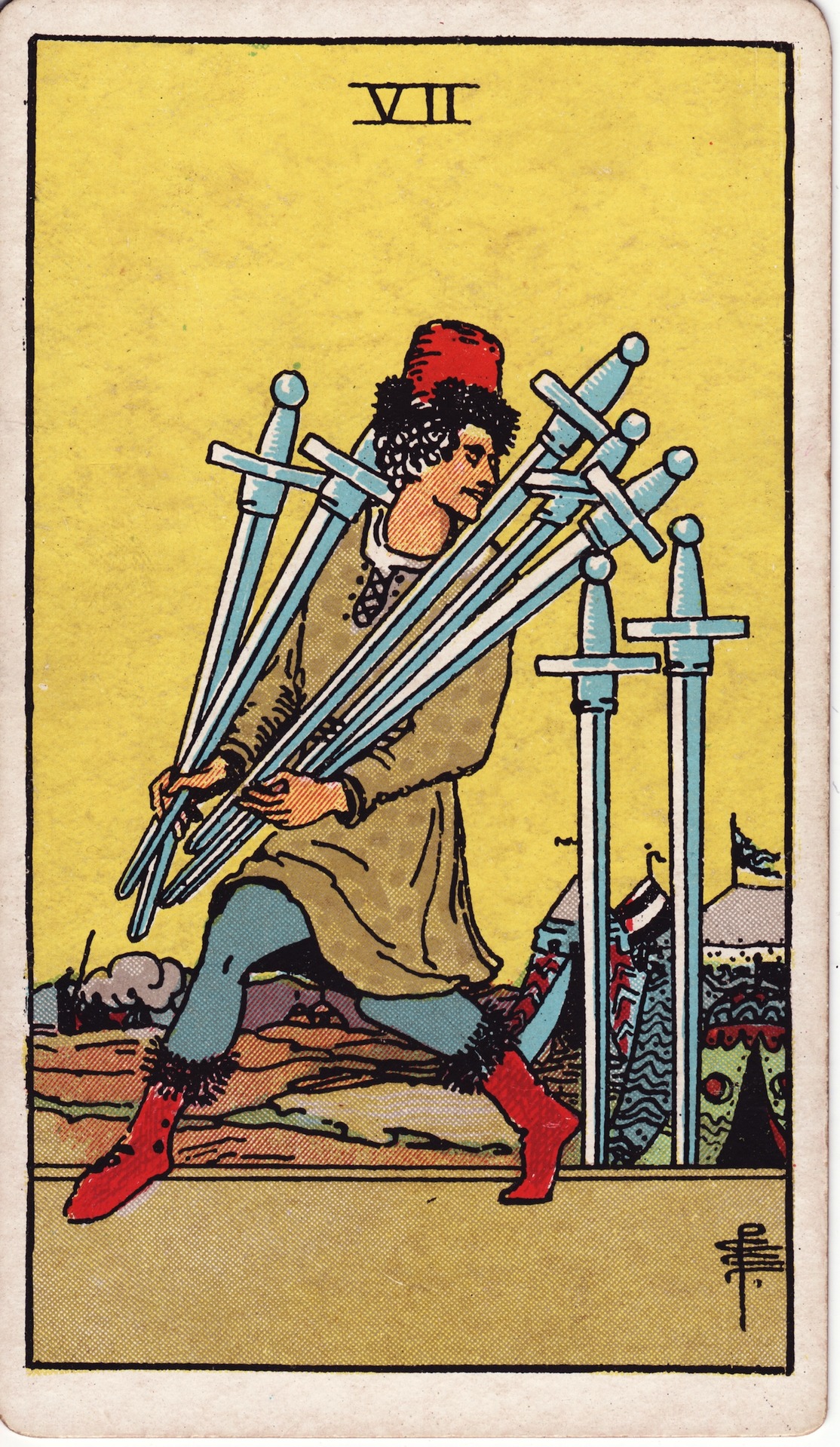
Seven of Swords — original Rider–Waite–Smith artwork by Pamela Colman Smith

VII · ⚔ / Swords

Seven of Swords

Strategy · secrecy · evasion

UPRIGHT
Indirect action, discretion or concealed motives may shape the situation. Assess whether a strategy is thoughtful or avoids necessary honesty.
REVERSED
Exposure, confession or self-deception may bring hidden behavior into view. Acknowledge what cannot be solved by evasion.
SYMBOLISM
A figure carries five swords away from a camp while looking back; two remain. The furtive posture and partial removal emphasize strategy, concealment and unfinished business.
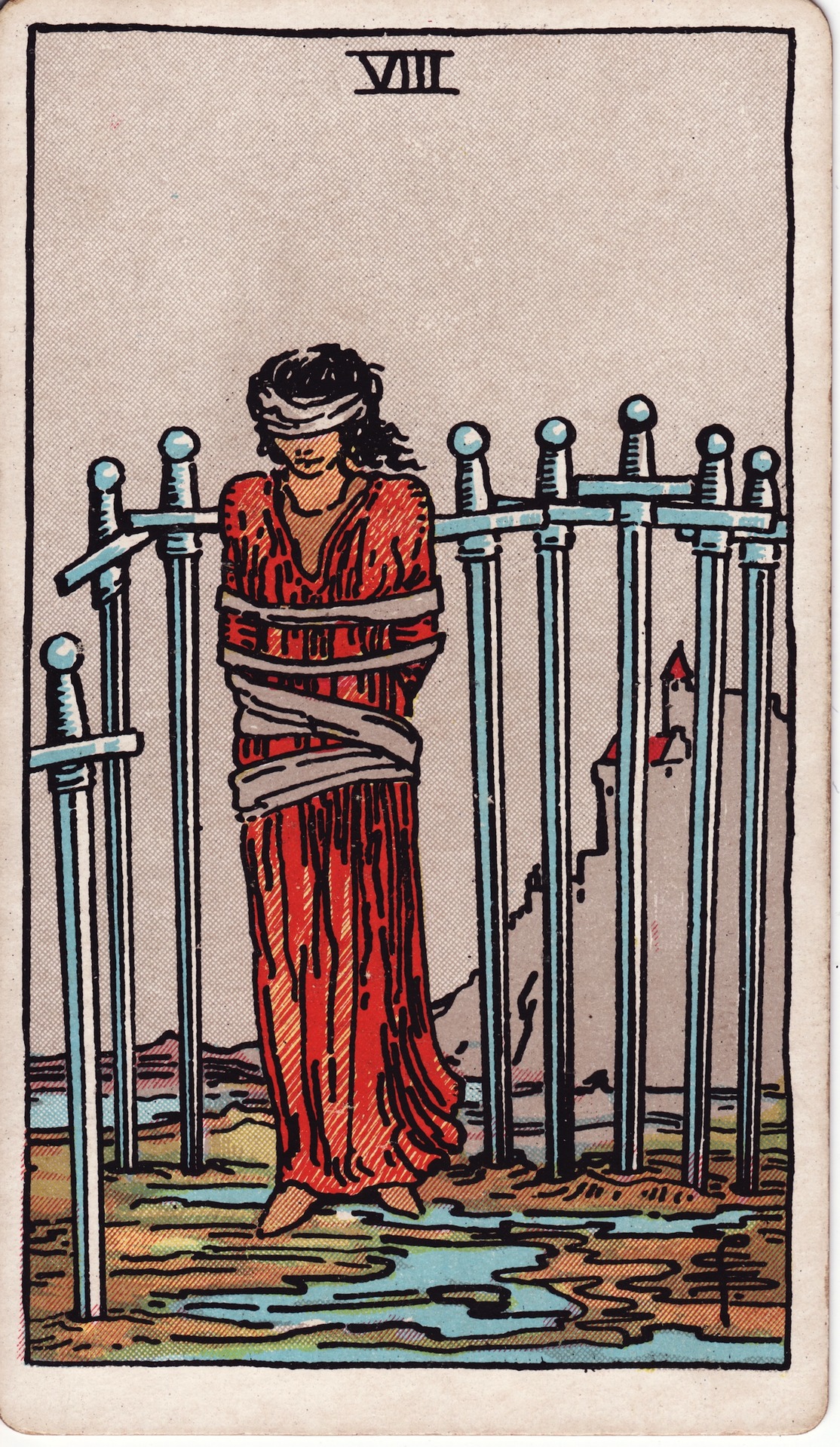
Eight of Swords — original Rider–Waite–Smith artwork by Pamela Colman Smith

VIII · ⚔ / Swords

Eight of Swords

Restriction · fear · limited perspective

UPRIGHT
A sense of entrapment may be intensified by fear or incomplete information. Seek the options and support that the current perspective excludes.
REVERSED
A widening perspective can loosen restrictions, though anxiety may persist. Take one safe step toward greater agency.
SYMBOLISM
A bound, blindfolded figure stands among eight swords. Gaps in the enclosure and the distant castle suggest a constraint that is not as absolute as it appears.
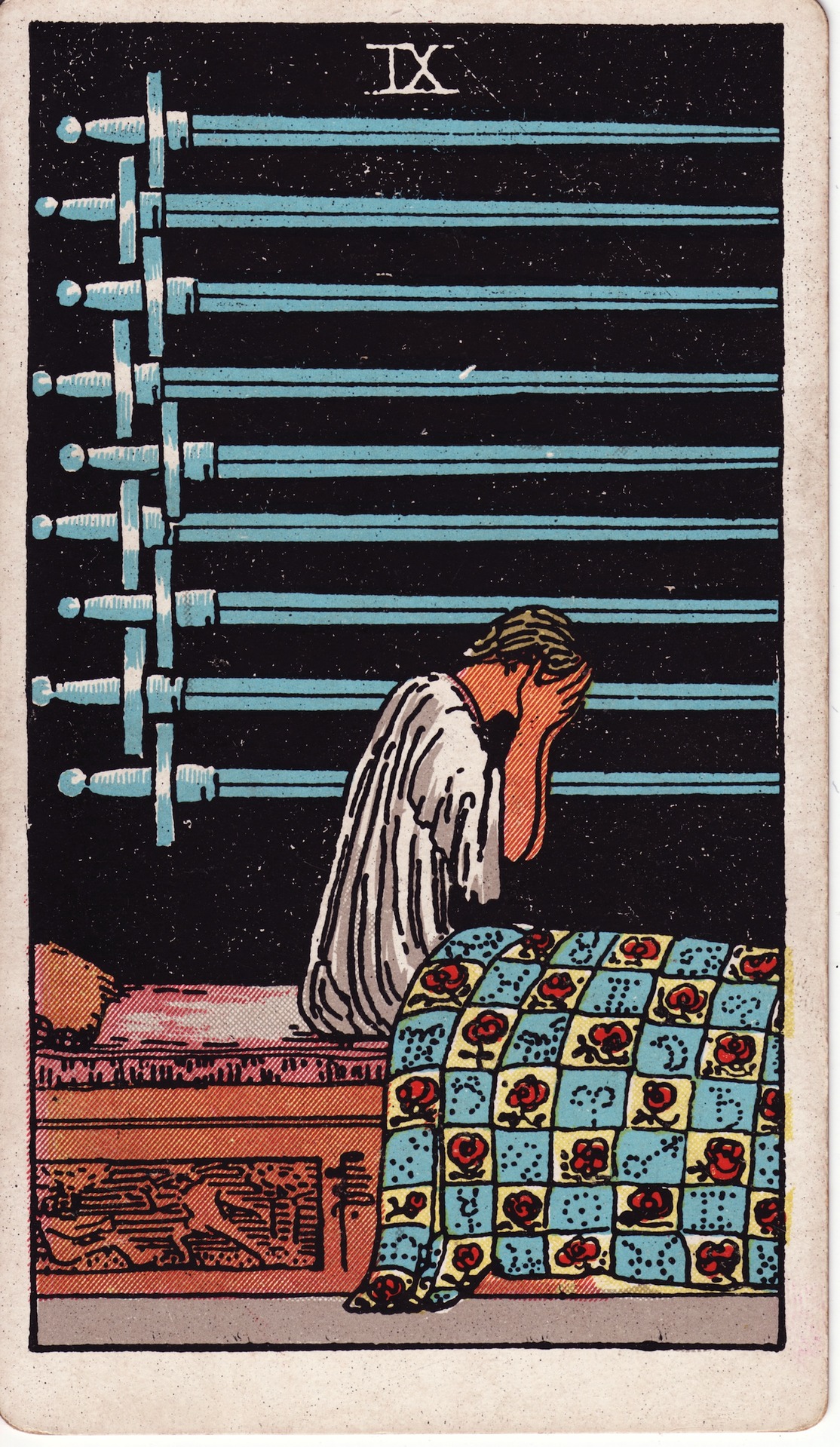
Nine of Swords — original Rider–Waite–Smith artwork by Pamela Colman Smith

IX · ⚔ / Swords

Nine of Swords

Anxiety · anguish · sleeplessness

UPRIGHT
Worry, remorse or mental distress may dominate attention. Treat suffering seriously while distinguishing feared outcomes from established facts.
REVERSED
Relief, seeking help or intensified private worry may come into focus. Do not confuse the need for support with personal failure.
SYMBOLISM
A figure sits upright in bed with face in hands beneath nine swords. The dark setting and decorated coverlet place the distress in an intimate, inward space.
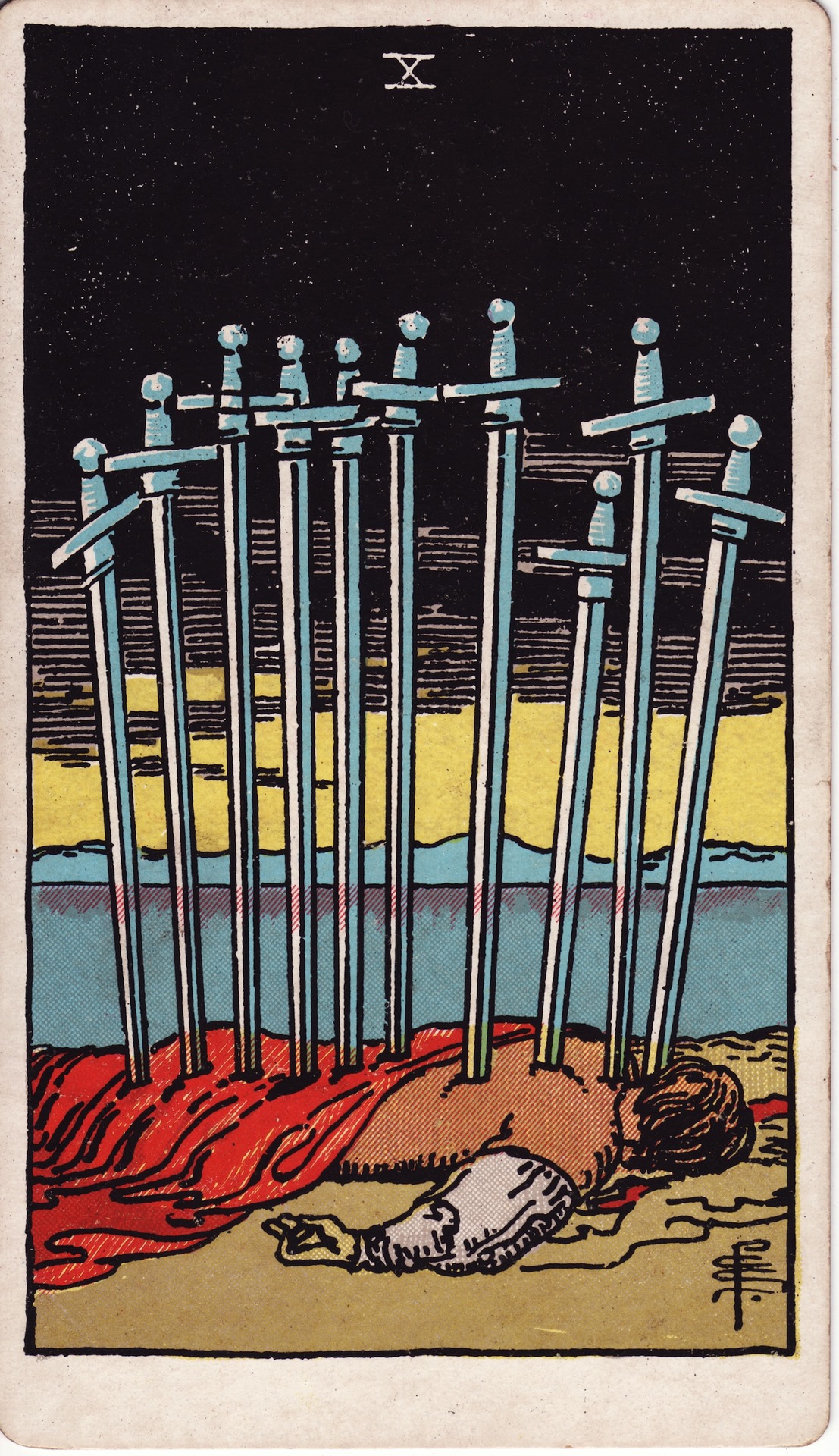
Ten of Swords — original Rider–Waite–Smith artwork by Pamela Colman Smith

X · ⚔ / Swords

Ten of Swords

Ending · exhaustion · finality

UPRIGHT
A painful ending or exhausted situation has reached its limit. Acknowledge what is over and look for the first practical step beyond it.
REVERSED
Recovery, survival or reluctance to accept an ending may shape the next phase. Healing begins with no longer sustaining the finished struggle.
SYMBOLISM
Ten swords lie in a fallen figure under a dark sky. Light appears at the horizon beyond still water, suggesting that even this stark ending does not consume the future.
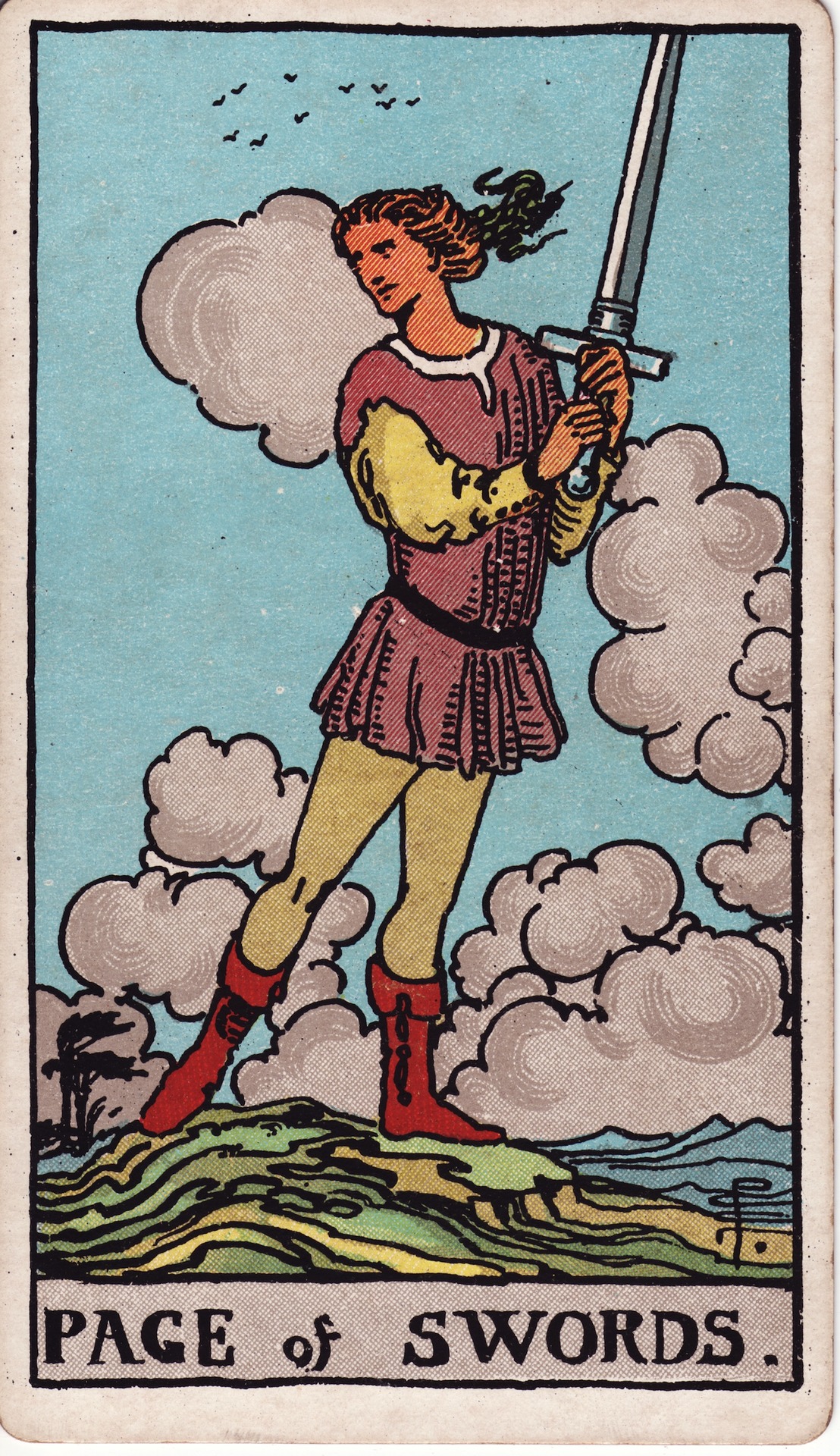
Page of Swords — original Rider–Waite–Smith artwork by Pamela Colman Smith

P · ⚔ / Swords

Page of Swords

Curiosity · vigilance · inquiry

UPRIGHT
Alertness, study and direct questions uncover useful information. Develop your ideas through evidence and careful communication.
REVERSED
Gossip, defensiveness or premature conclusions may misuse mental energy. Verify what you hear before passing it on.
SYMBOLISM
A youthful figure holds a raised sword while wind moves the trees and clouds. The watchful stance and uneven ground convey readiness, curiosity and unsettled conditions.
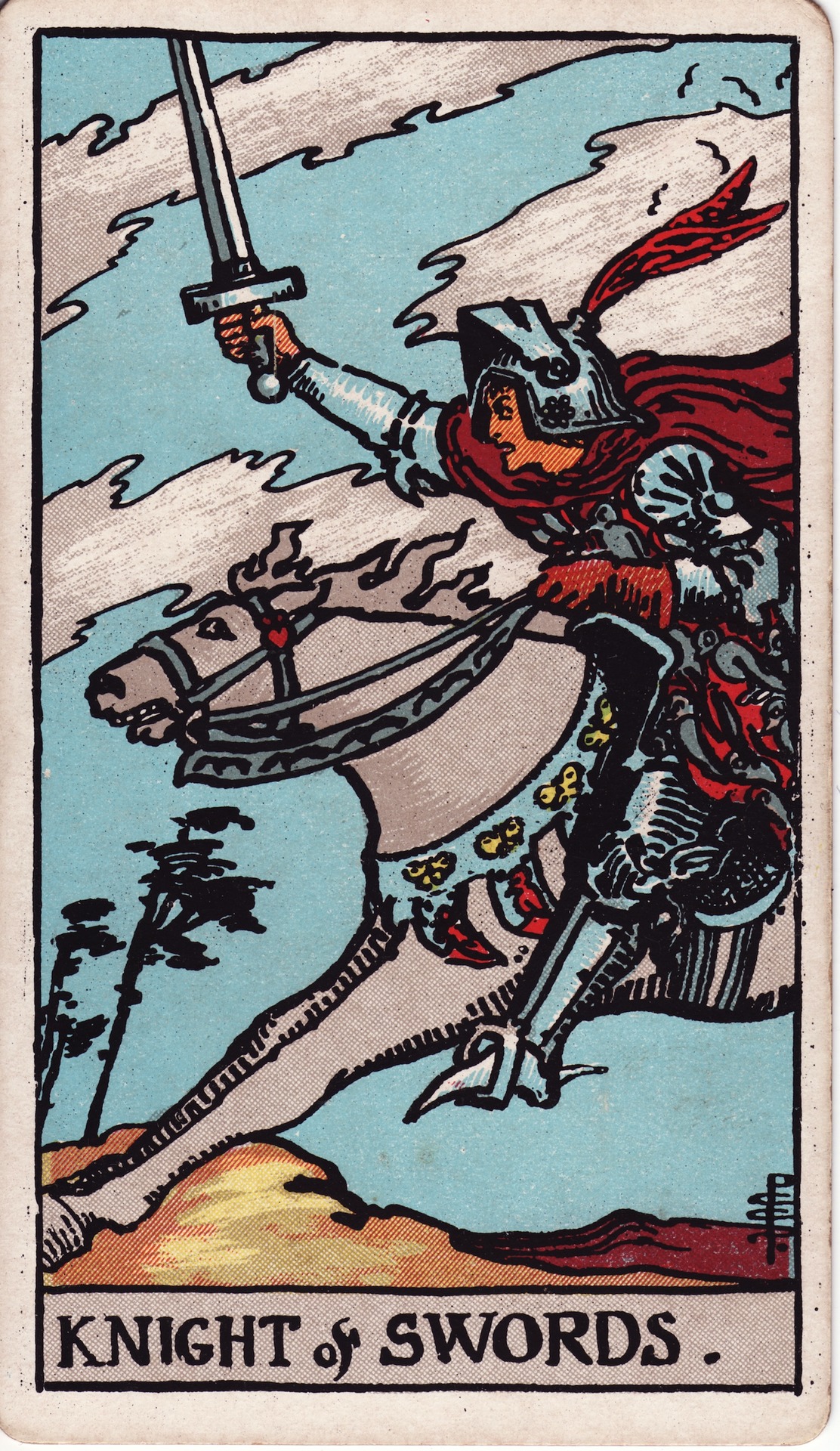
Knight of Swords — original Rider–Waite–Smith artwork by Pamela Colman Smith

Kn · ⚔ / Swords

Knight of Swords

Determination · speed · direct action

UPRIGHT
Decisive thought becomes rapid action. Pursue the objective clearly, while ensuring urgency does not erase nuance or care.
REVERSED
Aggression, haste or unfocused argument can cause unnecessary damage. Slow the charge enough to choose the right target.
SYMBOLISM
An armored rider charges with sword raised through a windswept landscape. The forward motion and stormy sky dramatize forceful, sometimes headlong, mental energy.
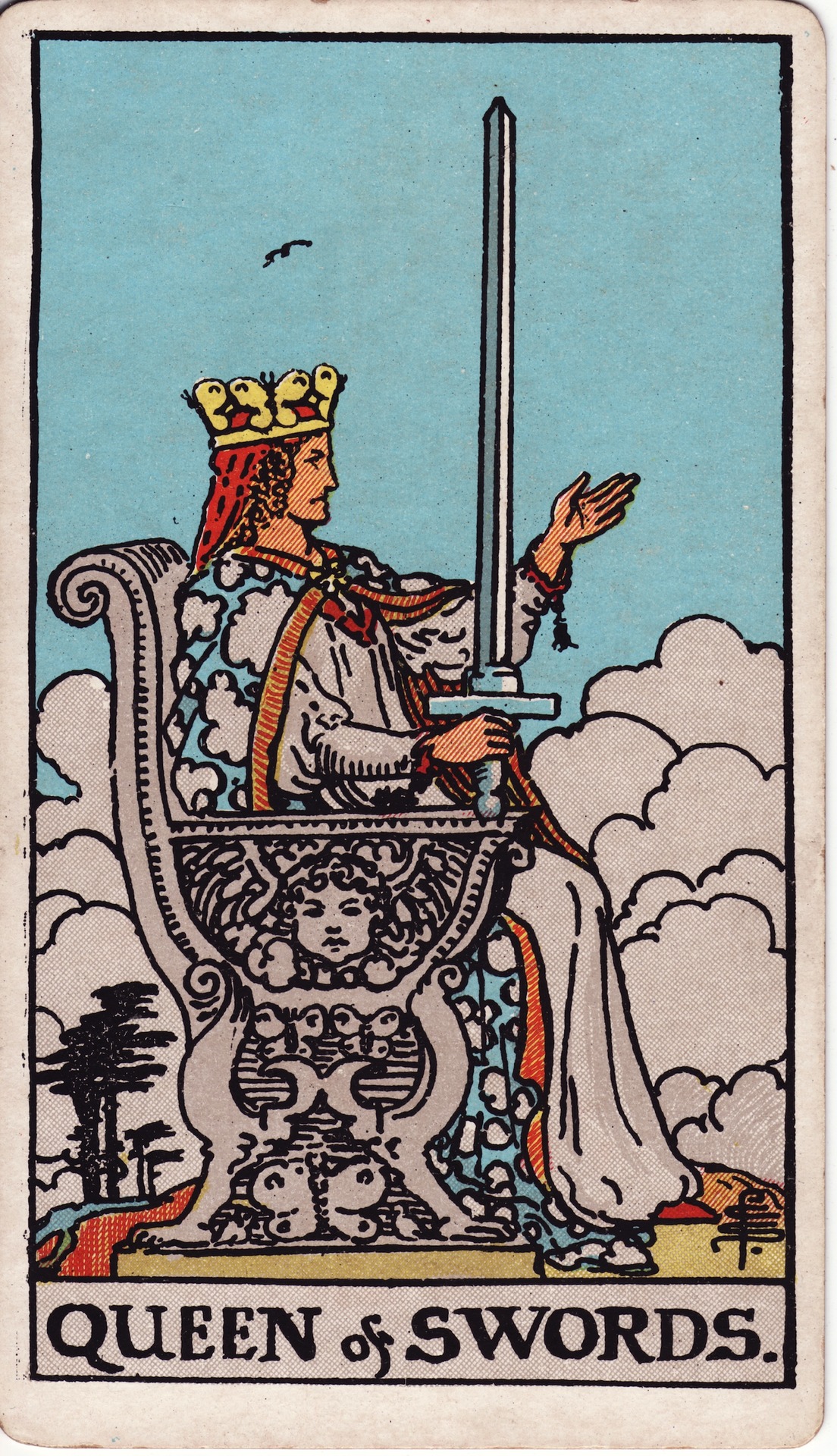
Queen of Swords — original Rider–Waite–Smith artwork by Pamela Colman Smith

Q · ⚔ / Swords

Queen of Swords

Discernment · independence · candor

UPRIGHT
Clear perception and honest speech help establish wise boundaries. Join intellectual independence with fairness and humane judgment.
REVERSED
Cynicism, coldness or biased criticism may harden useful discernment. Examine whether hurt is influencing the verdict.
SYMBOLISM
The queen holds an upright sword and extends an open hand. Clouds and butterfly details connect her with thought, while the open gesture balances rigor with receptivity.
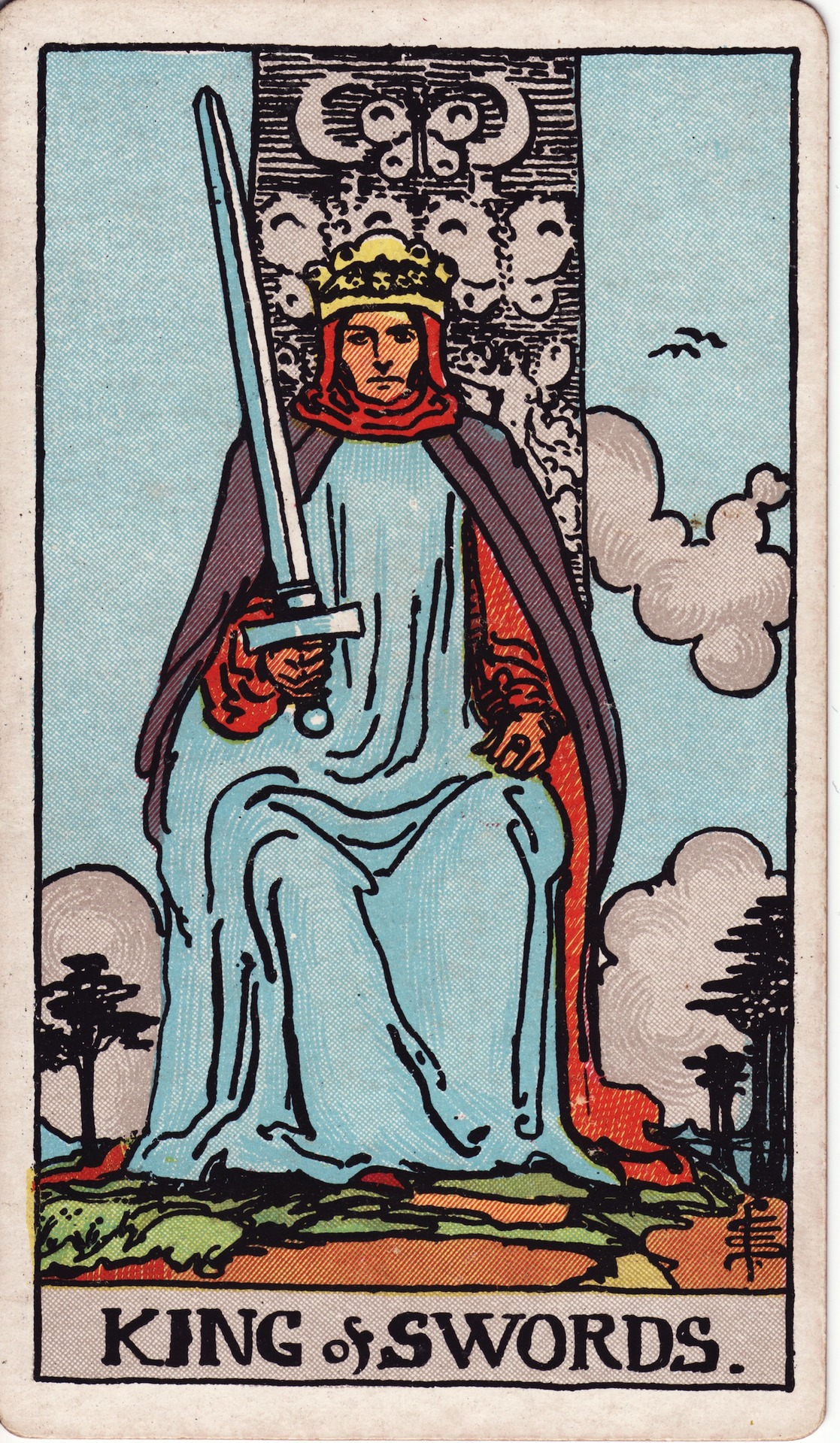
King of Swords — original Rider–Waite–Smith artwork by Pamela Colman Smith

K · ⚔ / Swords

King of Swords

Reason · authority · ethical judgment

UPRIGHT
Principled reasoning and clear standards support responsible decisions. Use authority to clarify and serve, not merely to prevail.
REVERSED
Misused authority, rigid thinking or manipulative reasoning can undermine fairness. Test the judgment against evidence and ethics.
SYMBOLISM
The king sits front-facing with sword upright on a butterfly-decorated throne. His composed stance and airy setting emphasize intellectual command and impartial judgment.

Pentacles

14

Earth — work, resources, the body and material foundations.

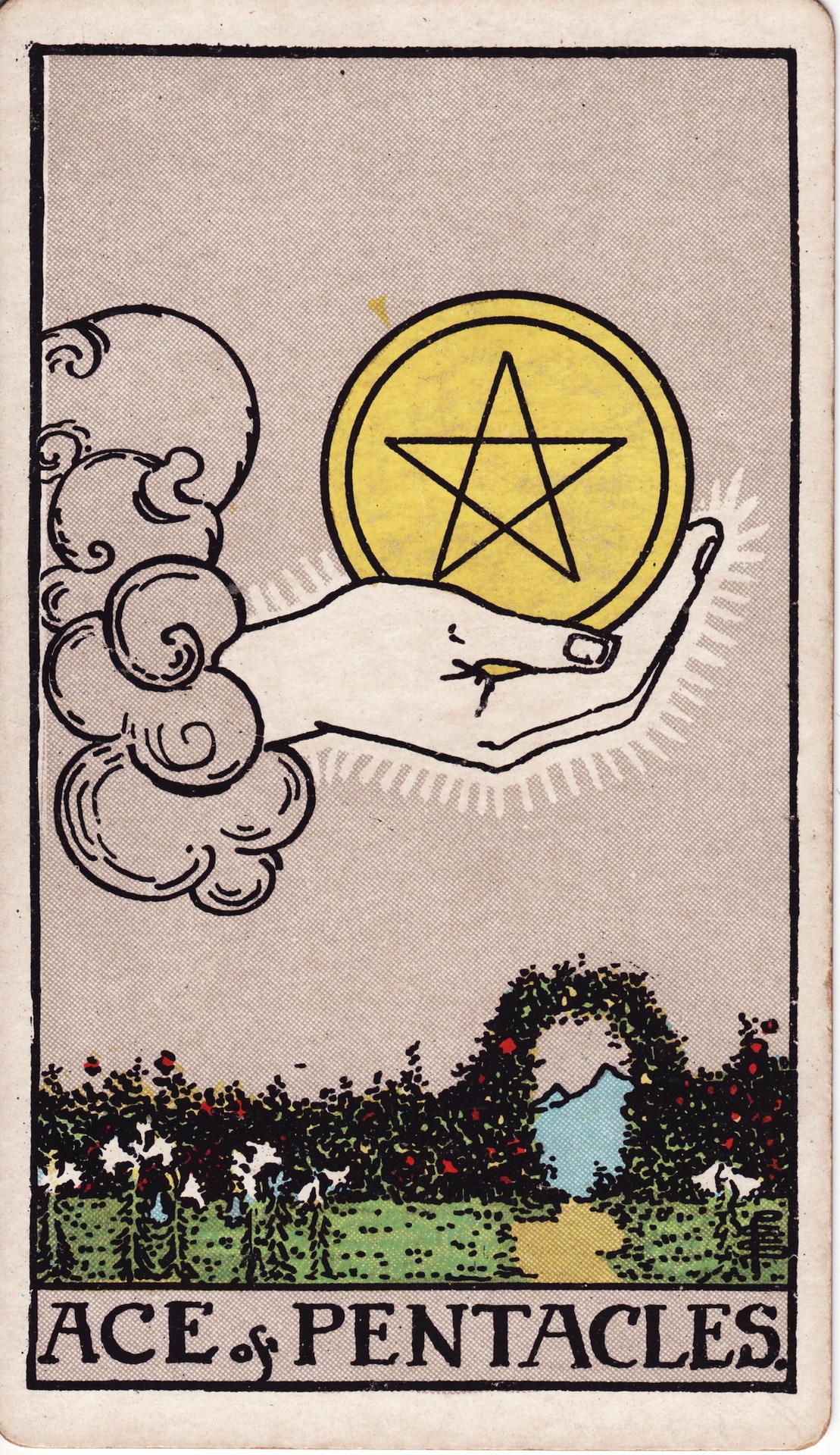
Ace of Pentacles — original Rider–Waite–Smith artwork by Pamela Colman Smith

A · ⬟ / Pentacles

Ace of Pentacles

Opportunity · security · a seed

UPRIGHT
A tangible opportunity can become a foundation through patient care. Begin with practical resources, skills and sustainable expectations.
REVERSED
A missed opportunity, poor planning or insecure foundations may limit growth. Assess what is viable before investing more.
SYMBOLISM
A hand offers a pentacle above a flowering garden. The archway opens toward distant mountains, joining immediate material potential with a longer path of effort.
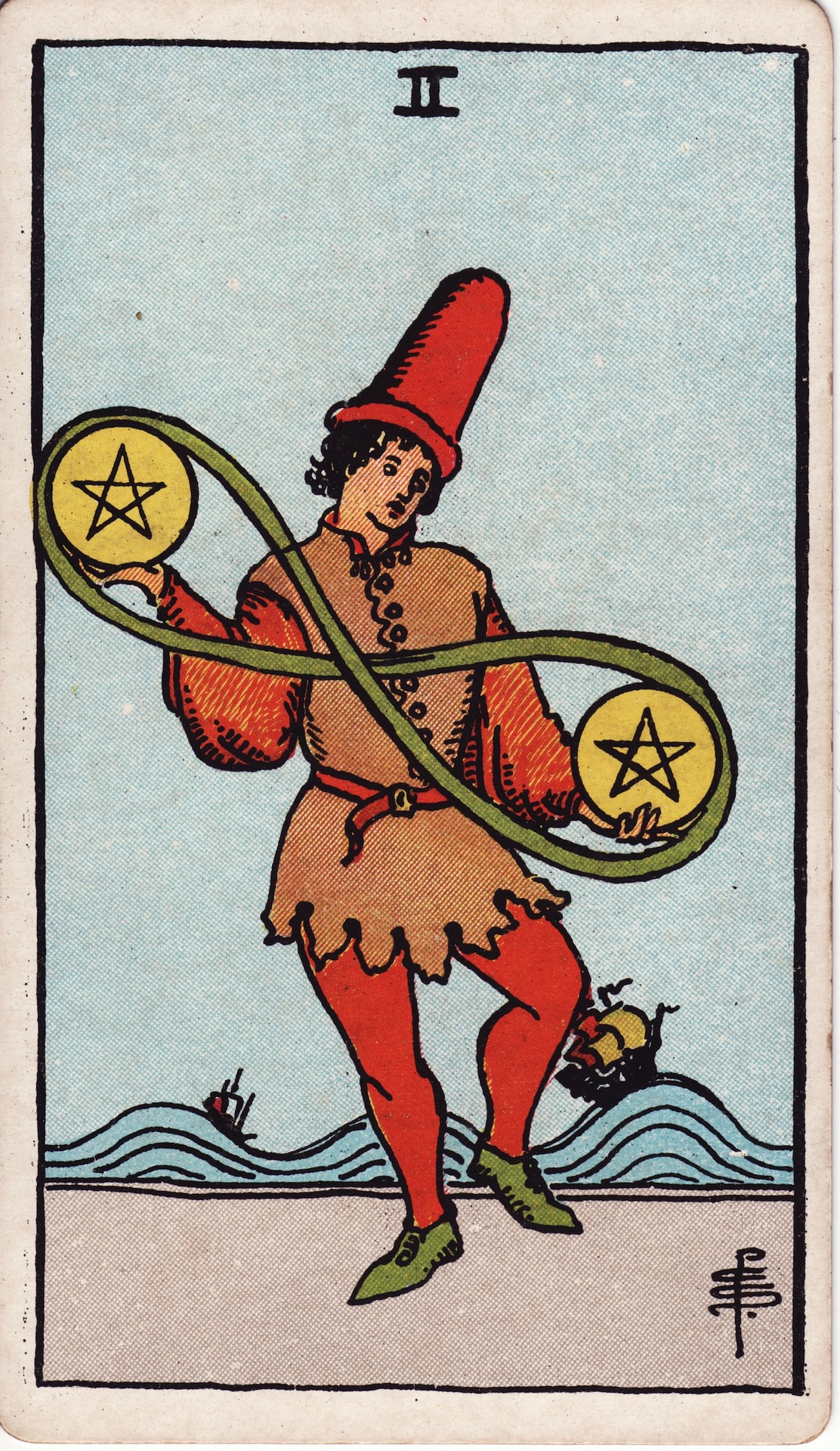
Two of Pentacles — original Rider–Waite–Smith artwork by Pamela Colman Smith

II · ⬟ / Pentacles

Two of Pentacles

Balance · adaptability · priorities

UPRIGHT
Multiple demands require flexibility and rhythm. Adjust your priorities so that change remains manageable rather than exhausting.
REVERSED
Overcommitment, disorganization or financial imbalance may stretch capacity. Simplify the load and restore a workable routine.
SYMBOLISM
A figure juggles two pentacles inside an infinity-shaped ribbon. Ships rise and fall on waves behind, suggesting ongoing fluctuation and adaptive movement.
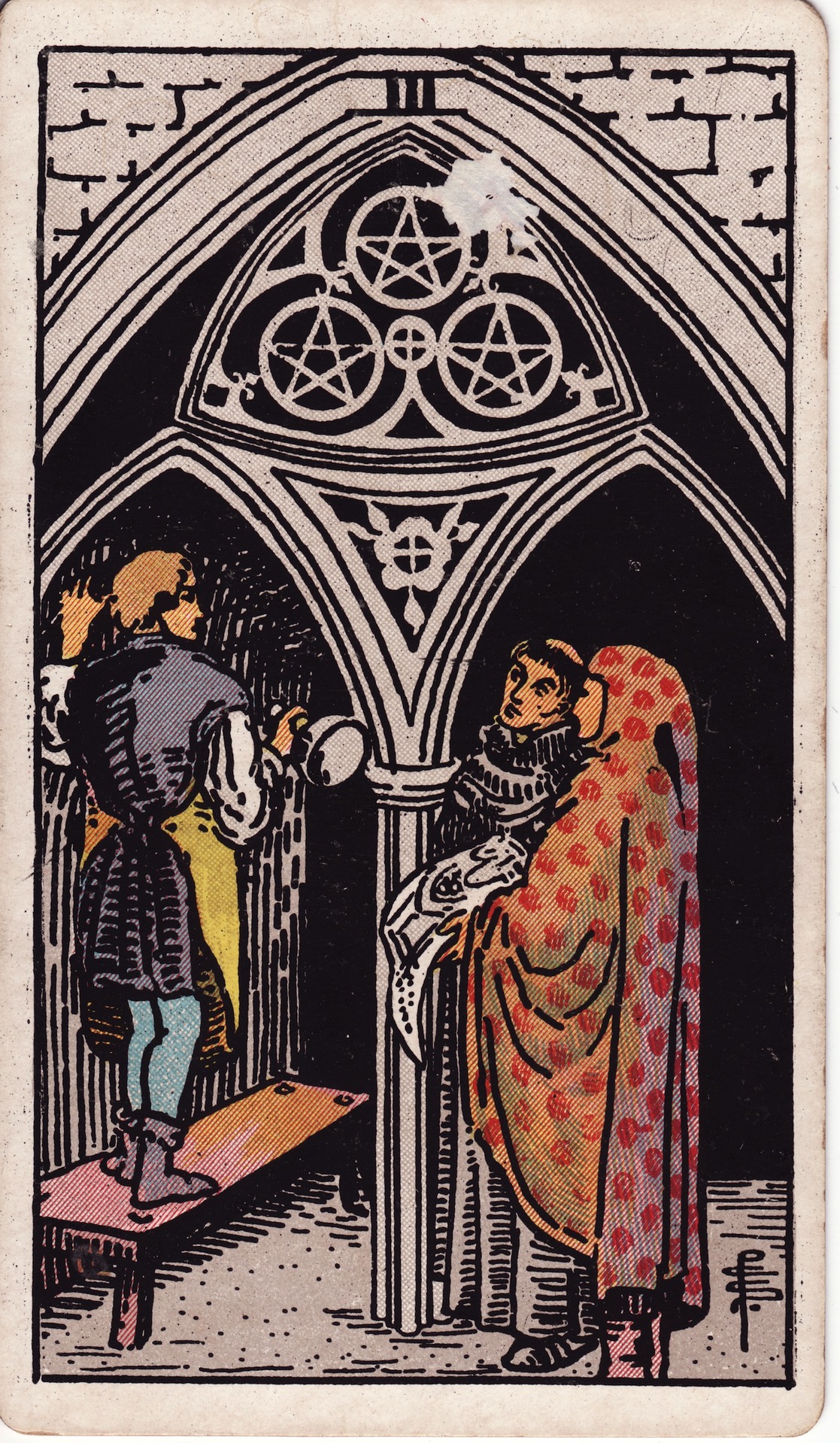
Three of Pentacles — original Rider–Waite–Smith artwork by Pamela Colman Smith

III · ⬟ / Pentacles

Three of Pentacles

Craft · teamwork · learning

UPRIGHT
Skilled work improves through collaboration, feedback and shared planning. Respect both your expertise and the contribution of others.
REVERSED
Poor coordination, undervalued skill or incompatible standards can weaken the work. Clarify roles and expectations.
SYMBOLISM
A craftsperson works in a church while two others consult a plan. Three pentacles set into the stone emphasize skill made durable through cooperative construction.
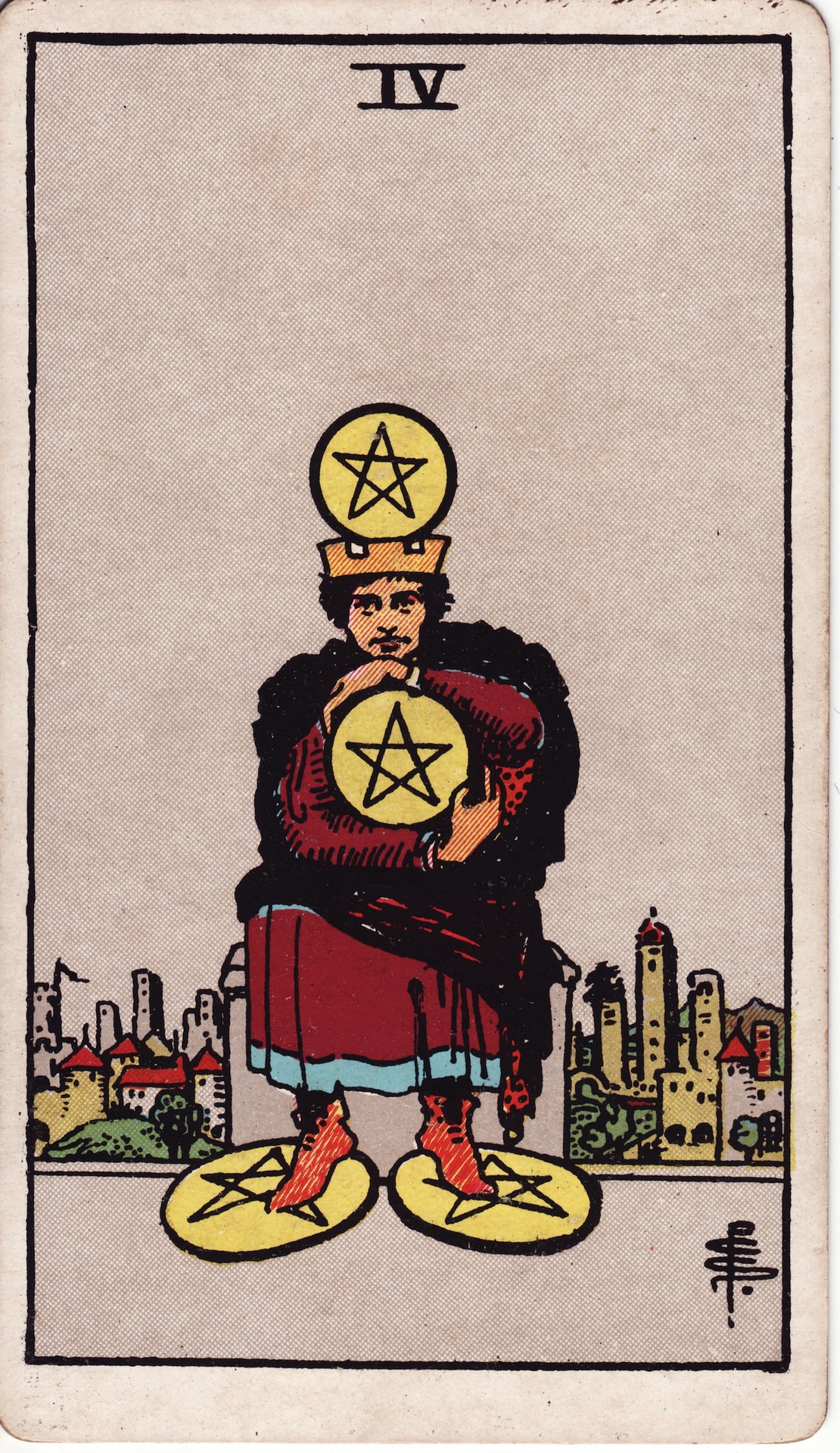
Four of Pentacles — original Rider–Waite–Smith artwork by Pamela Colman Smith

IV · ⬟ / Pentacles

Four of Pentacles

Security · possession · control

UPRIGHT
Preserving resources and setting limits can create stability. Watch when prudent protection becomes fear-driven refusal to share or grow.
REVERSED
Letting go, financial insecurity or excessive attachment may come into view. Decide what needs safeguarding and what can circulate.
SYMBOLISM
A figure grips one pentacle, balances another on the head and pins two beneath the feet. The distant city contrasts wider life with a tightly defended position.
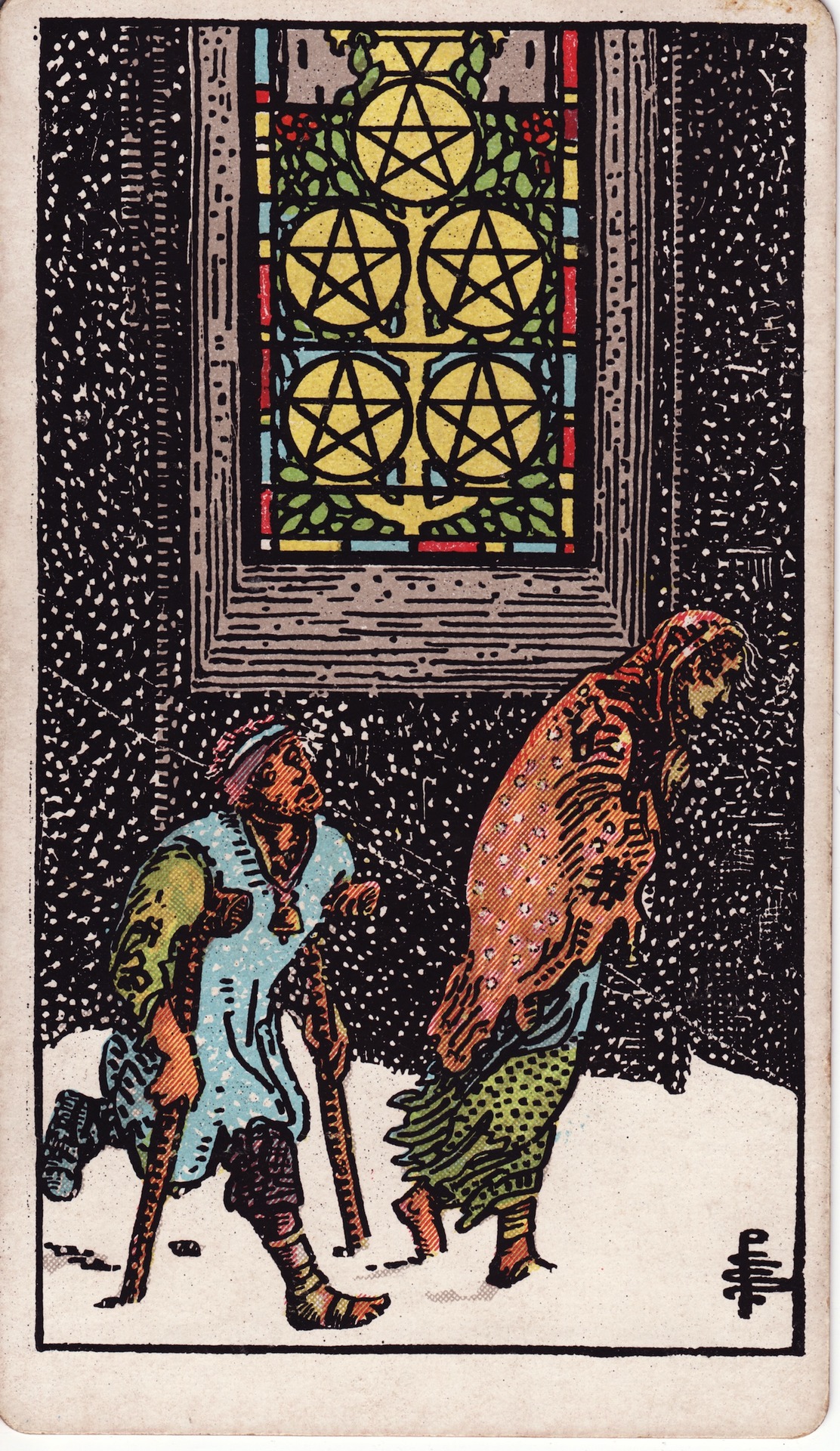
Five of Pentacles — original Rider–Waite–Smith artwork by Pamela Colman Smith

V · ⬟ / Pentacles

Five of Pentacles

Hardship · exclusion · support

UPRIGHT
Material difficulty or feeling excluded calls for practical help and compassion. Notice available support rather than facing hardship alone.
REVERSED
Recovery, renewed access to help or enduring isolation may shape the situation. Accept assistance without treating need as shame.
SYMBOLISM
Two poorly clothed figures pass a lit stained-glass window in snow. The contrast between cold outside and light within evokes hardship and potential sanctuary.
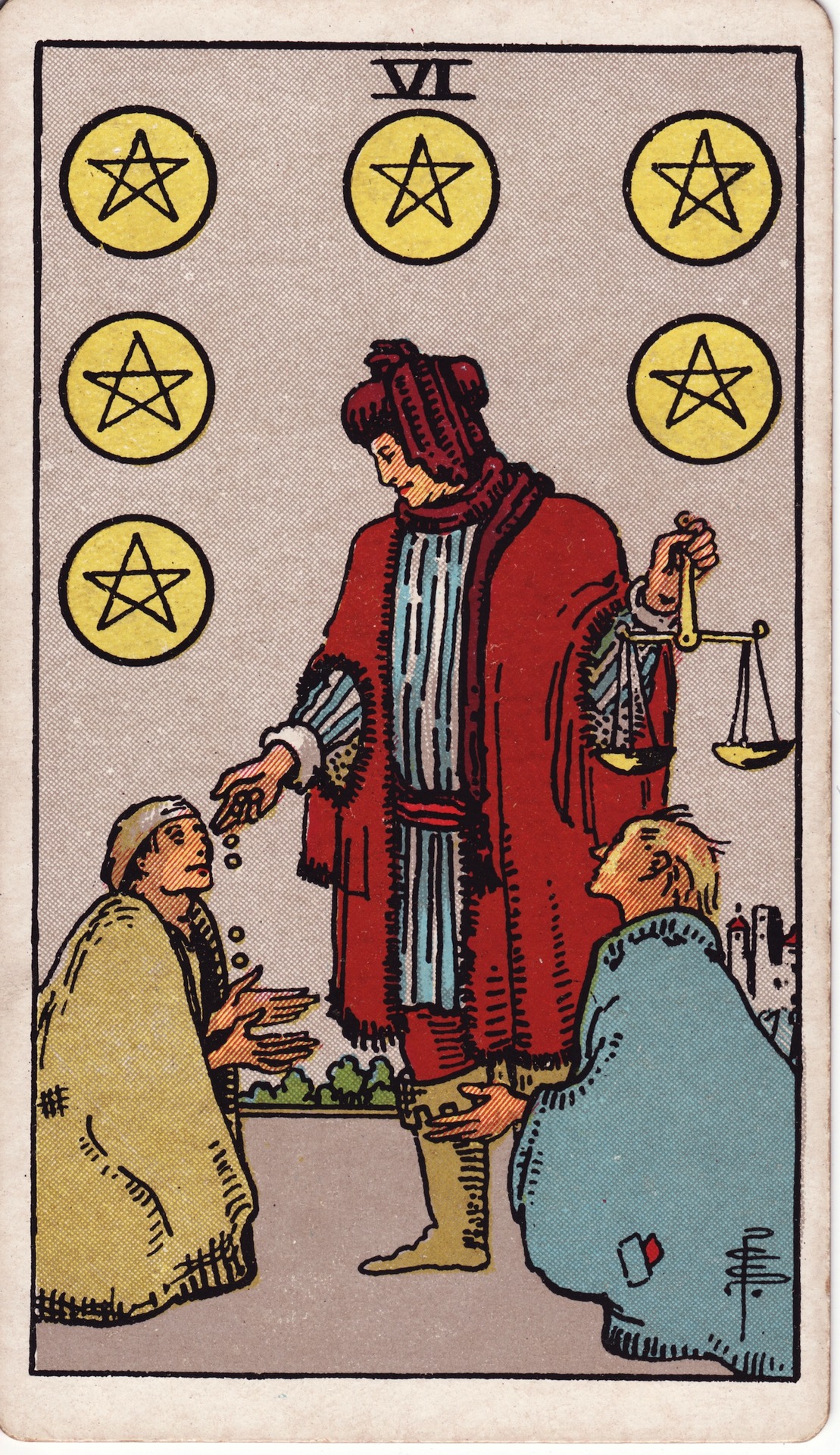
Six of Pentacles — original Rider–Waite–Smith artwork by Pamela Colman Smith

VI · ⬟ / Pentacles

Six of Pentacles

Generosity · exchange · fairness

UPRIGHT
Giving and receiving can restore balance when resources are shared fairly. Consider dignity and power as well as the size of a gift.
REVERSED
Strings attached, unequal exchange or overgiving may complicate generosity. Check whether help creates freedom or dependence.
SYMBOLISM
A standing figure holds scales while distributing coins to two kneeling people. The scene combines measured charity with the unequal positions of giver and receiver.
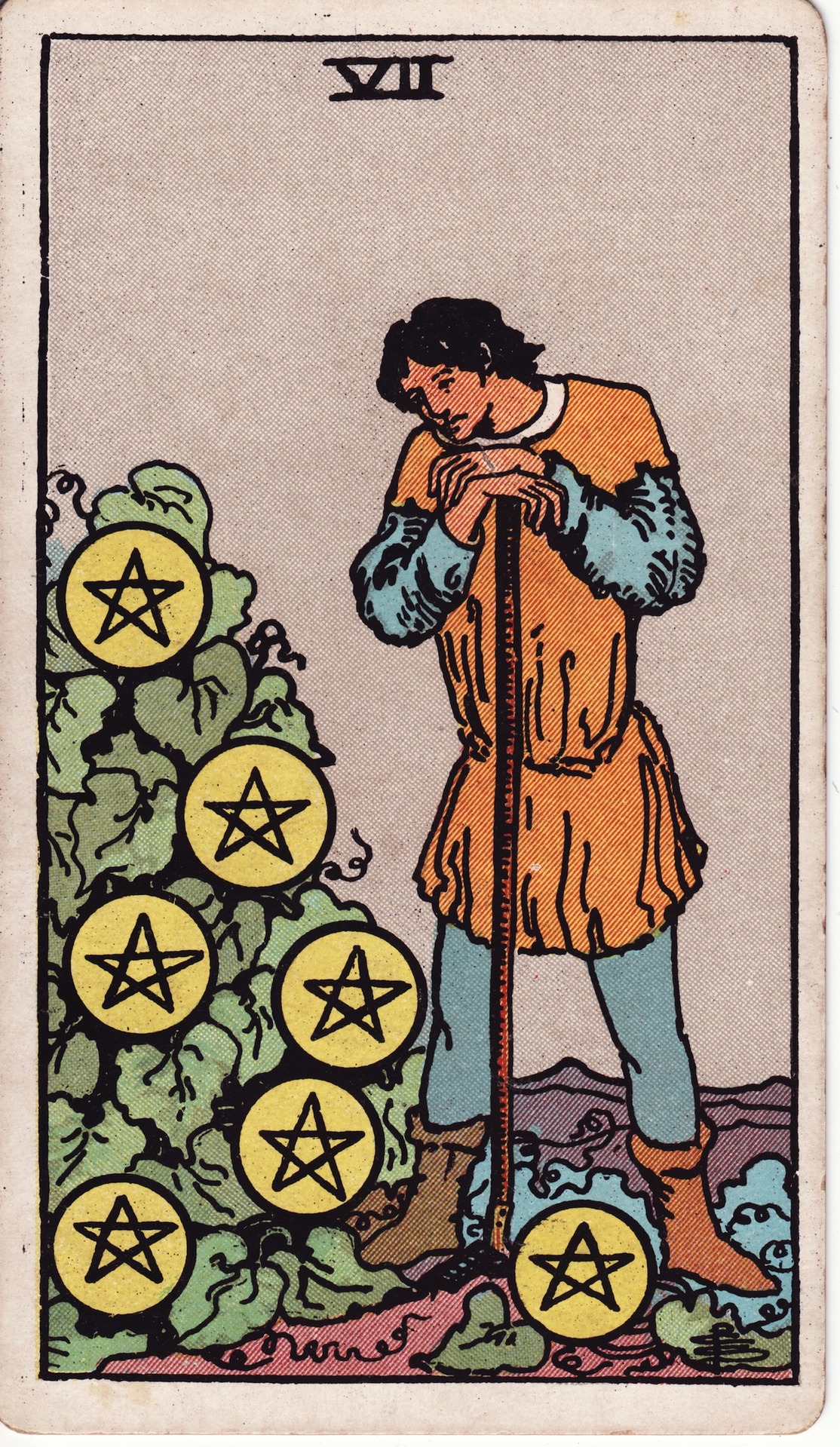
Seven of Pentacles — original Rider–Waite–Smith artwork by Pamela Colman Smith

VII · ⬟ / Pentacles

Seven of Pentacles

Patience · assessment · investment

UPRIGHT
Long-term effort asks for patient evaluation. Consider what is growing well and whether continued investment matches your aims.
REVERSED
Impatience, poor returns or effort without direction may require a change. Review the method before adding more labor.
SYMBOLISM
A worker rests on a tool while studying a vine bearing pentacles. The pause between effort and harvest emphasizes assessment, cultivation and delayed reward.
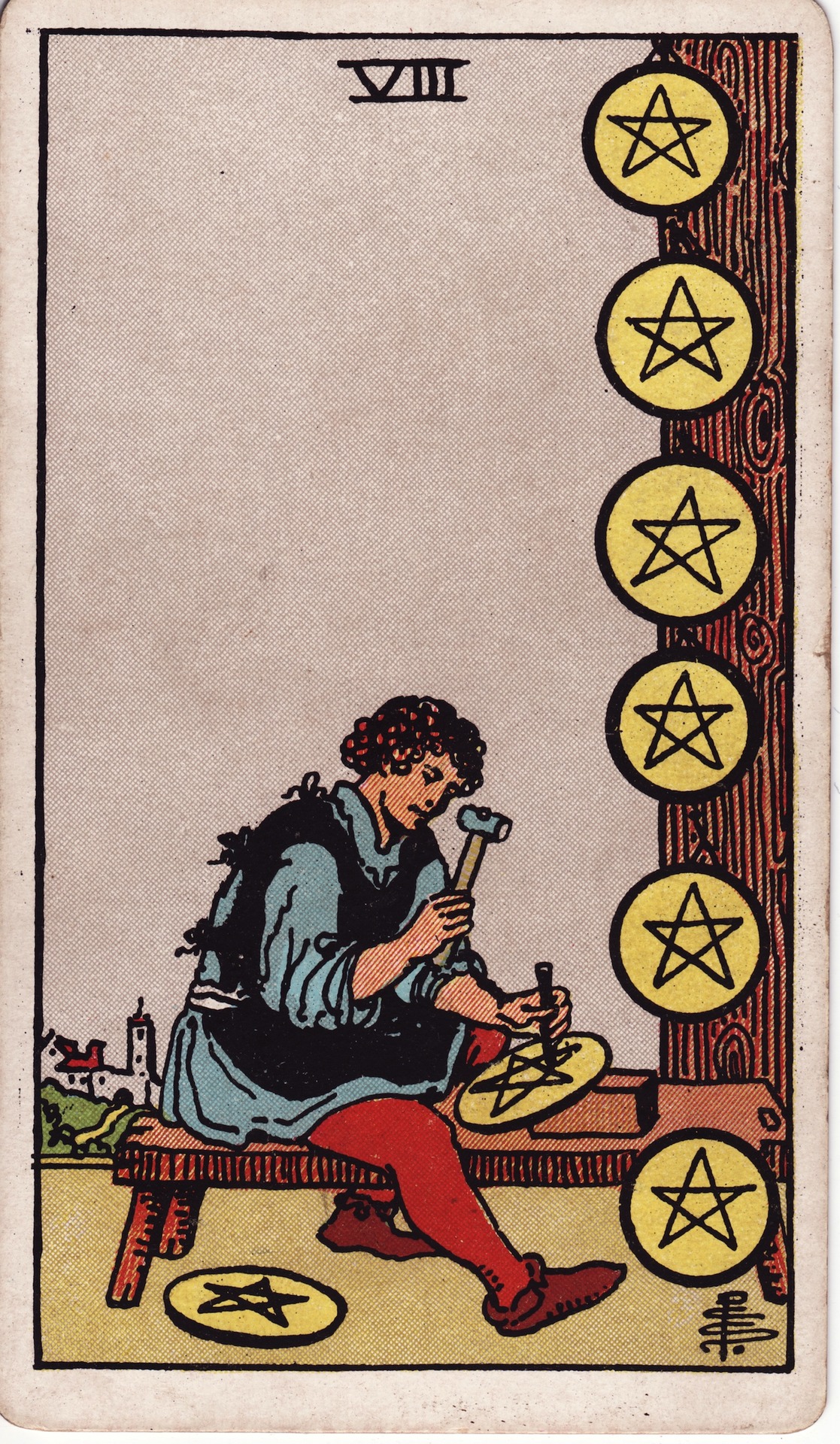
Eight of Pentacles — original Rider–Waite–Smith artwork by Pamela Colman Smith

VIII · ⬟ / Pentacles

Eight of Pentacles

Practice · diligence · mastery

UPRIGHT
Consistent practice and attention to detail build real competence. Focus on the work itself rather than rushing toward recognition.
REVERSED
Perfectionism, repetitive work without learning or careless shortcuts may reduce progress. Reconnect effort with useful improvement.
SYMBOLISM
A craftsperson engraves pentacles at a bench, with finished pieces displayed nearby. The town in the distance suggests concentrated work apart from distraction.
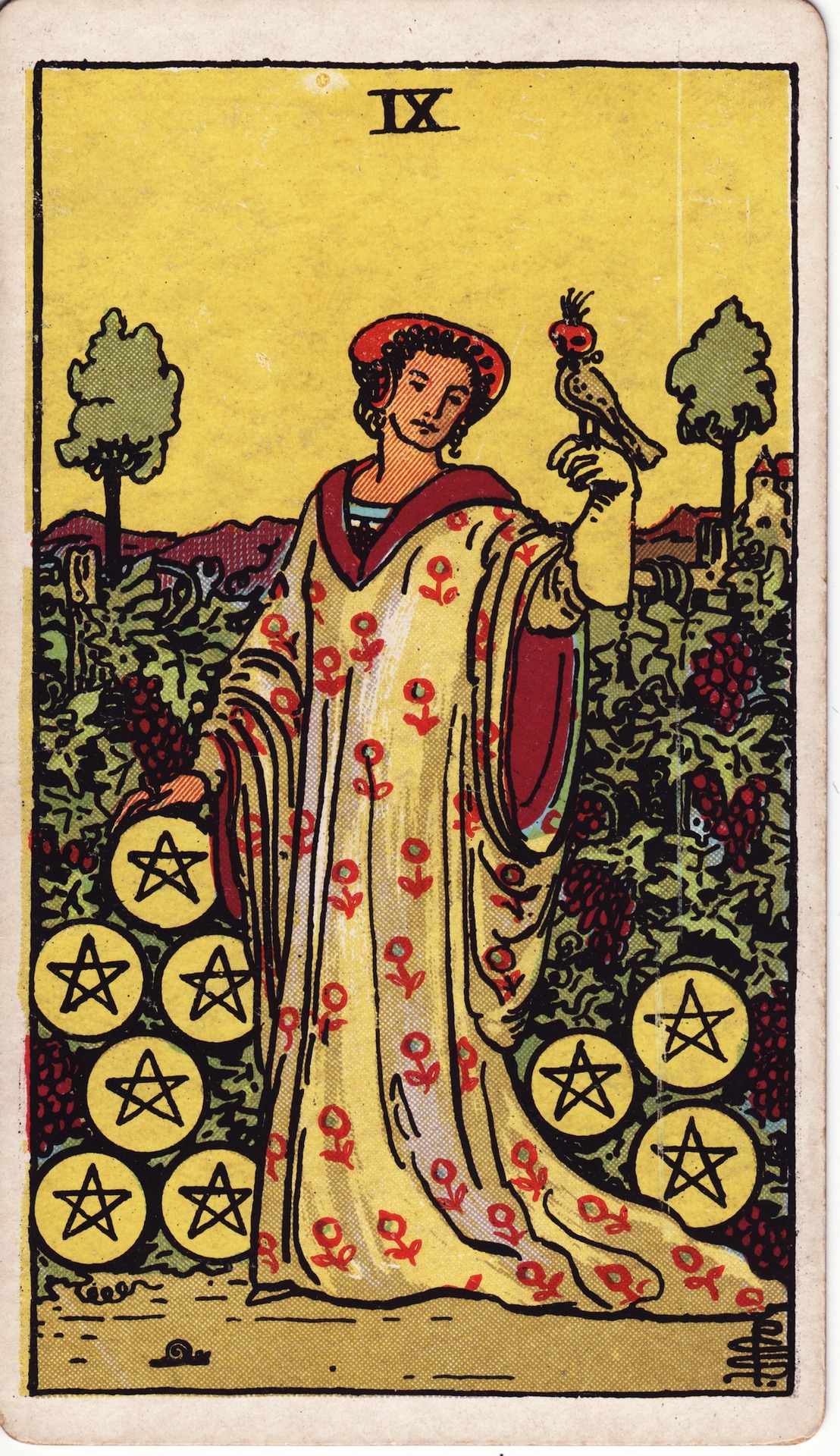
Nine of Pentacles — original Rider–Waite–Smith artwork by Pamela Colman Smith

IX · ⬟ / Pentacles

Nine of Pentacles

Independence · refinement · self-sufficiency

UPRIGHT
Enjoy the stability and confidence developed through disciplined effort. Material comfort is richer when accompanied by personal freedom.
REVERSED
Dependence, overwork or insecurity beneath appearances may complicate prosperity. Define success beyond display or status.
SYMBOLISM
A richly dressed figure stands among grapes and nine pentacles with a hooded falcon. The cultivated garden and trained bird suggest refinement, discipline and earned ease.
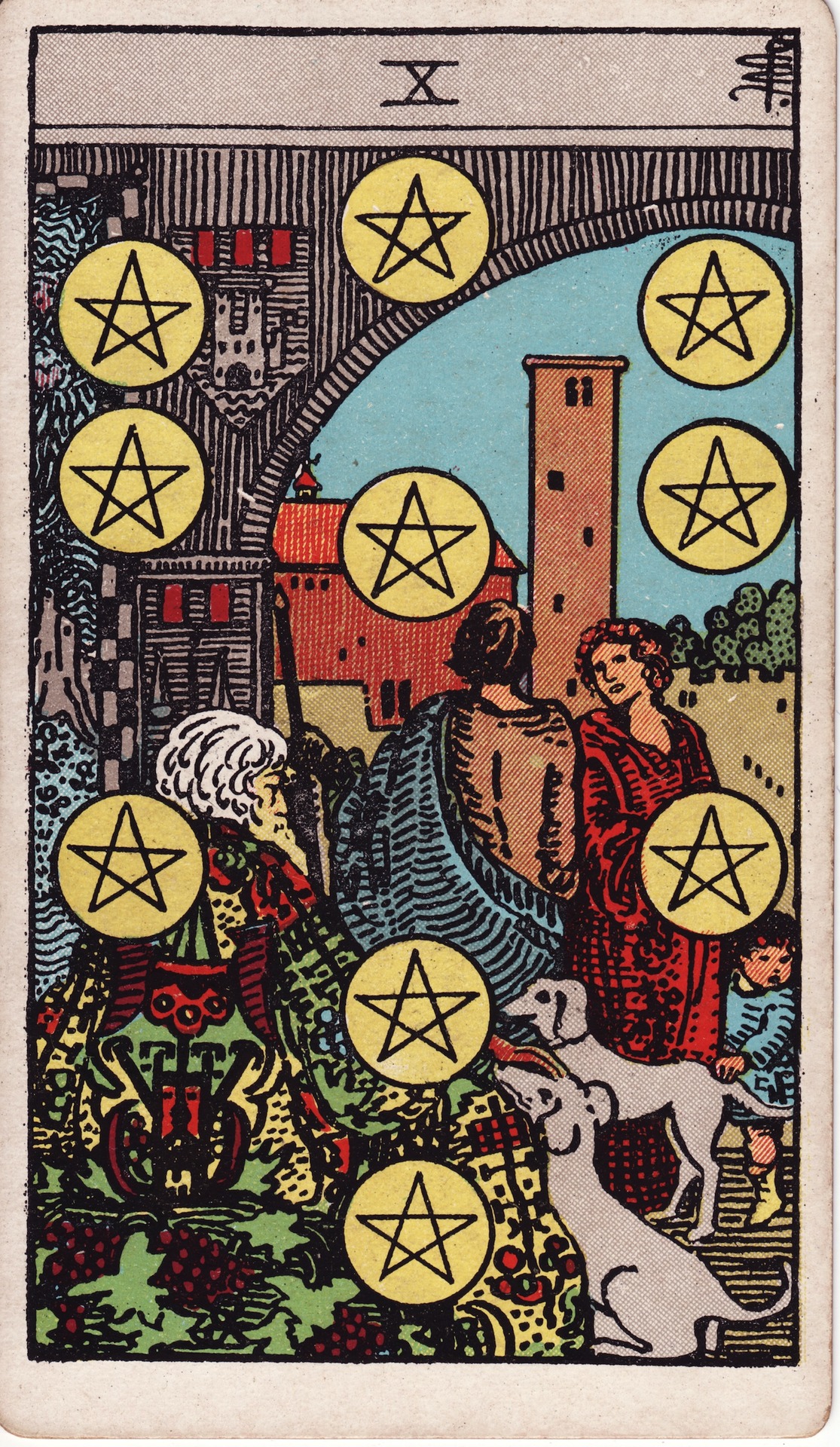
Ten of Pentacles — original Rider–Waite–Smith artwork by Pamela Colman Smith

X · ⬟ / Pentacles

Ten of Pentacles

Legacy · stability · inheritance

UPRIGHT
Long-term security grows through shared resources, continuity and stewardship. Consider what your choices contribute to those who follow.
REVERSED
Family conflict, unstable finances or restrictive inherited expectations may threaten security. Reevaluate the structure as well as the assets.
SYMBOLISM
An elder, a couple, a child and dogs appear beneath an archway. Ten pentacles arranged across the scene link generations, property and the enduring fabric of community.
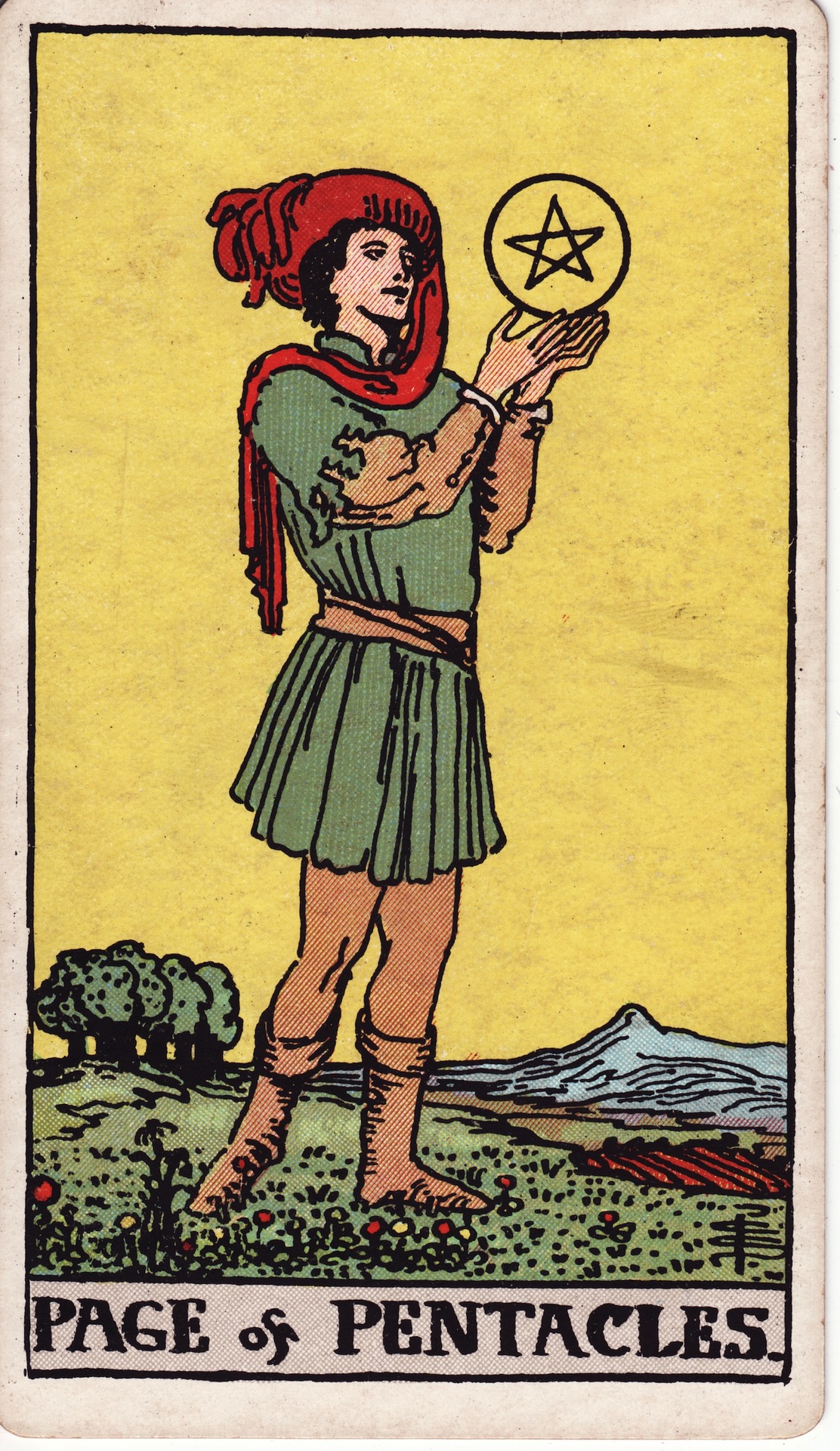
Page of Pentacles — original Rider–Waite–Smith artwork by Pamela Colman Smith

P · ⬟ / Pentacles

Page of Pentacles

Study · practicality · potential

UPRIGHT
A practical interest, course of study or small opportunity rewards commitment. Approach it as a learner prepared to build steadily.
REVERSED
Procrastination, unfocused study or unrealistic expectations may waste potential. Make the next step concrete and achievable.
SYMBOLISM
A young figure carefully studies a pentacle in a green field. Plowed ground and distant mountains suggest potential that will mature through patient work.
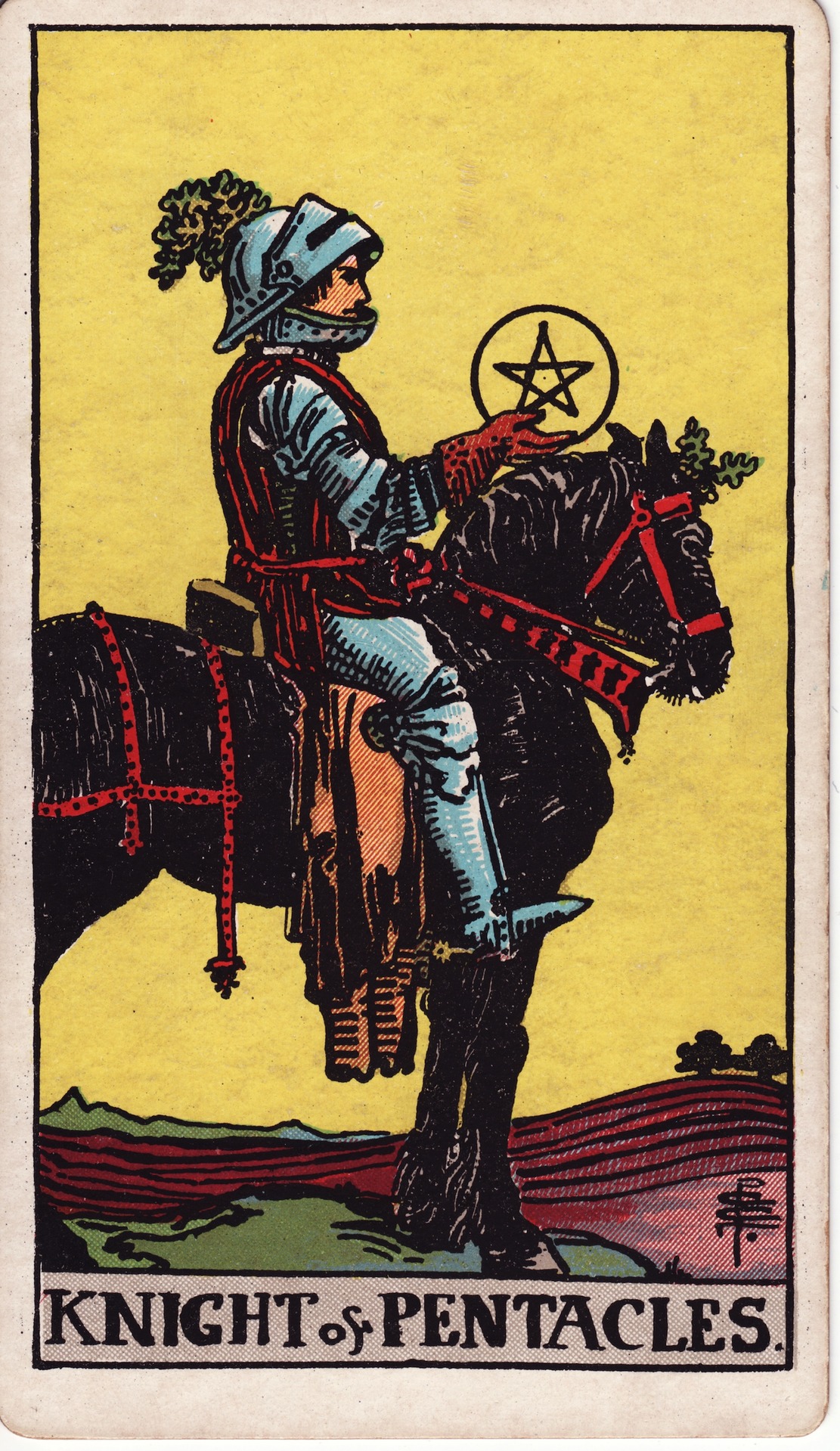
Knight of Pentacles — original Rider–Waite–Smith artwork by Pamela Colman Smith

Kn · ⬟ / Pentacles

Knight of Pentacles

Reliability · routine · persistence

UPRIGHT
Steady effort, careful planning and dependable conduct produce durable results. Honor the routine without losing sight of its purpose.
REVERSED
Stagnation, stubbornness or neglect of responsibilities may undermine reliability. A sound method still needs occasional adaptation.
SYMBOLISM
The knight sits on a stationary dark horse holding a pentacle. Furrowed fields and the unhurried posture emphasize preparation, work and deliberate progress.
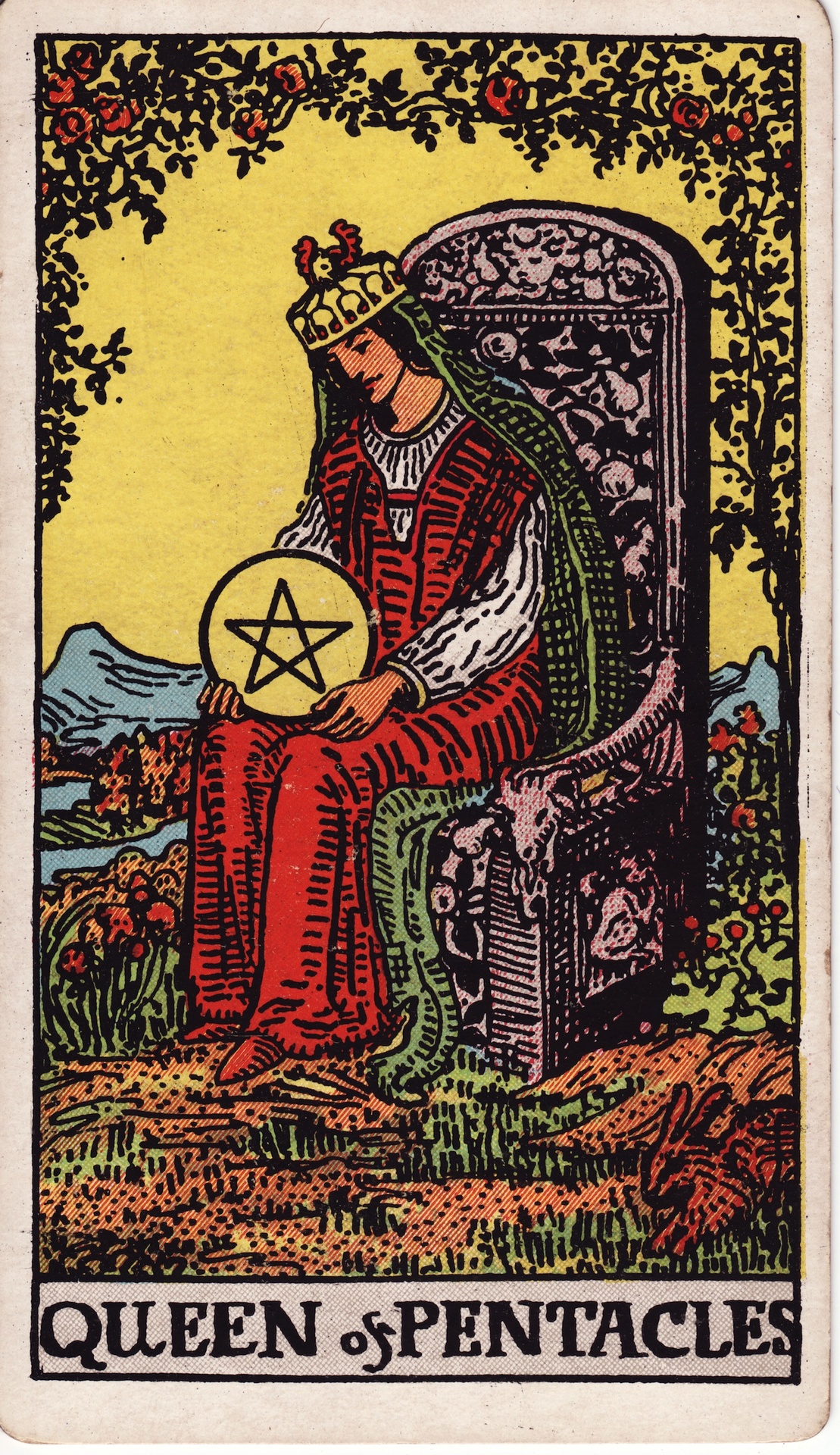
Queen of Pentacles — original Rider–Waite–Smith artwork by Pamela Colman Smith

Q · ⬟ / Pentacles

Queen of Pentacles

Practical care · resourcefulness · comfort

UPRIGHT
Grounded care combines material stewardship with generosity. Nurture your surroundings and needs without forgetting your own wellbeing.
REVERSED
Neglected self-care, overextension or anxiety about security may disrupt balance. Reorganize care so it remains sustainable.
SYMBOLISM
The queen cradles a pentacle in a lush garden. Fruit, flowers and a rabbit suggest abundance and fertility; the decorated throne roots care in the tangible world.
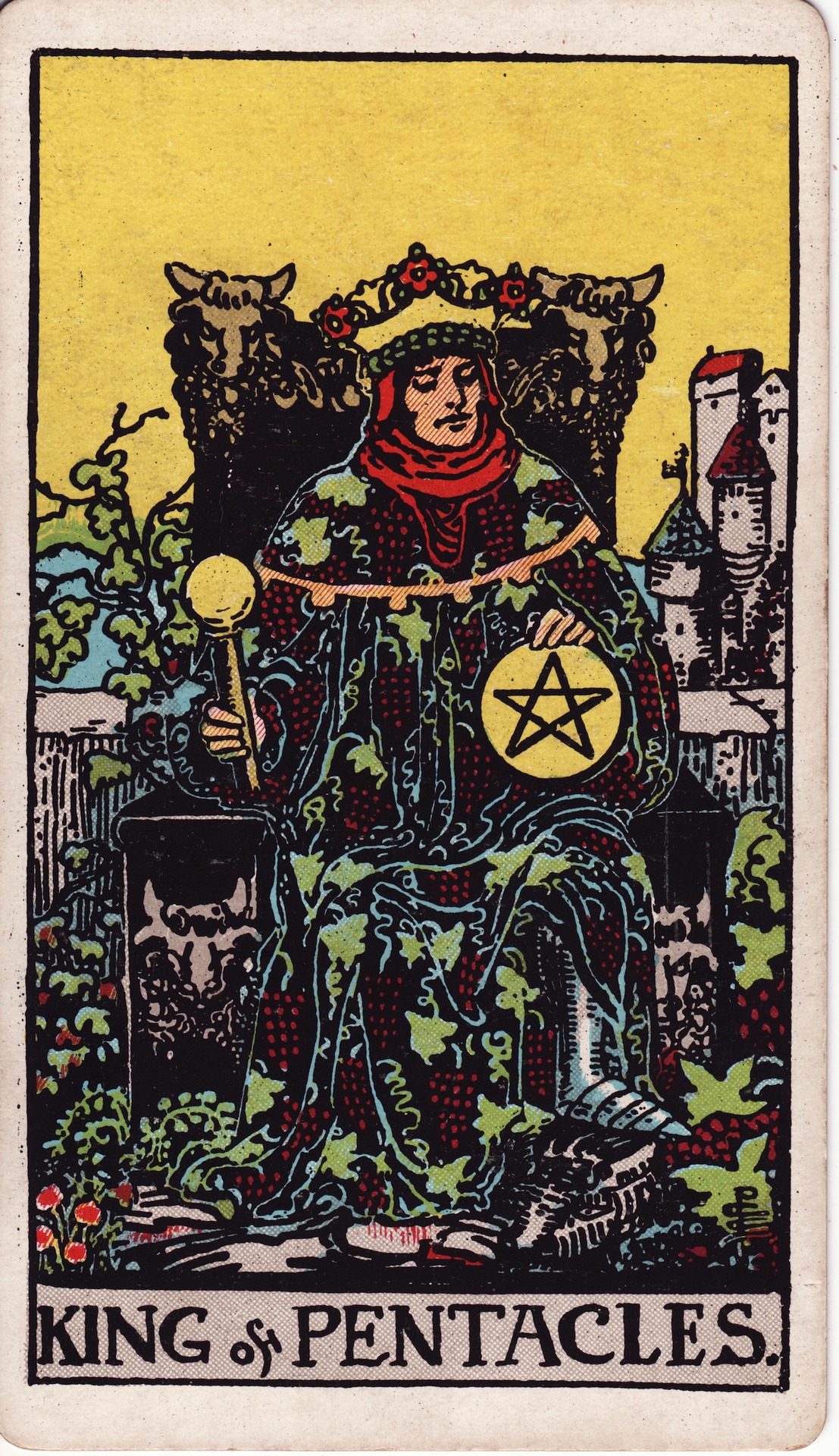
King of Pentacles — original Rider–Waite–Smith artwork by Pamela Colman Smith

K · ⬟ / Pentacles

King of Pentacles

Stewardship · prosperity · stability

UPRIGHT
Experience and responsible management create lasting material security. Use resources wisely and make success beneficial beyond yourself.
REVERSED
Greed, inflexibility or unreliable management may erode prosperity. Examine whether ownership has displaced responsibility.
SYMBOLISM
The king holds a pentacle and scepter amid vines and a castle. Bull motifs, rich clothing and the settled setting emphasize earthly authority and cultivated abundance.

Artwork by Pamela Colman Smith, with the symbolic direction of A. E. Waite; first published by William Rider & Son in 1909.

These are contemporary summaries of traditional Rider–Waite–Smith interpretations, not quotations from Waite. Reversals have no single universal meaning; context and reading traditions differ. Tarot offers symbolic reflection, not certain predictions.

Historical reference: The Pictorial Key to the Tarot, A. E. Waite (1911) ↗